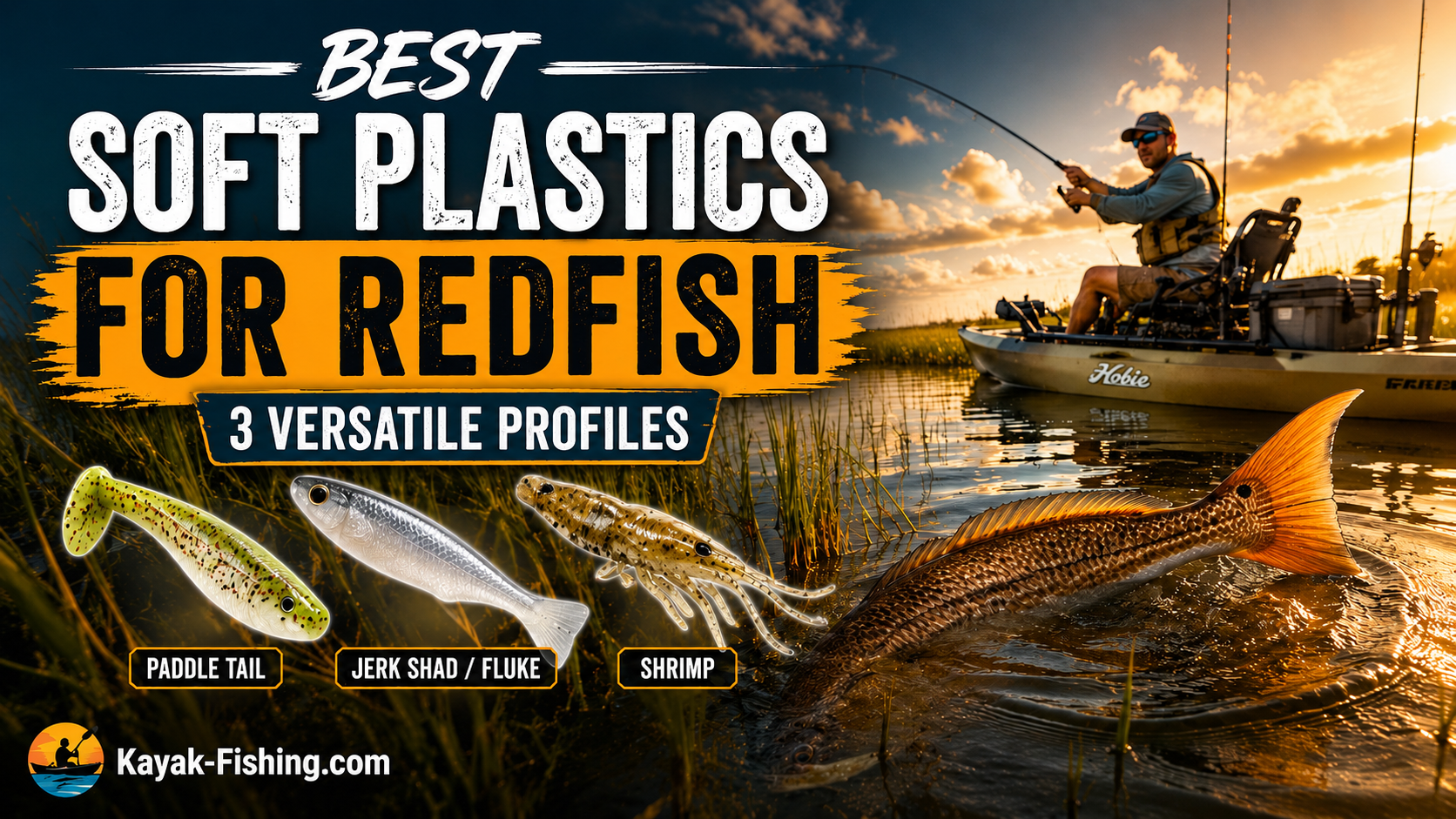
Best Soft Plastics for Redfish From a Kayak: 3 Versatile Profiles
Soft plastics are a practical choice for redfish from a kayak because one compact lure box can cover shallow grass, marsh drains, oyster edges, open flats, and changing current simply by changing the lure profile, weight, or rigging.
You do not need dozens of nearly identical baits. A useful starting lineup is a 3–4 inch paddle tail, a 4–5 inch jerk shad, and a 3–4 inch shrimp-style plastic. Together, those three profiles cover moving baitfish, subtle baitfish, and slower crustacean-style presentations.
That approach also fits documented redfish feeding behavior. Red drum eat a mix of forage that includes shrimp, crabs, and small fish, so the goal is not to find one universally “best” plastic. It is to carry a few profiles that let you adjust presentation to depth, current, cover, water clarity, and how the fish appear to be feeding.
Quick Answer: Best Soft Plastics for Redfish
For a simple redfish soft-plastic setup, start with three profiles: a 3–4 inch paddle tail for covering water, a 4–5 inch jerk shad for shallow or subtle baitfish presentations, and a 3–4 inch shrimp-style plastic for slower work around drains, shell, and current.
Use the lightest practical weight that still gives you enough control to know where the lure is in the water column. Add weight when wind, depth, or current makes the bait difficult to manage, and consider weedless rigging when grass or snag-prone cover makes an exposed hook impractical.
Table of Contents
Why Soft Plastics Work Well from a Kayak
Soft plastics suit kayak fishing because the same bait can be adjusted without carrying much tackle. Change the weight, hook style, retrieve, or lure profile and you can move from a shallow grass flat to a marsh drain or deeper edge without rebuilding the entire setup.
- Depth is easy to adjust: Change jighead or hook weight instead of changing the entire lure.
- Weedless options are available: Useful around grass, flooded vegetation, and other snag-prone cover.
- Retrieve speed is flexible: The same profile can often be swum, hopped, paused, or allowed to drift with current.
- A small selection covers several forage types: Paddle tails and jerk shads suggest baitfish, while shrimp-style plastics provide a crustacean profile.
The advantage is not that soft plastics are automatically better than every other redfish bait. It is that they provide a lot of presentation flexibility in a small, easy-to-organize tackle selection.
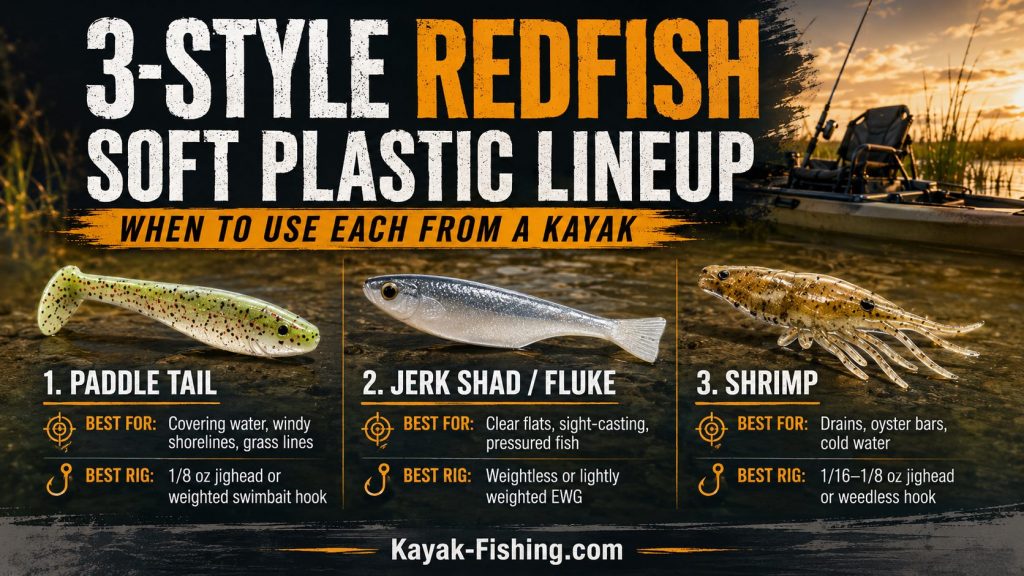
The 3-Profile Redfish Soft-Plastic Lineup
A compact redfish box can start with three complementary profiles:
- 3–4 inch paddle tail for covering water and imitating a moving baitfish.
- 4–5 inch jerk shad for shallow, subtle, or sight-oriented baitfish presentations.
- 3–4 inch shrimp-style plastic for slower work near drains, shell, current seams, and the bottom.
| Soft Plastic | Useful Starting Size | Common Rigging | Best Role |
|---|---|---|---|
| Paddle Tail | 3–4 inches | Jighead or weighted weedless swimbait hook | Covering water, grass edges, shorelines, and drains |
| Jerk Shad | 4–5 inches | Weightless or lightly weighted weedless hook; light jighead in some situations | Shallow flats, grass pockets, clear water, and subtle presentations |
| Shrimp-Style Plastic | 3–4 inches | Light jighead or weedless hook | Drains, shell edges, current seams, and slower bottom presentations |
These sizes and rigs are starting points, not rules. Water depth, current, wind, cover, lure design, and local forage all affect how a specific setup behaves.
Redfish feed on forage that includes shrimp, crabs, and small fish. Texas Parks & Wildlife provides additional background on red drum biology and feeding, while Florida Fish and Wildlife Conservation Commission also documents common redfish forage and the use of soft-bodied jigs.
Profile 1: Paddle Tails
A paddle tail is a soft-plastic baitfish imitation with a tail that moves during the retrieve. The built-in action makes it a straightforward option when you want to search water efficiently instead of working one small target slowly.
Size and Shape
A 3–4 inch paddle tail is a practical starting size for many inshore redfish situations. Rather than choosing solely by length, make sure the body works with the hook you plan to use and that the tail can move freely without the lure rolling or fouling.
Where a Paddle Tail Fits
- Grass lines: Swim the bait along the edge or through openings where the rig can pass cleanly.
- Shoreline points and pockets: Useful when you want to cover several targets without changing baits.
- Marsh drains: A paddle tail can be allowed to cross or travel with a current seam.
- Moderate wind: Adding enough weight to maintain lure control can make a moving bait easier to manage than an extremely light presentation.
A steady retrieve is the simplest starting point. If the lure is running too high, slow down or add weight. If it is constantly dragging or snagging, reduce weight, speed up slightly, or switch to a more weedless presentation.
Wind affects both lure control and the kayak itself. For more on casting angles, drift, and positioning, see our guide to kayak fishing in the wind.
Profile 2: Jerk Shads
A jerk shad or fluke-style plastic usually has less built-in tail action than a paddle tail. Most of its movement comes from rod twitches, pauses, current, and the lure’s glide or fall.
That gives you more control over how subtle or erratic the bait looks and makes the profile useful when a continuously swimming presentation is not what you want.
Where a Jerk Shad Fits
- Shallow grass flats: A lightly weighted or weightless rig can stay above vegetation.
- Potholes and grass openings: Twitch the lure into open pockets and let it pause.
- Clearer water: A restrained baitfish profile can be useful when you want less vibration and flash.
- Sight-oriented presentations: The lure can be placed ahead of a moving fish and worked with short twitches and pauses.
A simple twitch-twitch-pause retrieve is a useful place to start. Shorter pauses keep the lure moving; longer pauses allow more time to glide or fall. Add weight only when necessary to maintain control or reach the intended depth.
Profile 3: Shrimp-Style Plastics
Shrimp are documented redfish forage, so a shrimp-style soft plastic is a logical profile when you want a slower presentation near current, shell, or the bottom.
The important question is not whether a plastic perfectly copies every detail of a live shrimp. More important is whether its size, sink rate, and rigging let you keep the lure where redfish can encounter it.
Where a Shrimp Profile Fits
- Marsh drains and creek mouths: Let the lure move through the current seam rather than forcing an unnaturally fast retrieve.
- Oyster and shell edges: A slower presentation can keep the lure close to the structure, although snag and abrasion risk increase.
- Drop-offs and channel edges: Additional weight may be useful when the bait needs to reach deeper water.
- Situations that call for a slower presentation: Short lifts and pauses can keep the lure near the bottom longer than a continuously retrieved paddle tail.
Boat position becomes especially important around drains and current seams. If you need more control than a paddle or pedal stroke provides, compare appropriate options in our guide to the best kayak anchors for lakes, rivers, and inshore fishing. Avoid anchoring where current, traffic, depth, or bottom conditions make it unsafe.
How to Choose Soft-Plastic Colors for Redfish
Color is easy to overcomplicate. There is no universal redfish color that is best in every bay, marsh, tide, season, and level of water clarity.
A simpler approach is to carry a small contrast range and adjust based on visibility, bottom color, and local forage.
Natural or Translucent Colors
Pearl, silver, smoke, olive, tan, and other baitfish- or shrimp-like colors are reasonable starting options when the water is relatively clear and you want a less conspicuous presentation.
Darker Colors
Root beer, dark brown, new penny, black, and similar colors create a stronger silhouette. They can be useful when water clarity is reduced or when you want more contrast against a dark bottom.
Brighter or Higher-Contrast Accents
Chartreuse tails, white, and other brighter accents provide another contrast option in stained water or lower-visibility conditions. Bright does not automatically mean better; it simply gives you a different presentation when natural colors are difficult to see or are not producing.
For a compact tackle box, one natural color, one darker color, and one brighter or higher-contrast option in your most-used profile is a practical place to start.
Jigheads vs. Weedless Rigging
Rigging matters as much as the soft plastic itself. The goal is to use enough weight and hook exposure to control the lure without making it unnecessarily snag-prone.
When a Jighead Makes Sense
An exposed jighead is simple and gives direct contact with the lure. It can work well along relatively open shorelines, deeper drains, channel edges, and areas where grass or shell is not constantly catching the hook.
A useful shallow-inshore starting range is roughly 1/16 to 1/4 ounce, but treat that as an adjustment range rather than a fixed redfish rule.
- Go lighter when you want a slower fall, are fishing very shallow water, or are dragging bottom too often.
- Go heavier when wind, current, or depth prevents you from keeping useful contact with the lure.
- Change hook style when cover makes an exposed hook impractical.
When Weedless Rigging Makes Sense
Weighted swimbait hooks and other weedless rigs can be useful around grass, flooded vegetation, and snag-prone cover. Weightless or lightly weighted weedless hooks can also keep jerk shads and similar plastics higher in very shallow water.
Weedless does not mean snag-proof, and burying the hook point introduces a tradeoff in hook exposure. Match the hook size to the actual plastic so there is enough gap for the lure body without overpowering the bait.
Adjust Weight by What the Lure Is Doing
Instead of choosing a jighead because a chart says it is the “correct” size, watch what the lure is actually doing:
- If the lure never reaches the depth you are trying to fish, add weight.
- If it is constantly digging into the bottom or hanging up, reduce weight or change the rigging.
- If wind or current bows the line so badly that you lose track of the lure, add enough weight to regain control.
- If grass repeatedly fouls an exposed hook, switch to a weedless presentation before simply adding more weight.
Line, Leader, and Knots
Many inshore setups pair braided main line with a monofilament or fluorocarbon leader. Braid provides a thin, low-stretch main line, while the leader adds a separate abrasion-resistant section near shell, oysters, structure, and the fish.
There is no single pound-test combination that fits every redfish fishery. Choose line and leader strength based on lure weight, expected fish size, cover, abrasion risk, rod and reel capacity, and the conditions you normally fish.
Whatever combination you use, the connection depends on dependable knots. See our kayak fishing knots guide for line-to-leader and terminal-knot options.
How to Fish Each Profile from a Kayak
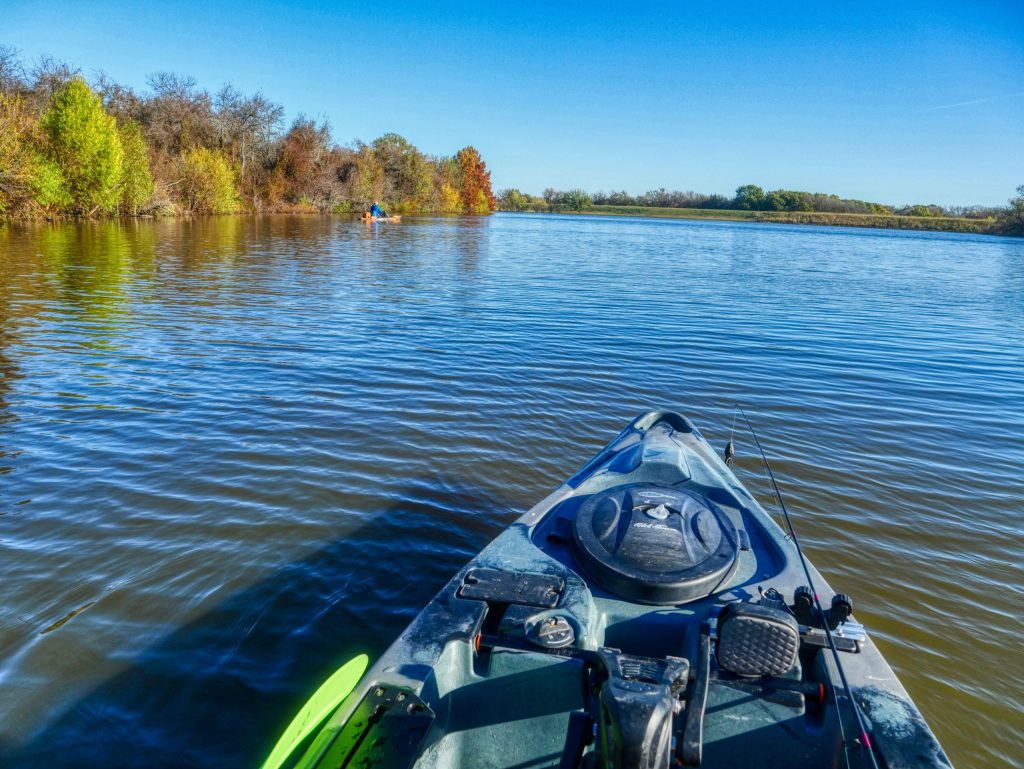
The same soft plastic can behave very differently depending on kayak position, current direction, and casting angle. Before changing baits, make sure the kayak is allowing the lure to travel through the target water effectively.
Paddle Tail: Cover Water
Along a shoreline or grass edge, position the kayak far enough away that you can make repeated casts without drifting directly over the water you want to fish. Cast across or slightly ahead of the drift and use a steady retrieve as the baseline.
If the bait is staying too high, slow the retrieve or add weight. If it is digging into shell or collecting grass, lighten the rig or switch to a weedless hook.
Jerk Shad: Twitch and Pause
On shallow flats or around grass pockets, cast beyond the target area when possible and bring the lure into it with short twitches followed by a pause. The pause is part of the presentation, not dead time.
A lightly weighted or weightless rig can keep the bait high in shallow water. Add weight only when wind, current, or depth makes the lure difficult to control.
Shrimp-Style Plastics: Slow Down Around Current
At a drain or current seam, set the kayak so the lure can travel with or across the flow rather than immediately being swept away from the target zone. Let the shrimp-style plastic sink, then use short lifts and pauses to keep it close to the structure or bottom.
Around oyster or shell, expect more snag and leader-abrasion risk. Weedless rigging can reduce hang-ups, but positioning the kayak so you are not dragging the lure directly through the roughest structure can be just as important.
Building a Small but Complete Soft-Plastic Box
A small redfish box can cover a wide range of conditions if every item has a distinct job.
Plastics
- Paddle tails, 3–4 inches: One natural color, one darker color, and one brighter or higher-contrast option.
- Jerk shads, 4–5 inches: One or two natural baitfish colors.
- Shrimp-style plastics, 3–4 inches: One natural shrimp tone plus an alternate contrast color.
Hooks and Jigheads
- Several light jighead weights that cover the depths and current you normally fish.
- Weighted weedless swimbait hooks matched to the paddle tails you carry.
- Weightless or lightly weighted weedless hooks matched to your jerk shads and shrimp plastics.
Line and Leader
Carry leader material appropriate for the cover and abrasion risk you expect. Shell and oysters generally call for more abrasion awareness than open grass or clean sand, but heavier is not automatically better in every situation.
The goal is a compact system where every plastic, hook, and weight gives you a meaningful alternative rather than another version of the same presentation.
Putting It Together on the Water
If you are starting with this three-profile system, use the conditions to decide which tool gets the first cast:
- Need to cover water? Start with the paddle tail and use a weight that keeps the lure under control.
- Fishing very shallow grass or clear water? Try a jerk shad on a lightly weighted or weightless weedless rig.
- Working a drain, current seam, shell edge, or deeper target slowly? A shrimp-style plastic gives you a different bottom-oriented presentation.
- Getting snagged or fouled? Change weight or hook style before assuming you need a completely different lure.
- Losing control in wind or current? Adjust kayak position and add only enough weight to regain useful contact with the bait.
If you want to compare soft plastics with natural bait and other redfish options, see our guide to the best bait for redfish from a kayak.
FAQs About Soft Plastics for Redfish
What is the best soft plastic for redfish?
There is no single soft plastic that is best in every redfish situation. A 3–4 inch paddle tail is a versatile starting profile because it can cover water and be rigged on either an exposed jighead or a weedless weighted hook. Jerk shads and shrimp-style plastics solve different presentation problems.
What size soft plastic should I use for redfish?
Around 3–4 inches is a useful starting range for paddle tails and shrimp imitations, while jerk shads are commonly a little longer at roughly 4–5 inches. Local forage, water clarity, fish size, and the lure design can justify going smaller or larger.
What color soft plastic is best for redfish?
Instead of relying on one universal color, carry a small range: a natural or translucent option, a darker silhouette, and a brighter or higher-contrast option. Start with the color that best fits the water clarity and forage, then adjust if necessary.
What size jighead should I use for redfish soft plastics?
Use the lightest weight that still lets you control the lure at the depth and in the current you are fishing. A useful shallow-inshore adjustment range is roughly 1/16 to 1/4 ounce, but depth, wind, current, lure size, and line angle can all justify going lighter or heavier.
Are paddle tails or jerk shads better for redfish?
Paddle tails are straightforward for covering water because the tail produces action during a steady retrieve. Jerk shads give you more control over the action and can be useful for shallow, clear, grassy, or sight-oriented presentations. Carrying both gives you more flexibility than forcing either profile to do everything.
Do shrimp-style soft plastics make sense for redfish?
Yes. Shrimp are documented redfish forage, so a shrimp-style plastic is a logical option around drains, shell edges, current seams, and other areas where a slower crustacean-style presentation fits the conditions.
Should I use a weedless hook or a jighead?
Use an exposed jighead where you want direct contact and snagging is manageable. Move to weedless rigging when grass, flooded vegetation, or other cover makes an exposed hook impractical. The best choice is the one that lets the lure move through the target water while still providing a usable hook presentation.
Sources and Method
This guide combines documented red drum feeding information from state fisheries agencies with established soft-plastic rigging principles and Kayak-Fishing.com analysis of how lure weight, cover, current, and kayak positioning affect presentation. It does not claim firsthand testing of the lure profiles or products discussed.
- Texas Parks & Wildlife Department — Red Drum
- Florida Fish and Wildlife Conservation Commission — Red Drum
Final Thoughts
You do not need a pile of soft plastics to build a useful redfish setup from a kayak. A small group of profiles can cover a wide range of presentations if each one has a clear role.
Start with a paddle tail for covering water, a jerk shad for a subtler shallow-water baitfish presentation, and a shrimp-style plastic for slower work around current and bottom structure. Then adjust weight, weedlessness, color, and kayak position to fit the water in front of you.
That approach keeps the tackle system simple while still giving you meaningful ways to adapt when depth, cover, wind, or current changes.