Kayak Fishing in Wind: Safe, Smart Tactics to Stay in Control and Catch Fish
Wind can turn kayak fishing into a boat-control problem very quickly. A light breeze that barely matters from shore can push a kayak off a casting line, bow the fishing line, build chop across open water, and make the return trip much harder than the paddle out.
That does not mean every windy forecast is an automatic no-go. It means wind speed alone is not enough information. Gusts, wind direction, fetch, waves, current, water temperature, boat traffic, your kayak, your propulsion system, your route, and your own boat-control skills all matter.
This guide explains how to evaluate kayak fishing in the wind, rig for better control, plan useful drift lines, adjust paddling or pedaling, and recognize when conditions are no longer worth fishing.
Quick answer: There is no universal wind-speed cutoff that makes kayak fishing safe or unsafe. Check sustained wind, gusts, wave conditions, wind direction, open-water fetch, current or tide, water temperature, thunderstorms, and the return route. If the forecast, advisories, or conditions at the launch exceed what you can comfortably control, choose protected water or do not launch.
Table of Contents
Why Windy Days Feel So Chaotic From A Kayak
A fishing kayak is relatively light and presents plenty of surface area above the water. The angler, seat, rods, crate, net, flag, electronics, and other gear all give the wind something to push.
That is why wind affects more than paddling speed. It can:
- Rotate the kayak when a gust hits from the side.
- Push the kayak off a shoreline, dock line, grass edge, or waypoint while you are casting.
- Create line belly that reduces lure control and bite detection.
- Build waves across open water, especially when wind blows over a long distance without protection.
- Turn an easy downwind outbound leg into a demanding return trip.
The important idea is that wind is both a boat-control variable and a route-planning variable. The goal is not to overpower it. The goal is to understand where it will move the kayak before you commit to a drift, crossing, or long shoreline.
Wind can also influence fishing. Surface chop may reduce visibility and wind-driven water movement can change where bait and predators concentrate. But a potentially productive bank is never a reason to accept conditions that make the kayak difficult to control.
Knowing When The Wind Is Actually Safe
No single wind-speed number can tell every kayak angler whether a trip is safe. A protected pond, a wide reservoir, a tidal bay, and a river can behave very differently under the same forecast.
Why There Is No Universal Safe Wind Speed
The old habit of treating a particular number—10 mph, 15 mph, or any other fixed cutoff—as a universal safety line is too simplistic. The National Weather Service notes that even Small Craft Advisory criteria vary by geographic area, and there is no precise federal definition of a “small craft.” A fishing kayak is even more sensitive to local conditions than many powered boats.
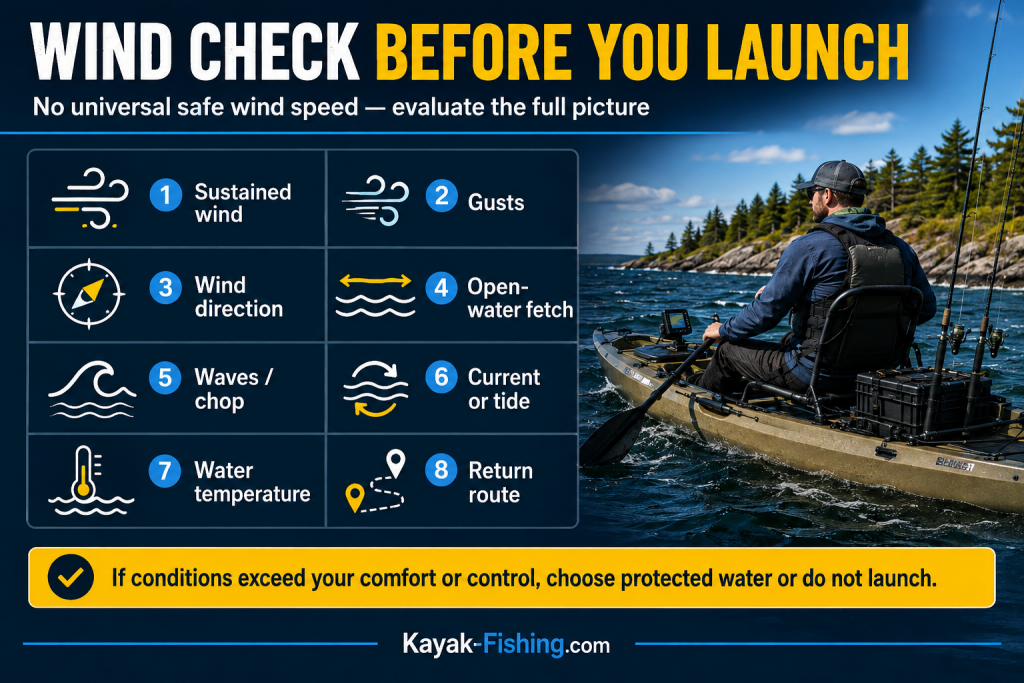
Use the forecast as a collection of conditions rather than one number:
| What to Check | Why It Matters in a Kayak |
|---|---|
| Sustained wind | Determines the continuous effort needed to hold position or make progress. |
| Gusts | Can rotate or accelerate the kayak suddenly and make boat control less predictable. |
| Wind direction | Changes which shorelines are protected and whether the return trip will be upwind, crosswind, or downwind. |
| Fetch | Wind blowing across a longer stretch of open water has more room to build waves. |
| Wave forecast | Wave height, steepness, and direction may matter more than the wind number itself. |
| Current or tide | Wind and current can reinforce each other or oppose each other and create steeper, confused chop. |
| Water temperature | Cold-water immersion increases the consequences of a capsize. |
| Storms and advisories | Thunderstorms can create rapid wind increases and dangerous lightning; marine advisories and warnings deserve serious attention. |
| Return route | A comfortable outbound drift can become an exhausting paddle or pedal back. |
Before launching, check the appropriate National Weather Service forecast for your waterbody. Coastal and Great Lakes anglers should review the NWS marine forecast and any active advisories or warnings. Local lake, river, and recreational forecasts may provide more useful detail inland.
Reading The Forecast Like A Kayak Angler
Pay particular attention to four things:
- Gusts versus steady wind:
A forecast with much stronger gusts than the sustained wind can produce abrupt changes in boat angle and drift speed. - Changes through the day:
Do not check only the launch hour. Look at the forecast for the entire trip and especially the planned return window. - Wind direction relative to the shoreline:
A lee shoreline may stay comparatively protected while an exposed shoreline across the same lake develops rougher water. - Wind against current or tide:
Opposing forces can create steeper, less organized waves. In tidal areas, combine the wind forecast with current and tide timing instead of treating them separately.
If thunderstorms are possible, treat them as a separate hazard rather than just another wind forecast. The National Weather Service advises boaters to head to shore and seek shelter when lightning is seen or thunder is heard.
Use A Near-Shore Reality Check
A brief check near the launch can help confirm how the kayak behaves in the actual wind, but it should not replace the forecast or override an advisory or warning.
Stay in protected water close to shore and note:
- How quickly the kayak drifts when propulsion stops.
- Whether gusts rotate the bow faster than you can comfortably correct.
- Whether you can make controlled progress into the wind without exhausting effort.
- Whether the visible waves match what you expected from the forecast.
If conditions are already harder to control than expected near the launch, the more exposed part of the route is unlikely to improve.
Quick Safety Reality Check
- Wear a properly fitted PFD while you are on the water.
- Leave a float plan with someone on shore, including your launch, general route, and expected return time.
- Dress for possible immersion. In cold-water conditions, the water temperature matters more than a comfortable air temperature.
- Do not use a favorable wind forecast to justify launching into thunderstorms, hazardous waves, strong current, or conditions beyond your experience.
- Review the broader kayak fishing safety guide before adding wind, cold water, boat traffic, or long crossings to the same trip.
Setting Your Kayak Up For Windy Conditions
Wind exposes inefficient rigging quickly. A cleaner, lower-profile setup gives the wind less to push and reduces the number of loose lines and objects you have to manage while correcting the kayak.
Seat Height, Hull Profile, And Clutter
A higher seat can be comfortable and improve visibility, but it also raises the angler’s center of gravity and increases exposed area above the water. If your kayak has a manufacturer-designed lower seating position, using it may improve stability and reduce wind exposure. Do not improvise a seat position the kayak was not designed to use.
Other items that can increase wind resistance include:
- Tall crates or tackle boxes extending above the tankwell.
- Long-handled nets stored upright.
- Multiple rods stored vertically.
- Flags, camera poles, and other tall accessories.
You do not need to strip the kayak bare. The goal is to keep unnecessary gear low, secure, and out of the way while preserving anything required for visibility or safety.
Anchors, Poles, Socks, And Other Control Tools
Position-control tools can help, but every anchor line, trolley, stakeout pole, or drift sock adds another system that must be managed safely. Beginners should learn basic paddle or pedal control before depending on extra rigging.
A Simple Anchor Setup
An anchor can hold a kayak on suitable lakes, ponds, and protected water, but anchoring becomes more consequential as wind, waves, and current increase.
- Keep anchor line organized so it cannot wrap around feet, rods, pedals, or other gear.
- Use enough line and the correct setup for the anchor, depth, and bottom rather than relying on an arbitrary rope length.
- Use a system that can be released quickly if the kayak is being loaded in an unsafe direction.
- Avoid learning anchor technique for the first time in strong current, heavy boat wakes, or rough open water.
For equipment choices and the tradeoffs among anchor types, see the kayak anchor guide for lakes, rivers, and inshore water.
Why An Anchor Trolley Can Help
An anchor trolley can move the effective anchor point toward the bow or stern, helping the kayak align more predictably with wind or current. That is generally preferable to allowing an anchored kayak to sit broadside to the load.
A trolley is not a substitute for judgment. Learn how the system releases, where the line runs, and how the kayak reacts in controlled conditions before relying on it in stronger weather.
Stakeout Pole In Shallow Water
On shallow flats, marsh edges, and protected coves with a suitable bottom, a stakeout pole can hold position without deploying a full anchor and long line. It is best suited to shallow water where the pole can be set securely without forcing the kayak into an unsafe angle.
Drift Socks For Slowing A Drift
A drift sock creates drag in the water and can slow a wind-driven drift on suitable open water. That can make it easier to work a shoreline, point, or offshore structure without repeatedly paddling back to the start.
It also adds a line and fabric in the water, so deployment and retrieval should be practiced in controlled conditions. Keep the system clear of the paddle, pedals, hooks, and other lines, and avoid using it where current, boat traffic, or underwater hazards make an additional tether a poor tradeoff.
Drag chains are sometimes discussed for moving water, but they add snag and entanglement concerns. They are not a beginner solution for controlling a kayak in current.
Understanding Wind, Current, And Your Drift
Useful windy-day boat control starts with understanding which forces are moving the kayak and how they interact.
Wind Above, Water Below
A simple working model is:
- Wind acts strongly on the angler, seat, rods, gear, and hull above the waterline.
- Current acts on the hull, rudder, pedal-drive fins or propeller, and other parts below the surface.
On a lake with little current, wind may dominate the drift. In tidal water or rivers, the kayak can point one direction while still moving another because the forces above and below the surface differ.
Watch three things before making the first cast:
- The direction the surface ripples and waves are moving.
- The direction and speed the kayak moves when you briefly stop paddling or pedaling in a safe area.
- The direction the fishing line moves while a lure sinks.
Think In Drift Lines, Not Just Spots
Trying to hold a kayak over one exact point can waste energy in wind. A more efficient approach is often to plan a controlled drift line that carries the kayak past a longer piece of fishable structure.
- Riprap bank: Start far enough upwind to settle into position before reaching the best section, then drift parallel to the rocks at a controllable distance.
- Grass edge: Set the kayak outside the vegetation and use the wind to move along the edge rather than repeatedly correcting back toward one spot.
- Offshore structure: Begin upwind of the target and use a waypoint, shoreline reference, or electronics to repeat the same productive line.
The reset point matters. If the first pass crosses the structure too quickly or at the wrong angle, move the next starting point rather than fighting the wind throughout the entire drift.
Real-World Positioning Scenarios
The following scenarios show how the same basic principles apply to common lake and inshore situations. Distances are intentionally not prescribed because kayak size, wind, depth, waves, casting range, and structure all change the correct setup.
Wind Pushing Straight At The Bank
When wind is pushing directly toward a shoreline or point, the challenge is preventing the kayak from being carried too close to rocks, docks, vegetation, or breaking waves.
- Begin farther off the bank than you would in calm conditions and evaluate the drift before casting.
- Keep the bow at an angle that allows immediate correction away from shore.
- Use paddle strokes, pedals, or a suitable drift-control tool to slow the approach rather than waiting until the kayak is already against the bank.
- If waves are breaking hard against the shoreline, choose a more protected bank instead of trying to fish the exposed edge.
Anchoring is not automatically the answer when the wind strengthens. Stronger wind and waves increase the load on the anchor system, so anchoring should only be used when the conditions and setup are appropriate.
Wind At Your Back On A Point Or Hump
On an offshore point or hump, a tailwind can carry the kayak over the productive zone before a lure has time to work through it.
- Approach so you can establish position before reaching the target.
- Start upwind and slightly to one side rather than directly on top of the structure.
- Use smooth correction strokes, light pedaling, or a properly managed drift sock when conditions are suitable.
- Use a waypoint or visual reference to repeat the drift if one line produces fish.
Cross Wind Along A Grass Line Or Docks
A crosswind can be useful when it runs parallel to a grass edge, dock line, or seawall, but the kayak needs enough separation that a gust does not push it into cover.
- Start on the upwind side with enough room for the kayak to slide toward the structure without reaching it.
- Angle the bow slightly away from the bank so a quick correction opens distance rather than closing it.
- Cast ahead of the kayak and let the drift carry you past each section of cover.
If the kayak starts pinballing between docks, grass, or shoreline cover, the drift is too tight. Reset farther out or move to a more protected section.
Paddling And Pedaling That Actually Help In Wind
Efficient propulsion matters more in wind because wasted effort reduces the energy available for the return trip.
Moving Upwind Efficiently
For paddle kayaks, smooth cadence and good torso rotation are generally more sustainable than repeated all-out sprints. Keep the paddle strokes controlled and use the kayak’s tracking rather than overcorrecting after every gust.
- Use protected shorelines, islands, reeds, points, and other wind breaks when they fit the route safely.
- Break a long upwind route into manageable legs instead of waiting until fatigue forces a stop.
- Keep enough reserve energy to deal with a wind increase, unexpected current, or a landing that requires extra maneuvering.
On a pedal kayak, a steady sustainable cadence is usually more useful than alternating hard sprints with long coasting periods. Keep the paddle secured and accessible as backup propulsion.
Micro-Positioning Without Spinning The Boat
Small corrections can keep the kayak on a useful casting line without a full reset:
- Draw strokes: Move the kayak sideways toward or away from structure without turning the entire boat.
- Gentle reverse strokes: Back away from a dock, stump, or grass edge while limiting unnecessary rotation.
- Rudder or steering corrections: On equipped kayaks, small steering inputs can be more efficient than waiting for the bow to swing far off course.
Plan The Paddle Back Before You Launch
A common windy-day trap is allowing an easy downwind leg to hide how difficult the return will be. The forecast may also strengthen or shift later in the day.
- Check the forecast for the expected return time, not only the launch.
- Identify where the return route becomes exposed to open water or a headwind.
- Set a turnaround point before fatigue or worsening weather makes the decision for you.
- If the wind is building faster than forecast, stop fishing and begin the return while you still have comfortable margins.
Lure Choices And Presentations That Work In Wind
Once boat control is manageable, lure selection can be adjusted for wind-driven line movement and faster drift speed. The point is not to use a completely different tackle box. It is to maintain contact and control.
Slightly Heavier When You Need Better Contact
Wind creates line belly and can make a lightly weighted lure harder to track. Depending on depth, current, species, and presentation, a modest increase in weight can help maintain bottom contact or keep the lure in the intended part of the water column.
- Move from a weightless soft plastic to a lightly weighted presentation when line control becomes difficult.
- Choose enough jighead weight to maintain useful contact without automatically jumping to an unnecessarily heavy lure.
- Moving baits with vibration or a strong profile can be easier to fish efficiently when chop reduces visual feedback.
For inshore anglers, the same principle applies to redfish presentations from a kayak: choose weight and presentation based on depth, current, wind, and the ability to control the lure rather than relying on one fixed jighead size.
Casting Angles To Reduce Line Belly
Wind blowing across the line creates a curve between the rod tip and lure. That can reduce sensitivity and make precise presentations harder.
- Downwind casts: Often create less crosswind bow because the lure and line travel more closely with the wind direction.
- Crosswind casts: Can work well when casting distance is controlled and slack is managed quickly.
- Long upwind casts with very light lures: Usually create the greatest control problem and may be worth shortening or avoiding.
Also account for the kayak’s movement. If the kayak is drifting toward the lure, retrieve speed may need to slow to maintain the intended presentation. If the kayak is moving away, slack may need to be picked up faster.
Topwater, Moving Baits, And Protected Finesse Water
Moderate surface chop can make moving baits practical because they cover water efficiently while the kayak is drifting. Spinnerbaits, bladed jigs, swimbaits, spoons, and similar presentations can all fit that role depending on the species and waterbody.
Finesse presentations may be easier in small protected pockets behind points, islands, reeds, or coves where the wind and waves are reduced. A windy day does not require one presentation everywhere; use the local conditions around each piece of structure.
Staying Safe, Calm, And Confident When It Blows
Fatigue is an important safety signal in wind. If ordinary corrections start feeling difficult, the route back deserves more attention than the next cast.
- Keep an exit plan:
Before crossing open water or drifting far from the launch, know where you can safely reach shore if propulsion fails or conditions worsen. - Use protected water when uncertain:
A shoreline, cove, island, or lee bank may provide a safer route than crossing the center of an exposed lake or bay. - Dress for the water:
The National Weather Service warns that cold-water immersion can be life-threatening and recommends dressing for the water temperature rather than the air temperature. Use the kayak fishing clothing guide to build an appropriate system for the season. - Wear the PFD:
The U.S. Coast Guard requires an approved wearable PFD for each person aboard a recreational vessel and recommends wearing a life jacket while underway. - Turn around early:
If the wind, waves, current, visibility, or fatigue are trending in the wrong direction, begin the return before the situation becomes urgent.
Carry required safety equipment and check state and local rules for the water you fish. A whistle or other appropriate sound-signaling device, waterproof communication, lighting when required, and a float plan become more important as the trip gets more exposed.
For the broader safety framework—including cold water, boat traffic, low light, emergency gear, and go/no-go decisions—read the Kayak Fishing Safety guide.
Simple Practice Drills To Get Better In Wind
Boat-control practice can improve confidence, but practice should happen in mild, controlled conditions near a safe landing—not by deliberately launching into hazardous wind.
- Light-wind hold-position drill:
In protected water, pick a fixed reference such as a dock post or shoreline marker and practice maintaining position with small paddle, pedal, or steering corrections. - Short upwind and crosswind runs:
Stay close to the launch and compare how the kayak tracks into, across, and with a mild breeze. The goal is to learn the boat’s behavior without committing to open water. - One drift, one adjustment:
After each short drift, note whether the starting point, angle, speed, and distance from structure were useful. Change one variable on the next pass.
Stop the exercise if conditions build beyond what you intended to practice. The point is controlled learning, not proving what the kayak can survive.
Letting Wind Work For You
Wind will keep moving a kayak. Productive windy-day fishing comes from predicting that movement, choosing a route with enough margin, and using controlled drifts instead of correcting every few seconds.
For the next suitable breezy trip, keep the experiment simple: choose one protected drift line, start upwind of it, watch where the kayak actually travels, and adjust the next pass. That teaches more about wind control than memorizing a universal speed limit that does not account for the water in front of you.
When wind strengthens beyond your comfortable control, changes the wave picture, complicates the return, or stacks with cold water, current, storms, or heavy boat traffic, the smart tactic is not a better lure or anchor. It is a more protected plan—or a different day.