Kayak Fishing Safety: Cold Water, Boats, and Common Sense on the Water
Kayak fishing safety problems do not always arrive with lightning, whitecaps, or an obviously bad forecast. Warm air can hide cold water, a calm launch can become windy later, and a low-profile kayak can be difficult for powerboat operators to see.
The safest approach is to plan for the conditions you could encounter during the whole trip, including an unexpected swim, rather than judging risk only by how comfortable the parking lot feels.
That is especially important with cold water. The National Weather Service advises boaters and paddlers to dress for the water temperature, not simply the air temperature, and to be prepared for sudden immersion.
This is not meant to scare anyone away from fishing out of a kayak. It is the opposite. The more honest you are about cold water, boat traffic, night fishing, wind, visibility, and basic decision-making, the more confidently you can fish.
Quick Answer: What Matters Most for Kayak Fishing Safety?
The biggest kayak fishing safety habits are simple: wear your PFD, dress for the water temperature, stay visible around boat traffic, watch wind and current, keep emergency gear within reach, and make your go/no-go decision before you launch. Most bad situations start when several small risks stack together.
Table of Contents
Safety Is Part of Fishing Well
Good kayak anglers already pay attention to boat position, casting angles, water color, current seams, wind lanes, and bait movement. Safety uses the same kind of awareness.
The trouble usually starts when a few small risks stack on top of each other. Cold water by itself is manageable if you are dressed for it. Wind by itself is manageable if you picked protected water. Boat traffic by itself is manageable if you are visible and staying out of bad spots.
But cold water, a rising breeze, low light, and a long paddle back to the ramp? That is a different trip.
Serious problems often develop when several manageable risks stack together: cold water, a rising breeze, low light, heavy boat traffic, a long return paddle, unsecured gear, or an anchor line under load. The safest plan reduces those risks before they overlap.
The goal is not to turn every launch into a survival drill. The goal is to build habits that work even when you are thinking about a fish, a backlash, a snag, or the boat wake rolling toward you.
A safe kayak is also easier to fish from. You move cleaner. You reach gear faster. You make better decisions because you are not constantly reacting to problems you could have prevented at the ramp.
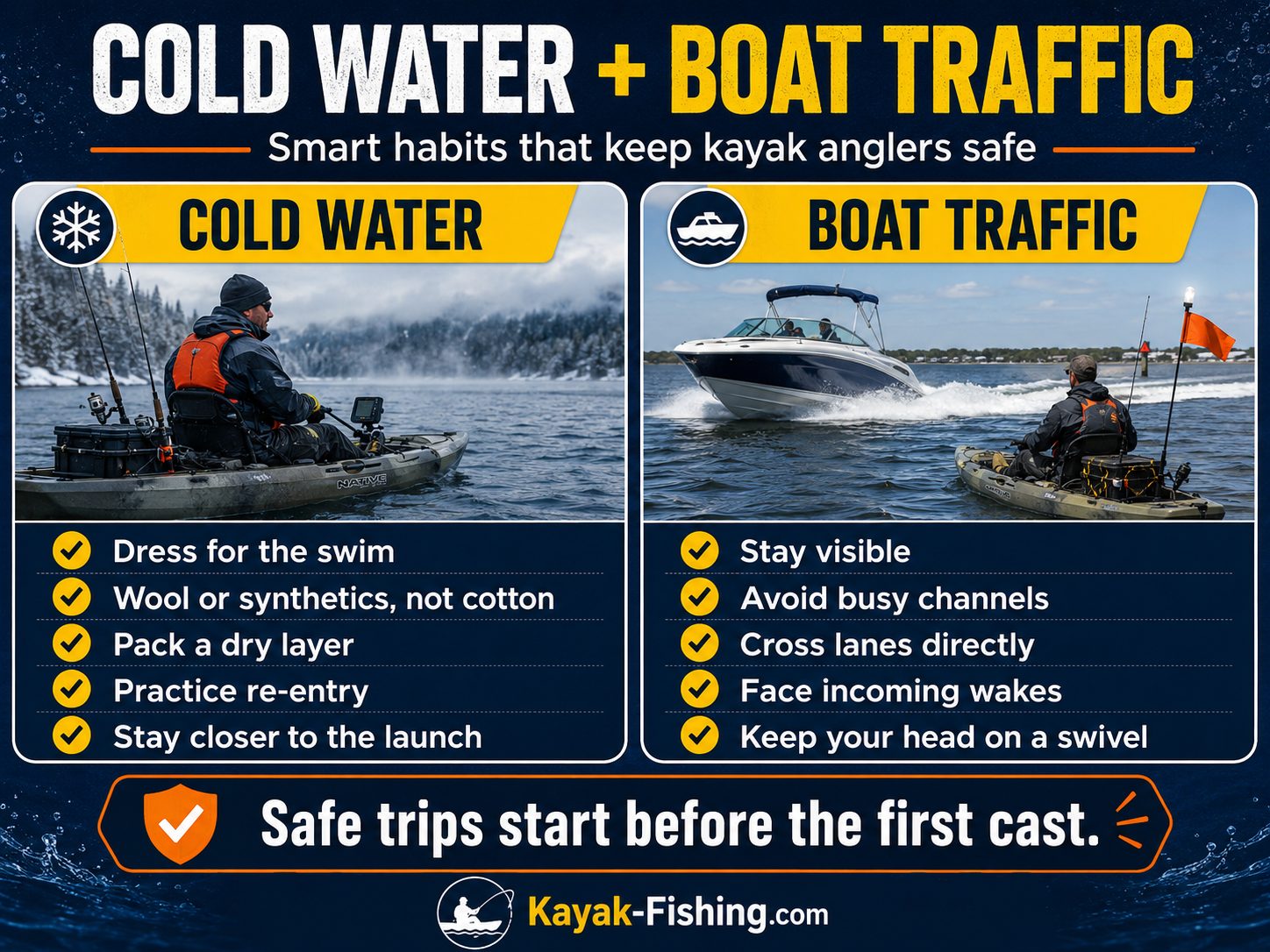
Cold Water Does Not Give You Much Room for Error
Cold water kayak safety matters most in late fall, winter, and early spring, but do not stop thinking about it when the calendar says summer. Deep reservoirs, northern lakes, tailwaters, spring-fed rivers, and inshore water after a front can stay cold long after the air feels comfortable.
The mistake is dressing for the paddle instead of the swim.
That sounds dramatic until you have been wet in cold wind. A cotton hoodie that felt fine at the launch becomes a heavy, useless towel. Wet hands lose strength. Buckles get harder to work. A simple knot feels complicated. Even climbing back into the kayak can take more coordination than you expected.
Cold-water immersion can quickly reduce useful movement and coordination. The National Weather Service cold-water guidance recommends preparing for the possibility of sudden immersion, wearing a life jacket, checking water temperature before departure, and dressing for the water rather than the air.
Cold-water protection should match the water temperature, exposure risk, distance from shore, and difficulty of rescue or re-entry. Depending on conditions, that may mean a wetsuit, dry suit, or other immersion protection rather than ordinary fishing clothes. A dry change of insulating clothing stored in waterproof protection is also useful backup gear, but it is not a substitute for dressing appropriately for immersion.
If you are still dialing in your clothing system, start with this guide on what to wear kayak fishing. Safety starts before you ever drag the kayak to the water.
Hands deserve attention because cold can make paddling, operating buckles, using pliers, or performing a re-entry harder. Choose hand protection that still allows reliable control of the paddle and essential gear, and keep critical backup items dry.
Cold water also changes how you rig the deck. Leave yourself room to get back in. A crate, rods, net, fish bag, anchor line, and loose tackle spread everywhere might be fine until the kayak is upside down. Practice re-entry when conditions are controlled, not for the first time when the water is cold and you are tired.
A useful planning question is simple: if an unexpected swim would create a serious problem in the clothing and conditions you have chosen, change the plan. That may mean better immersion protection, smaller or more sheltered water, staying closer to shore, fishing with a partner, or not launching.
The fish will still live there next week.
Wear the PFD Like It Belongs There
A life jacket behind the seat is mostly a decoration when you flip without warning.
That sounds blunt because it should. Kayaks flip quickly. A wake hits while you are reaching for a rod. You lean too far to free a lure from grass. You stand in water that is just a little rougher than you thought. You get sideways to current while messing with an anchor. By the time you realize you want your PFD, it is already too late to calmly put it on.
Federal carriage requirements generally require a U.S. Coast Guard-approved wearable PFD for each person aboard a recreational vessel. Wear requirements can vary by age, state, waterbody, activity, and other circumstances, so check the rules that apply where you launch. The Coast Guard also recommends wearing an approved PFD while underway. For kayak fishing, wearing it is far more useful than storing it behind the seat.
A good fishing PFD should fit securely and allow an unrestricted paddle stroke while seated. Kayak-friendly back panels and well-placed pockets can improve comfort, but avoid loading the vest with bulky gear that interferes with paddling or re-entry. Keep essential signaling and problem-solving gear, such as a whistle and small light, where it can be reached quickly.
If your current vest is uncomfortable enough that you keep taking it off, that is the real problem. A fishing PFD you can actually wear all day is worth more than another rod in the crate.
Inflatable PFDs can be less bulky, but they require maintenance and must be used according to their labeling and manufacturer instructions. The Coast Guard notes that inflatables need a full cylinder and proper status indicators to be serviceable, and that they are not appropriate for weak or non-swimmers. Choose a U.S. Coast Guard-approved PFD that is appropriate for the intended activity and conditions.
Whatever style you choose, the practical advantage comes from wearing a properly fitted, serviceable PFD rather than treating it as gear to retrieve after a capsize.
Fit matters. A loose PFD that rides up around your chin is not doing its job well. Cinch it snug before launching, then paddle and cast a little. If it rubs your neck raw or blocks your stroke, you will start making excuses not to wear it. Fix the fit or buy one that suits kayak fishing better.
The right PFD should disappear into the day. You notice it when you need a tool, a whistle, or flotation. The rest of the time, it just goes fishing with you.
Boat Traffic Is Not Background Noise
Powerboats are not automatically the enemy. Most boaters do not want to crowd you, swamp you, or ruin your drift. The problem is that a kayak is low, slow, and easy to miss.
You may feel obvious because you are sitting in the middle of the creek mouth with four rods sticking up. From the helm of a boat looking into sunrise glare, chop, shoreline clutter, dock posts, and other traffic, you may be almost invisible.
That is especially true around ramps, marinas, bridges, channel bends, seawalls, and long points where boats naturally run. A dark kayak, camo clothing, and a low seat do not help.
Avoid lingering where boats naturally need to maneuver, including busy ramp mouths, marina entrances, and narrow traffic lanes. When a crossing is necessary, make it deliberate and predictable rather than drifting across while distracted by fishing or tackle.
Wakes deserve respect too. A small rolling wake is usually nothing. A larger wake that hits you broadside while you are turned around netting a fish can get your attention fast. Around seawalls and riprap, wakes bounce back and get messy. Under bridges, wakes stack with current and wind in ways that can make a calm-looking spot feel unstable.
When nearby boat traffic demands attention, pause fishing and prepare to control the kayak. Secure the rod, keep the paddle or pedals available, watch the approaching vessel and wake, and avoid being caught reaching into storage when boat control matters most.
Being visible helps. Bright clothing, a flag, reflective tape on paddle blades, and smart light use in low visibility all make a difference. So does acting predictably. Hold a line. Do not drift into lanes. Do not assume the other operator understands where you plan to go.
The safest place to catch a fish is rarely the exact place every boat needs to travel.
Wind and Current Can Turn a Good Trip Around
Wind is not just a casting problem. Current is not just a bait-positioning detail. From a kayak, both are safety issues.
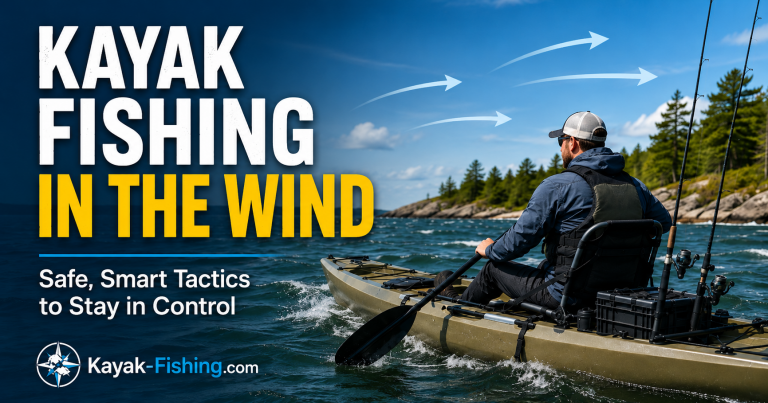
The classic mistake is having an easy first half and a miserable second half. You launch with the wind at your back, drift down a bank catching fish, and look up two hours later realizing the ramp is a long grind straight into whitecaps.
The same thing happens on tidal creeks. An outgoing tide slides you along nicely until the switch comes, the wind pushes against it, and every open stretch starts feeling bigger.
When the route and conditions allow, doing the harder work against wind or current earlier can reduce the chance of leaving the toughest leg for the end of the trip. That is not a universal rule—tides, river flow, changing forecasts, and launch geometry can alter the plan—so think through both the outbound and return conditions before committing.
Set a turnaround point before you need one. A certain bridge. A point. A dock line. A marsh drain. Once you pass it, you are no longer exploring. You are borrowing energy from the paddle back.
If wind regularly gives you trouble, read this breakdown of how wind changes boat control from a kayak. The best kayak anglers are usually not fighting wind all day. They are choosing banks, angles, and launch plans that keep the wind from taking over.
Anchoring deserves its own risk assessment. Current can load an anchor line and change the kayak’s angle quickly, especially when wind or wakes are also involved. Beginners should avoid anchoring in strong or unpredictable current, keep anchor line organized, and use a setup that can be released quickly if conditions change. Do not let saving an anchor become more important than maintaining control of the kayak.
In shallow water, a stakeout pole or shallow-water anchor can be cleaner. Even then, pay attention to the wind direction, bottom type, and boat traffic. Being pinned in one place is only helpful when that place stays safe.
This is also where pride gets anglers in trouble. Turning around early feels silly when you are still catching fish. It feels smart at the ramp when the wind is pushing foam across the main lake.
Rig the Kayak for the Bad Five Minutes
Most of the day, your kayak only needs to help you fish. For five bad minutes, it may need to help you solve a problem quickly.
That changes what should be within reach.
A whistle should not be buried in the hatch. A knife should not be under three tackle boxes. Your phone should not be loose in the footwell, especially if you are fishing cold water, current, or inshore areas. A spare paddle does no good if it is left in the truck because the pedal drive “never fails.”
It helps to separate fishing gear from problem-solving gear. Tackle can live in the crate or hatch. Emergency and control gear should remain reachable while seated, including when you are wet, tired, or being pushed by wind.
For many kayak anglers, useful safety gear includes a worn PFD, an efficient sound signal such as a whistle, waterproof phone protection, appropriate lighting, a line-cutting tool, basic first aid, a paddle or backup propulsion option, and dry storage for needed clothing. The Coast Guard requires vessels under 12 meters to have a means of making an efficient sound signal. On cold, remote, or coastal water, a VHF radio or personal locator device may also be appropriate; choose communication equipment for the area and know how to use it.
For a leaner starting point, use the beginner kayak fishing gear checklist, then remove anything that adds clutter without solving a real fishing or safety need.
Do not rig yourself into a trap. Rod leashes, anchor rope, fish stringers, electronics cables, and loose line all seem harmless one at a time. Together, they can create a mess around your legs when you need to move quickly.
A crowded tankwell may seem harmless until you need to reach clothing, release an anchor line, or move quickly. Keep rods, cords, leashes, and tackle organized so they do not create avoidable entanglement or block access to essential gear.
A clean kayak is not just prettier. It is safer, quieter, and easier to fish from.
Low Light Makes Every Mistake Harder to See
Some of the best kayak fishing happens in the dark edges of the day. Summer topwater at sunrise. Dock lights after sunset. Bridge shadow lines. Foggy creek mouths. A falling tide in the first gray light before boat traffic wakes up.
That same low light hides problems.
Night kayak fishing safety starts with legal lighting and a clear visibility plan. Under the U.S. Navigation Rules, kayaks and canoes are treated as vessels under oars. Between sunset and sunrise, Rule 25 provides several lighting options, including prescribed sailing-vessel lights, a compliant all-round white light, or having an electric torch or lighted lantern ready in time to warn approaching vessels. Review the Coast Guard Navigation Rules guidance for kayaks and canoes and check state or local requirements, which may be more specific. A headlamp for tying knots is not automatically a substitute for required navigation lighting.
Reflective material on paddle blades, bright clothing, a visibility flag, or reflective patches can improve conspicuity in some conditions, but treat them as supplements rather than substitutes for required navigation lights and a proper lookout.
Low light also changes fishing behavior. Treble hooks are more annoying when you cannot see them clearly. Dock cables and brush are harder to judge. A shoreline that looked obvious at sunset can turn into a black wall after the moon drops. Fog can erase landmarks in minutes.
Before fishing at night, choose a simple return route and save the launch location on a phone or GPS if appropriate. Fog and darkness can make familiar shorelines difficult to recognize, so avoid relying on visual memory alone.
One more thing: keep the deck cleaner than you think you need to. A loose topwater plug with trebles, a net across your lap, and a headlamp beam bouncing off the water is a bad combination.
Night fishing can be quiet, productive, and beautiful. It just punishes sloppy habits faster than daylight does.
Make the Go or No-Go Call Before You Are Emotionally Invested
The hardest safety decision is usually made before the kayak touches water.
Once you have driven to the launch and rigged the kayak, it becomes easier to rationalize marginal conditions. Make the serious go/no-go decision before launching, while turning around still costs only a missed trip.
Check wind direction, not just wind speed. Ten miles per hour blowing into a protected bank is different from ten miles per hour pushing straight across three miles of open water. Look at gusts. Look at storms. For inshore trips, look at tide timing and how wind may stack against current. On rivers, think about flow, debris, strainers, and how hard it would be to stop if something goes wrong.
Have a bailout plan. That might be a protected cove, a public bank, a marina, a beach, or simply staying close enough to the launch that you can quit without drama. On new water, keep the first trip conservative. Learn how the place behaves before you commit to long crossings or remote sections.
Leave a float plan with someone you trust. At minimum, provide the launch location, general route or fishing area, communication method, and expected return time, then update that person if the plan changes. The U.S. Coast Guard float-plan guidance is useful even for small craft such as kayaks.
Solo trips reduce the immediate help available when something goes wrong, so conservative decisions about distance, weather, current, cold water, and communication become more important. Newer anglers should build those judgment skills on protected water before adding remote routes or difficult conditions.
Newer kayak anglers should be even more conservative while building judgment. If you are still sorting out basic launch habits, boat control, and gear setup, start with these kayak fishing for beginners fundamentals before adding tougher weather, longer paddles, or night trips.
When Things Start Going Wrong, Stop Fishing First
A lot of on-water problems get worse because the angler keeps trying to fish through them.
The wind builds, but they make one more cast. A storm line shows up, but the bite is finally good. Boat traffic gets heavy, but the fish are still on the channel edge. A lure gets buried in a hand, but the kayak is still drifting toward riprap.
When things start going wrong, stop fishing first.
Secure the rod. Get the paddle or pedals ready. Point the kayak where it needs to point. Then solve the problem.
If you capsize, prioritize breathing, flotation, and getting out of dangerous water as safely as conditions allow. In cold water, the National Weather Service advises minimizing time immersed and evaluating whether you can get to safety rather than wasting energy. A worn PFD, controlled deck layout, and practiced re-entry give you more options, but the safest response depends on water temperature, current, waves, distance from shore, and available rescue.
If you lose a paddle, call that a real problem early. Use the spare, pedal drive, hand paddle, or whatever backup you have, but do not wait until you are twice as far from the ramp to admit you need help.
If wind builds, stop casting and start moving while you still have choices. The same goes for storms. Leaving before the scary gust hits feels overly cautious only until you see what that gust does to the water.
If you get hooked badly, secure the kayak before working on your hand. A treble in the thumb is painful. A treble in the thumb while drifting into current, boat traffic, or rocks is worse.
If boat traffic becomes difficult to manage, move to a safer area or end the trip. A secondary pocket, protected shoreline, or no-wake area may be a better choice than continuing to fish a productive spot where traffic is compromising visibility or boat control.
The best emergency move is usually boring and early.
A Two-Minute Check Before You Launch
Before the first cast, run a quick check. It should become as normal as clipping pliers to your PFD.
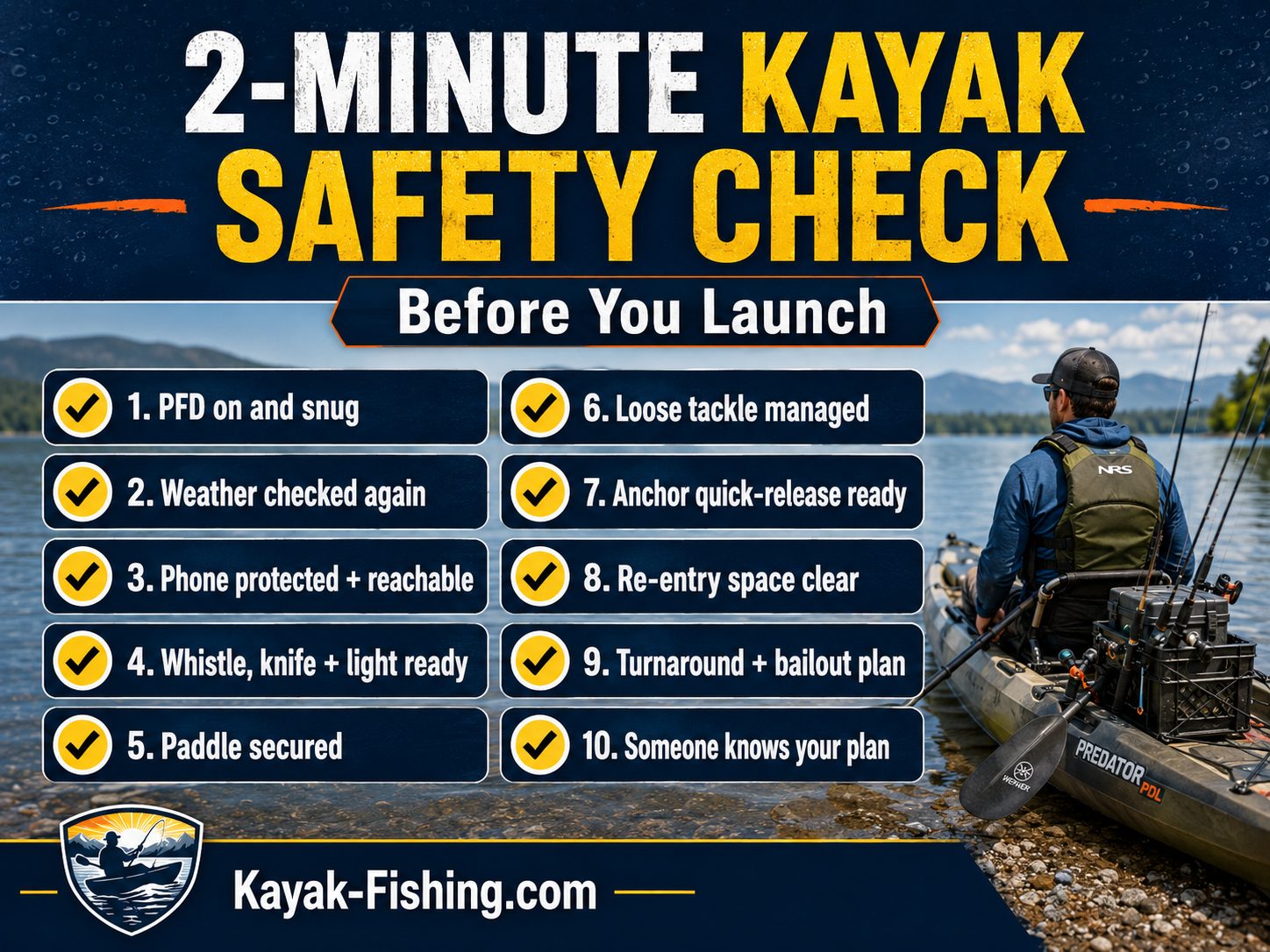
| Safety Check | What to Confirm Before Launching |
|---|---|
| PFD | On, zipped or buckled, and snug enough that it will not ride up. |
| Weather | Wind, gusts, storms, temperature change, and return-trip conditions checked at the ramp. |
| Phone | Protected from water and reachable while seated. |
| Sound signal, line cutter, and light | Reachable without digging through a hatch; lighting must meet the rules that apply to your trip. |
| Paddle | Secured, even if you use a pedal drive. |
| Loose tackle | Managed so it cannot roll underfoot, snag lines, or block re-entry. |
| Anchor setup | Line is clean, controlled, and quick to release if conditions change. |
| Re-entry space | Deck and side area reasonably clear in case you need to climb back in. |
| Plan | Launch route, turnaround point, and bailout option are clear. |
| Contact | Someone knows where you launched and when you expect to be back. |
That check takes less than two minutes once it becomes habit. Do it before you start thinking about which rod gets the first cast. The lake, river, bay, or marsh will still be there after you check your gear.
Kayak Fishing Safety FAQs
Do I really need to wear a PFD while kayak fishing?
Yes. Federal rules generally require an approved wearable PFD for each person aboard, while actual wear requirements can vary by age, state, waterbody, and activity. The Coast Guard recommends wearing an approved PFD while underway, and that is the safer approach for kayak fishing.
What is the biggest safety mistake kayak anglers make?
The biggest mistake is letting several small risks stack up. Cold water, low light, wind, boat traffic, loose gear, and a long paddle back may each seem manageable by themselves. Together, they can turn a normal trip into a problem.
Is night kayak fishing safe?
Night kayak fishing adds visibility and navigation risk. Follow the lighting rules that apply where you fish; under federal Navigation Rules, kayaks and canoes are vessels under oars with specific sunset-to-sunrise lighting options. Keep the deck organized, use a simple return route, and avoid assuming a headlamp alone satisfies navigation-light requirements.
What should I carry for kayak fishing safety?
Core safety gear includes a worn, properly fitted PFD; an efficient sound signal such as a whistle; waterproof communication; appropriate lighting; a line-cutting tool; a paddle or backup propulsion option; basic first aid; and clothing appropriate for the water temperature. On remote, cold, or coastal water, a VHF radio or personal locator device may also be appropriate.
How should I think about cold water kayak safety?
Dress for the water temperature, not just the air temperature. The National Weather Service recommends preparing for sudden immersion and using appropriate cold-water protection. Depending on conditions, that may mean a wetsuit or dry suit, staying closer to shore, choosing more protected water, or skipping the trip.
Come Home With the Story
Kayak fishing safety is not about being nervous on the water. It is about respecting the parts of the trip that do not care how experienced you are.
Cold water does not care that the air feels nice. A powerboat wake does not care that you hooked a good fish. Wind does not care that the bite is better on the far bank. Darkness does not care that you know the shoreline by memory.
The good news is that most smart safety habits are simple. Wear the PFD. Dress for the water. Watch the wind. Stay visible. Keep your kayak clean. Carry what you can reach. Turn around before the decision gets hard.
Do those things, and you will fish better because your head is clearer.
And when conditions do not support the plan, choose smaller water, a protected shoreline, or another day. Good judgment includes knowing when the safest fishing decision is not to launch or to head back early.