Beginner Kayak Fishing Mistakes: 13 Things to Avoid
Beginner kayak fishing mistakes usually come from the same few problems: too much gear, too little attention to conditions, weak boat-control habits, and taking on more water than your experience supports. The good news is that most of them are preventable before the kayak ever leaves the bank.
If you are reading this, you are probably trying to skip some of that frustration.
This guide walks through 13 common beginner kayak fishing mistakes and the practical fixes that make early trips safer, simpler, and easier to manage on lakes, slow rivers, and protected inshore water.
Quick Answer: Common high-impact beginner kayak fishing mistakes include bringing too much gear, not wearing a PFD, ignoring wind or current, launching in difficult conditions, cluttering the deck, and trying to fish too much water in one trip. Start with protected water, one or two rods, a small tackle box, basic safety gear, and a conservative plan for getting back to the launch.
Beginner Kayak Fishing Mistakes at a Glance
| Mistake | Quick Fix |
|---|---|
| Bringing too much gear | Start with one or two rods and one small tackle box. |
| Not wearing a PFD | Wear it the entire time you are on the water. |
| Dressing for air temperature only | Dress for water temperature and possible immersion. |
| Ignoring wind or current | Plan the route around the harder return leg and changing conditions. |
| No float plan | Text someone your launch, route, and expected return time. |
| No plan for securing key gear | Secure critical gear without creating an entanglement hazard. |
| Cluttered deck | Keep only frequently used items within reach. |
| Poor paddling technique | Practice boat control before focusing only on fishing. |
| Misusing anchors | Learn controlled drifts first; avoid anchoring in strong current. |
| Launching at busy ramps | Choose protected coves, no-wake zones, or hand launches. |
| Fishing bad conditions | Start with short trips in light wind and moderate weather. |
| Changing lures too often | Stick with two or three confidence baits. |
| Trying to fish too much water | Pick one small area and fish it thoroughly. |
Table of Contents
Treating your kayak like a tiny bass boat
One of the fastest ways to scare yourself in a kayak is to forget that it is not a shrunken-down bass boat. It behaves differently, and your body is a much bigger part of the system.
Moving like you are in a big, wide boat
A kayak reacts more directly to body movement than a larger fishing boat. Reaching behind the seat, twisting sharply, leaning over one gunwale, or standing before you understand the hull can shift your center of gravity quickly.
In a sit-on-top kayak, quick twists, hard leans, and standing up “just to look” can all feel sketchy until you learn the boat.
Fixes:
- For your first several trips, plan to stay seated while you fish. Move slowly and deliberately until you really know where your balance point is.
- Keep heavy items low and near the centerline. Rods in holders and tackle in a crate or under the seat are better than stacking gear high on one side.
- Before you ever leave the bank, sit in shallow water and purposely lean a bit from side to side. Learn how far the kayak will edge before you reach the “oh no” point.
Bringing your whole garage
Overloading a small fishing kayak with tackle boxes, a cooler, camera gear, and loose accessories can make the deck harder to manage and may put unnecessary weight high or off-center. The goal is not to use every storage area just because it is there.
Fixes:
- Start with one or two rods.
- Bring one small box of confidence baits for your local fish.
- Carry one small terminal box, pliers, and line cutters.
- Pack water, snacks, sun protection, and required safety gear before extra tackle.
- Add gear only when you feel like you truly missed it on multiple trips. If you did not reach for something all day, it probably does not need to be on the kayak next time.
Safety mistakes beginners should avoid
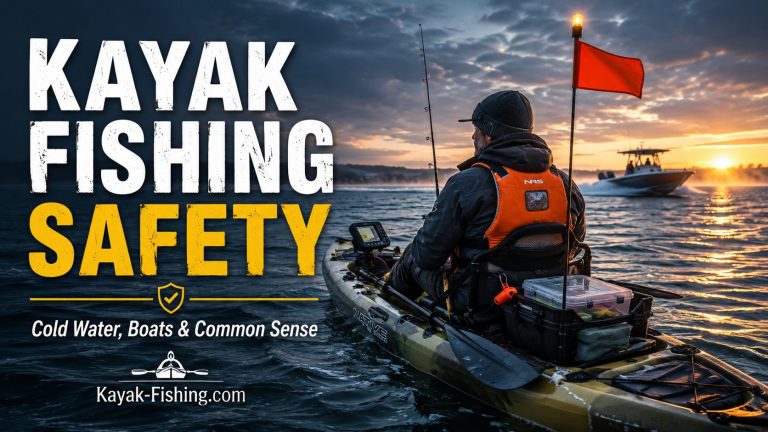
These are the mistakes with the biggest safety consequences. For a broader safety checklist covering cold water, boat traffic, visibility, wind, and emergency planning, see the kayak fishing safety guide.
Not wearing a PFD the whole time
A life jacket stored behind the seat cannot provide immediate flotation during an unexpected capsize. The U.S. Coast Guard recommends wearing a properly fitted, approved life jacket while boating, and state or seasonal rules may add specific wear requirements.
Even on small lakes and ponds, it only takes one surprise wake, one log you do not see, or one awkward reach.
Fixes:
- Choose a comfortable kayak-fishing PFD that gives you room to paddle and cast. Confirm that it is the correct size, properly fitted, in serviceable condition, and approved for the intended use.
- Adjust it at home. Tighten the straps so it hugs but does not pinch, then trim or tuck any loose ends so hooks do not grab them.
- Make a simple rule for yourself: if you are on the water, it is on your body. No exceptions.
Always check current state and local rules for the water you fish. The U.S. Coast Guard life-jacket guidance is a useful federal starting point.
Dressing for the air, not the water
Warm air can hide cold-water risk. The National Weather Service advises dressing for the water temperature rather than the air temperature because an unexpected immersion can rapidly affect breathing, coordination, and heat loss.
Fixes:
- Check water temperature as part of the trip plan, not just the daytime air temperature.
- Use synthetic or wool base layers instead of cotton in cold-water seasons.
- Add light, quick-drying pants and a windproof shell when conditions call for it.
- Use neoprene booties or waterproof socks when cold water and wet feet are likely.
- Plan clothing around possible immersion. The National Weather Service cold-water guidance recommends dressing for water temperature, not air temperature.
Ignoring wind, current, and tide
A common planning mistake is allowing a favorable wind or current to make the outbound leg deceptively easy, then discovering that the return requires much more effort. Wind direction, gusts, current, tide, distance, and available bailout points all matter.
On lakes and ponds, wind is the main thing that will move your kayak around. On rivers, even slow current can add up. In inshore bays and marshes, tide plus wind can push you toward places you really do not want to be, like boat lanes.
Fixes:
- Before you drive to the ramp, look at the wind speed and direction for your time window. If it is strong and gusty, pick a more sheltered spot or skip it.
- When practical, avoid setting up a route where the return leg depends on paddling a long distance directly into worsening wind or current. Conditions can change, so keep a conservative turnaround point.
- On rivers, pick slow sections with easy shorelines and avoid areas with strainers, fallen trees, and logjams until you are very comfortable.
- In saltwater, start in calm marsh ponds and protected creeks on light-wind days and simple tides. Avoid strong outgoing tides that could drag you toward a main channel.
Going totally solo with no float plan
Fishing alone is very different from launching without anyone knowing where you are. A simple float plan gives someone on shore useful information if you are overdue.
If something goes wrong, you want someone on land who can say, “They launched here, at about this time, and planned to fish this area.”
Fixes:
- Before you launch, give a responsible person your launch location, general fishing area or route, expected return time, and basic vessel description. The U.S. Coast Guard recommends float plans even for small kayaks.
- Keep your phone in a waterproof pouch clipped to your PFD, not buried in a hatch.
- Carry an efficient sound signal such as a whistle, and check the navigation-lighting rules that apply if you may be underway from sunset to sunrise. State rules can add requirements.
Gear and packing mistakes that make trips miserable
Once the basic safety stuff is set, the next set of beginner kayak fishing mistakes are all about comfort, hassle, and how much actual fishing you get to do.
Way too much tackle, not enough essentials
A common packing failure is prioritizing extra tackle over essentials such as water, sun protection, appropriate clothing, and safety gear. A small “day box” is usually easier to manage than bringing a large portion of the tackle collection.
Fixes:
Think in terms of a “day box” instead of your whole collection. For most beginner trips, a simple loadout is plenty:
- A few soft plastics you already trust, such as Texas-rig worms, stickbaits, or flukes.
- One or two moving baits, such as a small swimbait, spinnerbait, or lipless crankbait.
- A basic topwater for low light.
- One small terminal tackle box with hooks, weights, and snaps.
- Pliers, line cutters, and a tape measure or small board.
- Water, snacks, sun protection, and bug protection.
The practical benefit is simple: less gear means less time digging through boxes and fewer loose items competing for deck space.
No leashes on the important stuff
Kayaks have limited deck space, and loose gear can go overboard during a wake, capsize, awkward landing, or simple reach behind the seat. The solution is selective—not attaching long cords to everything within reach.
Fixes:
- Secure the paddle and other critical gear in a way that keeps it accessible without surrounding the cockpit with long tethers.
- Keep leashes short and tidy. You do not want long coils wrapping around your feet or hooks.
- Do not tether everything. A couple of smart leashes are enough to prevent the most painful losses.
The tradeoff matters: a tether can prevent a costly loss, but too many cords can create an entanglement problem. Keep any leashes short, purposeful, and out of the footwell.
Deck chaos and the “yard sale” effect
A cluttered deck feels manageable at the ramp but becomes harder to control when a fish, wake, gust, snag, or landing demands quick movement. Loose pliers, open tackle boxes, line, straps, and hooks also add avoidable snag and entanglement points.
Fixes:
- Use a crate or small milk crate behind your seat with two or three labeled boxes inside.
- On the deck, keep only what you truly touch every few minutes: maybe one open box, pliers, and your current rod or two.
- Put things back in the same place every time. It feels fussy, but when a fish pulls you toward a laydown, muscle memory helps.
Paddling and boat control mistakes
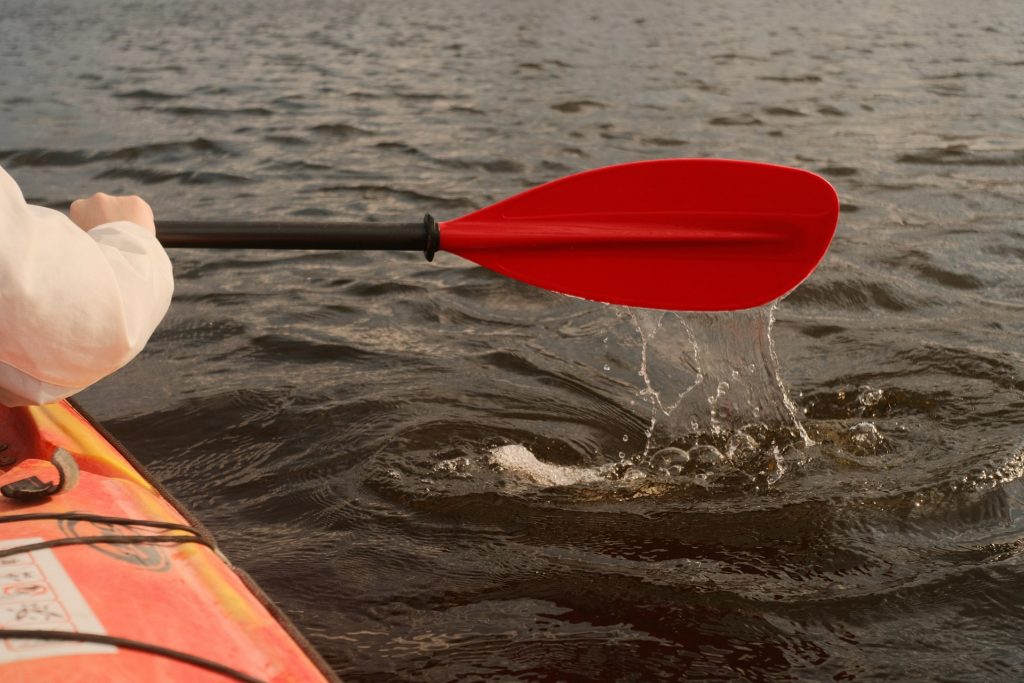
Kayak fishing is really three skills stacked on each other: paddling, boat control, and fishing. Most new anglers focus only on the third one and get frustrated.
Treating paddling as an afterthought
Trying to fish before learning basic strokes often leads to inefficient one-handed corrections, overshooting targets, drifting sideways, and unnecessary fatigue. Boat control deserves practice on its own.
Fixes:
Take ten minutes at the start of a trip in a quiet cove or near the ramp:
- Plant the blade near your toes and pull it back beside the kayak, exiting around your hip.
- Rotate your torso instead of just pulling with your arms. You will go straighter and get less tired.
- Practice gentle turns and stopping quickly with a few reverse strokes.
A few minutes of deliberate practice near the launch can make positioning, stopping, and turning much easier once you start fishing.
Letting wind and current decide where you fish
In a kayak, you are light and have a lot of surface area. That means wind and current can push you around more than you expect.
On lakes and ponds, the main issue is being blown into the very cover you are trying to fish. On rivers, the current can spin you sideways if you are not paying attention. In bays and marshes, you can drift into shallow oyster bars or out toward boat channels.
Fixes:
- Try to keep your bow pointed generally into the force that is moving you, whether that is wind or current. It gives you more control.
- Use short backstrokes as brakes when you come up to a dock, laydown, or grass edge.
- When possible, fish from the upwind or upcurrent side of structure so you drift away from trouble, not into it.
Misusing anchors and stakeout poles
Anchors are useful tools, but beginners should understand the added risk before relying on one. Current, wind, wakes, bottom snags, and an improperly managed line can load or turn a kayak in ways that are difficult to control.
Fixes:
- For your first trips, consider skipping an anchor completely. Focus on learning to use wind and current for controlled drifts.
- In suitable shallow, protected water, a stakeout pole may be simpler than a conventional anchor. Match any anchoring method to the bottom, depth, current, wind, and local rules.
- If you use a conventional anchor, learn the full setup—including how to release it quickly—before using it in moving water. Avoid strong or unpredictable current until you have the skills and equipment to manage it safely.
As always, pay attention to any local rules about anchoring in navigable channels.
Choosing the wrong water, time, or conditions
Many frustrating first trips start with too many variables at once: a crowded launch, open water, strong wind, current, heavy boat traffic, extreme heat, or cold-water exposure.
Launching where the chaos is
The main boat ramp on a sunny Saturday feels like the obvious place to start. The problem is that it is often the worst spot for a new kayak angler. You are trying to load and unload while big boats are backing down, kids are swimming, and wakes are rolling through.
Fixes:
- Look for smaller, secondary ramps on the same lake.
- Use parks with gently sloping banks where you can hand-launch.
- Choose areas labeled as paddle-only or no-wake zones when possible.
- Do not be afraid to drag your kayak an extra 30 or 40 yards to a calmer spot. The launch will be slower paced, and you can sort your gear without pressure.
Picking the worst times of day
Midday summer heat can add sun exposure, dehydration, and fatigue, while early-season trips can combine comfortable air with much colder water. Neither situation is ideal for a first outing unless the angler is prepared for the conditions.
Cold mornings in spring can create the opposite problem: air feels crisp, water is still winter-cold, and you are underdressed.
Fixes:
- For your earliest trips, aim for calm mornings or evenings.
- Pick light-wind days with moderate temperatures.
- Keep early trips short enough that fatigue does not become part of the return trip. Increase distance and duration gradually as boat control and conditioning improve.
- Avoid midday summer heat and cold-water spring conditions unless you are dressed and prepared for them.
Jumping into big open water or wide bays
There is nothing wrong with dreaming about chasing birds in open bays or running long stretches of big reservoirs. You will enjoy those scenarios a lot more after you learn what your kayak feels like in smaller, safer places.
Fixes:
- Start with protected coves on lakes and reservoirs.
- Choose short stretches of gentle river with multiple take-out options.
- Try tucked-away marsh ponds and back creeks inshore before big open bays.
- Pay attention to how your boat feels in light chop. That awareness will pay off later when you add one more variable at a time: more wind, more current, and more boat traffic.
Fishing mistakes that cost bites and confidence
This is where most people think the problems are. In reality, the fishing is the fun part, but there are still a few common kayak fishing mistakes that show up again and again.
Changing lures constantly
Constantly changing lures makes it harder to learn what is actually working and creates more rigging work in a confined space. Beginners usually benefit from a small set of proven presentations matched to the water they are fishing.
Fixes:
- Pick two or three presentations you believe in for that day and stick with them.
- Before you change lures, change your casting angle, retrieve speed, depth, or how tight you stay to cover.
- Let yourself actually learn how each bait behaves from a kayak, because boat positioning affects the way baits move too.
Fishing over the best water
From a kayak, it is easy to drift or paddle directly over shallow structure before making the best cast. Good boat positioning helps preserve casting angles and reduces unnecessary disturbance in the water you intend to fish.
Fixes:
- Stop short and fan-cast ahead and to the sides before you drift over an area.
- Be aware of your shadow and the noise of the hull slapping in little waves.
- Think of the kayak as part of your presentation. Where you put the boat changes how stealthy you are.
Trying to fish the whole lake
A route that tries to cover every point, cove, and dock may create more paddling than fishing, especially in a paddle kayak. A smaller area is easier to learn thoroughly and keeps the return distance predictable.
Fixes:
- On each trip, choose one creek arm, one stretch of shoreline, or one small marsh drain network.
- Fish that smaller area thoroughly instead of bouncing all over the lake.
- Note wind direction, current, where you get bites, and how you approached those spots.
- Keep simple notes in your phone. A few lines about conditions, what worked, and what did not will teach you more than randomly covering water.
Awkward fish handling and photo chaos
Fish handling gets awkward quickly when the rod, net, phone, paddle, measuring board, and fish are all competing for the same small workspace. Decide where each item goes before a fish is beside the kayak.
Fixes:
- Create a small landing zone with a net or lip grip within easy reach.
- Keep a simple bump board or measuring tape nearby if you plan to measure fish.
- Pick one safe spot on the deck where the fish goes for a quick photo.
- Practice the routine on smaller fish. Get in the habit of unhooking, quick photo or measure, and release before you ever handle a big one in tight quarters.
A simple pre-trip checklist that prevents common problems
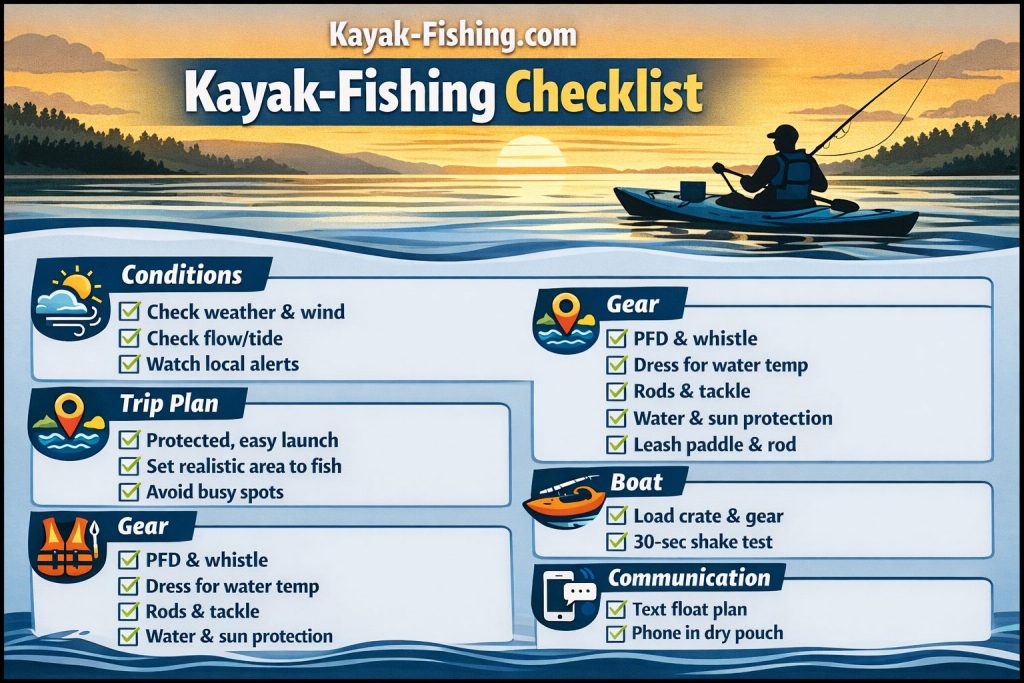
A short checklist is an easy way to catch missing safety gear, forgotten equipment, and poor trip assumptions before they become on-water problems.
Here is a simple run-through you can adapt and keep on your phone or inside your crate:
Conditions
- Check the weather for your exact time window.
- Look at wind speed and direction.
- If on a river or inshore, check flow or tide along with any local warnings.
Trip plan
- Choose protected water for early trips: coves, backwaters, small bays, marsh creeks, or slow river stretches.
- Pick an easy launch with calm access, not the busiest ramp on the lake.
- Decide on a realistic distance or area to fish.
Gear
- PFD and whistle, set out where you will put them on immediately.
- Clothing matched to water temperature, not only air temperature.
- Paddle, rods, minimal tackle, pliers, and line cutters.
- Water, snacks, sun protection, and bug protection.
- Critical gear secured without long loose tethers around the footwell.
Boat
- Load the crate and gear before you are blocking a ramp.
- Do a 30-second “shake test” on land: wiggle the boat and see what rattles, rolls, or falls. Fix it before launching.
Communication
- Text a float plan to someone: where you will launch, the rough area you will fish, and when you expect to be done.
- Keep your phone in a dry pouch clipped to your PFD.
Once this becomes routine, the checklist takes very little time and reduces the number of decisions you need to make at the water.
Avoid the most common beginner kayak fishing mistakes:
FAQs: Beginner Kayak Fishing Mistakes
What is the biggest mistake beginner kayak anglers make?
One of the most consequential mistakes is underestimating wind, current, and distance. A kayak that feels easy to control in calm water can become much harder to manage as conditions change. Start in protected water, keep the route conservative, and avoid creating a long return leg against worsening wind or current.
How much gear should a beginner bring kayak fishing?
Most beginners should start with one or two rods, one small tackle box, pliers, line cutters, water, snacks, sun protection, and required safety gear. Bringing too much tackle makes the kayak cluttered, harder to paddle, and more frustrating to fish from.
Should you always wear a PFD while kayak fishing?
Yes. A PFD should be worn the entire time you are on the water, not stored behind the seat or inside the kayak. The time you need it is usually the time you will not be able to grab it and put it on.
Should beginners use an anchor while kayak fishing?
Beginners should be careful with anchors, especially in current. For early trips, it is often better to learn controlled drifts first. If you do use an anchor, start in shallow, protected water and use a setup that can be released quickly if conditions change.
What conditions are best for a first kayak fishing trip?
The best first trips are short sessions on protected water with light wind, moderate temperatures, and easy launch access. Small lakes, quiet coves, slow river stretches, marsh ponds, and no-wake areas are usually better than big open water or busy ramps.
What should I do after a bad first kayak fishing trip?
Do not assume kayak fishing is not for you. Write down what went wrong, then simplify the next trip. Pick calmer water, bring less gear, shorten the route, and focus on boat control as much as catching fish. Most frustrating first trips come from too many variables at once.
Encouragement and next steps
If several of these mistakes sound familiar, the useful response is not to add more gear. Simplify the next trip and remove one or two avoidable problems at a time.
Experience usually improves through repeatable habits: a cleaner deck, better weather checks, a realistic route, a worn PFD, and a consistent pre-launch routine. Those systems matter more than trying to remember everything in the parking lot.
Your next step does not have to be complicated. Plan one short, simple trip with:
- Safe, protected water.
- Reasonable conditions.
- Minimal gear.
- A focus on paddling and boat control as much as catching fish.
After each trip, jot down what worked, what created friction, and one thing to change next time. Small adjustments to gear, route, launch choice, and boat control can make the next outing simpler without rebuilding the entire setup.
You do not need a perfect setup to start. You need a manageable kayak, appropriate safety gear, conservative conditions, and enough boat-control practice to keep the fishing secondary when conditions demand your attention.