Kayak Fishing Knots: Simple, Reliable Knots Every Kayak Angler Should Know
Strong kayak fishing knots are non-negotiable. From a kayak, you are closer to the fish, closer to structure, and often working with lighter tackle than you would from a bigger boat. A bad knot does not just lose a lure. It can cost you the best fish of the day.
The good news is simple: you do not need to know every fishing knot ever invented. If you learn a small set of reliable knots and practice them until you can tie them quickly, you will be ready for most freshwater, inshore, and light saltwater kayak fishing situations.
This guide breaks down the best knots for kayak fishing, when to use each one, and which knots are easiest to tie when you are sitting low to the water with wind, waves, and gear all around you.
Table of Contents
Quick Answer: Best Kayak Fishing Knots
For additional visual knot references, Animated Knots has a helpful fishing knots library that can be useful when practicing these knots at home. For this kayak-focused guide, the goal is to keep your system simple and practical on the water.
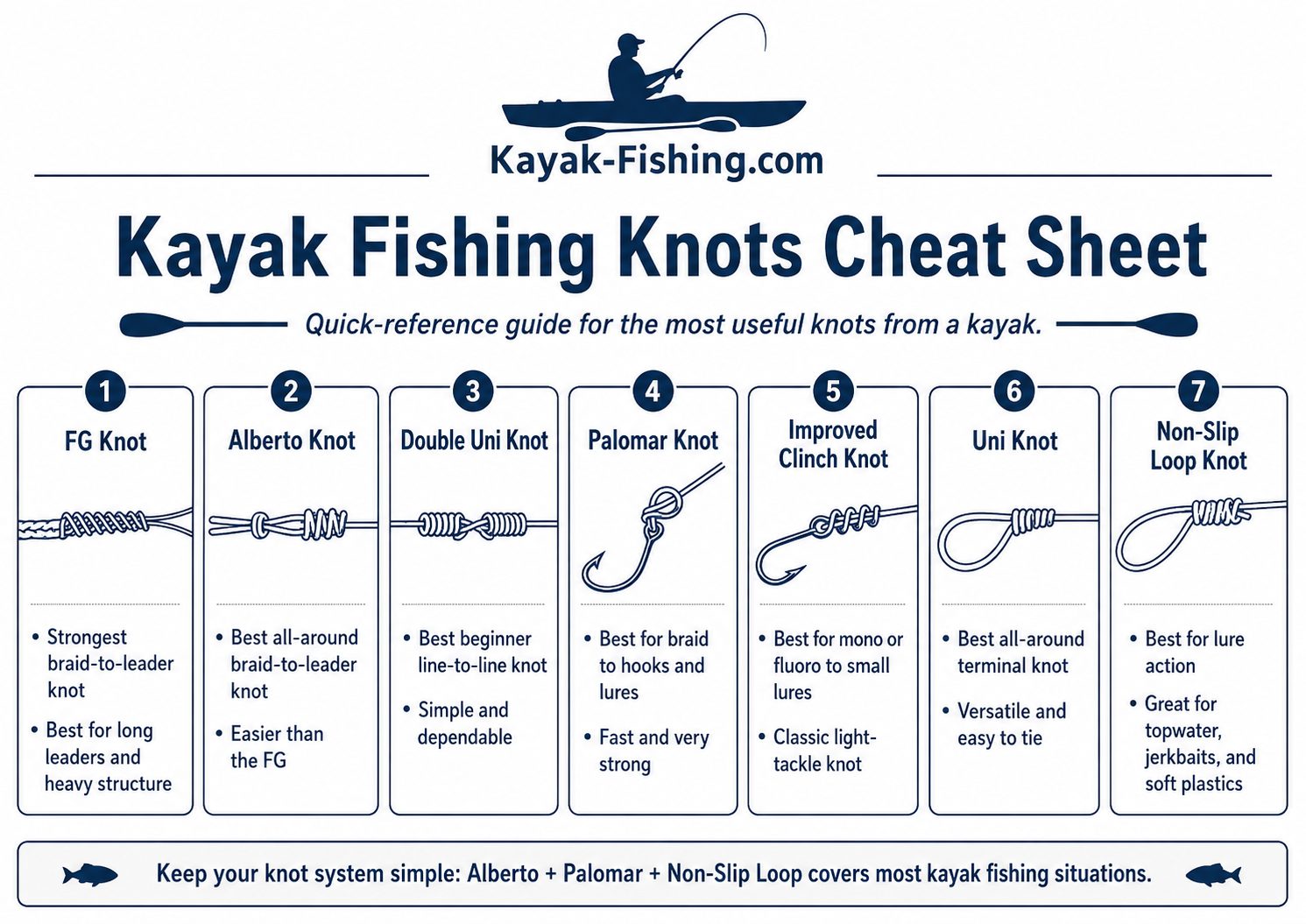
The best kayak fishing knots are the ones that are strong, simple, and realistic to tie from a small boat. For most kayak anglers, the most useful knots are the FG knot, Alberto knot, Double Uni knot, Palomar knot, Uni knot, Improved Clinch knot, and Non-Slip Loop knot.
| Situation | Best Knot | Why It Works |
|---|---|---|
| Braid to fluorocarbon leader, strongest setup | FG Knot | Very slim and strong through rod guides |
| Braid to leader, easier to tie on the water | Alberto Knot | Strong, compact, and easier than the FG |
| Beginner braid-to-leader connection | Double Uni Knot | Simple, dependable, and easy to remember |
| Braid or mono to hooks and lures | Palomar Knot | Fast, strong, and braid-friendly |
| Mono or fluoro to small lures | Improved Clinch Knot | Classic knot for light to medium tackle |
| All-around terminal knot | Uni Knot | Versatile and works with many line types |
| Topwater, jerkbaits, and soft plastics | Non-Slip Loop Knot | Allows the lure to move more naturally |
If you are new to kayak fishing, do not try to learn all of these at once. Start with the Alberto knot, Palomar knot, and Non-Slip Loop knot. That simple combination will cover a lot of real-world kayak fishing.
The Simple 3-Knot Kayak Fishing System
One of the biggest mistakes beginners make is trying to learn too many knots. From a kayak, simple usually wins. You want knots you can tie when your hands are wet, your kayak is moving, and the bite is on.
If I could only use three knots from a kayak, I would use this system:
| Knot | Main Job | Best Use |
|---|---|---|
| Alberto Knot | Braid to leader | Everyday freshwater and inshore kayak fishing |
| Palomar Knot | Line to hook or lure | Jigs, hooks, spoons, and many lures |
| Non-Slip Loop Knot | Line to lure with extra action | Topwaters, jerkbaits, paddle tails, and twitch baits |
That three-knot system is not the only way to rig, but it is simple, strong, and easy to remember. Once you are comfortable, add the FG knot for maximum braid-to-leader performance and the Uni knot as a versatile backup.
For more beginner setup advice, read our guide on beginner kayak fishing mistakes.
Why Knots Matter in Kayak Fishing
Knots matter from any boat, but they matter even more from a kayak. You have less room, less leverage, and less margin for sloppy rigging.
On a kayak, good knots help you:
- Land fish around docks, rocks, grass, oysters, laydowns, and bridge pilings.
- Use braid and leader combinations with confidence.
- Spend more time fishing and less time retying.
- Avoid losing fish because of a rushed or poorly seated knot.
Reliable knots are like good brakes in a car. You may not think about them when everything is working, but you will notice immediately when they fail.
This is especially true when fishing in wind. If conditions are making boat control harder, knot tying becomes harder too. Our guide to kayak fishing in wind covers more on managing rougher conditions from a small boat.
Best Braid-to-Leader Knots for Kayak Fishing
Many kayak anglers use braided main line with a fluorocarbon or monofilament leader. Braid casts well, has excellent sensitivity, and cuts through vegetation better than mono. A leader adds abrasion resistance and can be less visible around clear water, shell, rocks, docks, and toothy fish.
The connection between braid and leader is one of the most important knots in your setup.
1. FG Knot: Strongest and Slimmest
The FG knot is one of the best braid-to-leader knots because it is slim, strong, and passes through guides better than bulkier knots. Instead of simply tying two lines together, the braid grips the leader with tight wraps.
Best for:
- Long leaders
- Heavy structure
- Bigger fish
- Situations where the knot repeatedly passes through rod guides
Pros:
- Very slim profile
- Excellent strength when tied correctly
- Great for braid to fluorocarbon leader
Cons:
- Takes practice to tie consistently
- Can be frustrating in wind or chop
- Not the knot I would teach first to a brand-new kayak angler
2. Alberto Knot: Quick and Strong
The Alberto knot is one of the best everyday braid-to-leader knots for kayak fishing. It is easier to learn than the FG, still strong, and compact enough for most normal leaders.
Best for:
- General freshwater and inshore kayak fishing
- Medium-length leaders
- Fishing around moderate structure
- Anglers who want a practical alternative to the FG knot
Pros:
- Easier to tie than the FG knot
- Strong enough for most kayak fishing situations
- Works well with braid to mono or braid to fluorocarbon
Cons:
- Bulkier than the FG knot
- May tick through guides more if the leader is long
3. Double Uni Knot: Simple and Reliable
The Double Uni knot is easy to understand and easy to remember. It is not as slim as the FG or Alberto, but it is a good beginner knot and a useful backup if you need to retie quickly.
Best for:
- Beginners
- Shorter leaders
- Moderate-pressure situations
- Quick repairs on the water
Pros:
- Very easy to learn
- Works with many line combinations
- Easy to inspect after tying
Cons:
- Bulkier than the FG and Alberto
- Not ideal for long leaders that pass through guides all day
Best Terminal Knots for Lures and Hooks
Terminal knots connect your line or leader to the lure, jig, hook, or swivel. These are the knots you will tie most often from a kayak, so they need to be fast and dependable.
1. Palomar Knot
The Palomar knot is one of the best terminal knots for kayak fishing because it is strong, simple, and works especially well with braid.
Use for:
- Braid to hooks
- Braid to jigs
- Mono to many lures
- Quick retying in low light or windy conditions
Why it is good:
- Very strong when tied correctly
- Simple steps
- Great with braided line
- Easy to remember under pressure
2. Improved Clinch Knot
The Improved Clinch knot is a classic terminal knot for mono and fluorocarbon. It is especially useful for smaller hooks, light tackle, and finesse presentations.
Use for:
- Mono or fluorocarbon to small hooks
- Small crankbaits, spoons, and inline spinners
- Light to medium tackle
Why it is good:
- Easy to tie
- Works well with mono and fluoro
- Good for smaller tackle where a bulky knot is not needed
3. Uni Knot
The Uni knot is one of the most versatile fishing knots. You can use it as a terminal knot, and many anglers also use Uni-style knots for line-to-line connections.
Use for:
- Mono, fluoro, or braid to hooks and lures
- A dependable “do-everything” knot
- Situations where you want one knot that works in many places
Why it is good:
- Adaptable
- Easy to adjust before tightening
- Useful as a backup knot when conditions get tough
4. Non-Slip Loop Knot
The Non-Slip Loop knot, also called the Kreh Loop, is excellent when you want a lure to move freely. Instead of cinching tight to the eye, it creates a small loop that gives the lure more action.
Use for:
- Topwater lures
- Jerkbaits and twitch baits
- Paddle tails and soft plastics
- Inshore presentations for redfish, trout, snook, and flounder
Why it is good:
- Improves lure movement
- Strong when tied correctly
- Excellent for artificial lures that need freedom to swing
Step-By-Step Tying Instructions
You do not need to memorize dozens of knots. Focus on tying a few cleanly and consistently. A simple knot tied perfectly is better than a complicated knot tied poorly.
FG Knot: Braid to Leader
There are several ways to tie the FG knot. This is a simplified version that works well once you practice it.
- Keep the braid tight. Hold tension on the braid with your fingers, rod handle, or another stable point.
- Lay the leader against the braid. Keep the leader straight and controlled.
- Wrap the braid over and under the leader. Alternate sides so the braid grips the leader evenly.
- Make 16 to 24 total wraps. Keep the wraps tight, clean, and stacked.
- Add locking half-hitches. Tie a half-hitch around both the braid and leader, then add a few more around the braid only.
- Trim the leader tag closely. Use care so you do not damage the braid.
- Finish the knot. Add a few final half-hitches or a Rizzuto-style finish.
- Pull test the knot. The wraps should bite into the leader and stay compact.
The FG knot is excellent, but it is not forgiving when tied sloppy. Practice it at home before relying on it during a trip.
Alberto Knot: Braid to Leader
- Form a loop in the leader. Hold the loop between your thumb and finger.
- Pass the braid through the loop. Leave enough tag end to work with.
- Wrap the braid up the leader. Make 7 to 10 wraps.
- Wrap back down over the first wraps. Make another 7 to 10 wraps back toward the loop.
- Pass the braid tag back through the leader loop. It should exit the same direction it entered.
- Lubricate and tighten slowly. Pull on the braid main line and leader while keeping the wraps neat.
- Trim both tags. Leave clean ends without cutting too close before testing.
The Alberto is a great practical knot for kayak anglers because it is strong without being overly complicated.
Palomar Knot: Line to Hook or Lure
- Double 6 to 8 inches of line. Pass the loop through the eye of the hook or lure.
- Tie an overhand knot. Do not tighten it all the way yet.
- Pass the hook or lure through the loop. Make sure the loop clears the entire lure or hook.
- Lubricate and pull evenly. Cinch the knot down with steady pressure.
- Trim the tag end. Check that the lines are not crossed.
The biggest Palomar mistake is letting the doubled lines cross while tightening. Keep everything aligned before you cinch the knot tight.
Improved Clinch Knot: Light to Medium Terminal Knot
- Pass the line through the eye of the hook or lure.
- Wrap the tag end around the main line 5 to 7 times.
- Pass the tag through the small loop just above the eye.
- Pass the tag through the larger loop you just created.
- Lubricate the knot and tighten slowly.
- Trim the tag end.
The Improved Clinch is best with mono and fluorocarbon. With slippery braid, the Palomar or Uni is usually a better choice.
Uni Knot: Versatile Terminal Knot
- Pass the line through the eye and double it back to form a loop.
- Wrap the tag end around both the main line and the loop 4 to 6 times.
- Lubricate the knot.
- Pull the tag end to snug the coils together.
- Pull the main line to slide the knot down to the eye.
- Trim the tag end.
The Uni knot is a good knot to know because it can solve a lot of problems when you need a dependable all-around option.
Non-Slip Loop Knot: Lure Action Knot
- Tie a loose overhand knot. Leave it open about 6 to 8 inches from the tag end.
- Pass the tag through the eye of the lure.
- Bring the tag back through the overhand knot. It should come back through from the same side it exited.
- Wrap the tag around the standing line. Make 3 to 5 wraps.
- Pass the tag back through the overhand knot again.
- Lubricate and tighten slowly. Control the loop size as the knot seats.
- Trim the tag end. Pull test before fishing.
The loop should be small enough to stay controlled but large enough to let the lure move freely.
When to Use Each Knot
Choosing the right knot is easier when you think in terms of what the knot needs to do.
| Need | Best Choice | Backup Choice |
|---|---|---|
| Strongest braid-to-leader connection | FG Knot | Alberto Knot |
| Easiest braid-to-leader knot for beginners | Double Uni Knot | Alberto Knot |
| Best all-around kayak braid-to-leader knot | Alberto Knot | FG Knot |
| Braid directly to hook or lure | Palomar Knot | Uni Knot |
| Mono or fluoro to small lure | Improved Clinch Knot | Uni Knot |
| Soft plastics, jerkbaits, or topwater lures | Non-Slip Loop Knot | Uni Knot |
For most kayak fishing trips, Alberto + Palomar + Non-Slip Loop will handle the majority of your rigging. FG + Palomar is a stronger, more advanced system if you are comfortable tying the FG cleanly.
If you fish lakes and rivers, your knot system does not need to be complicated. A simple setup works well for bass, crappie, trout, smallmouth, and many other freshwater species. You can see this kind of practical approach in our Old Hickory Lake kayak fishing guide.
Tips for Tying Knots in Rough Water
Kayak conditions are rarely perfect. Wind, current, wakes, and chop can make even a simple knot feel harder than it should. These tips help you retie without turning a small problem into a mess.
1. Create Stability First
- Point the bow into waves, wakes, or chop when possible.
- Keep your feet braced against the foot pegs or hull.
- Lay the rod across your lap or secure the rod butt before tying.
- Do not rush the knot while the kayak is drifting toward structure.
2. Use Short, Manageable Tag Ends
Long tag ends can wrap around rod tips, pedal drives, handles, seat frames, and other gear. Use enough line to tie the knot correctly, but do not give yourself so much extra line that it becomes a problem.
3. Pre-Tie Leaders Before Launching
One of the easiest ways to reduce frustration is to do more rigging at home. Pre-tie leaders, check your knots, and organize extra rigs before you launch. That way, you are not trying to tie your most complicated knot while bouncing in wind and boat wake.
4. Keep Your Knot System Small
In rough conditions, you do not want to mentally search through ten different knot options. Pick a few dependable knots and practice them until they become automatic.
5. Practice at Home
Practice your knots while watching TV or sitting at the kitchen table. Tie them with heavier line first so you can see the wraps, then practice with the actual line and leader you fish with.
A knot you can tie perfectly at home may still feel awkward from a kayak. Practice makes it much easier when the water is moving.
Common Kayak Fishing Knot Mistakes
Most knot failures are not because the angler chose a terrible knot. They usually happen because the knot was rushed, seated poorly, or damaged before the cast.
Not Wetting the Knot
Friction can weaken line as the knot tightens. Wet the knot before cinching it down, especially with mono and fluorocarbon.
Cinching Too Fast
Pull slowly and evenly. If the wraps jump, twist, or stack incorrectly, cut the knot and retie it.
Not Checking for Crossed Lines
Crossed lines are especially common with the Palomar knot. Before tightening, make sure the doubled line sits cleanly and does not pinch over itself.
Trimming Too Close Too Early
Pull test the knot before trimming tags extremely close. If the knot slips even slightly, you want enough tag left to catch the issue before it fails on a fish.
Using a Complicated Knot You Have Not Practiced
The FG knot is excellent, but a poorly tied FG is not better than a clean Alberto. Use the knot you can tie correctly under real conditions.
FAQs About Kayak Fishing Knots
How many knots do I really need to know for kayak fishing?
Most kayak anglers only need 4 to 6 knots. A good starter set is the Alberto knot, Palomar knot, Uni knot, and Non-Slip Loop knot. Add the FG knot once you are ready for a stronger and slimmer braid-to-leader connection.
What is the best knot for kayak fishing?
There is no single best knot for every situation. For a simple kayak fishing setup, the Alberto knot is great for braid to leader, the Palomar knot is excellent for tying directly to hooks or lures, and the Non-Slip Loop knot is best when you want more lure action.
Is the FG knot worth learning?
Yes, the FG knot is worth learning if you use long leaders, fish around structure, or want a slim knot that passes through guides well. However, it takes practice. Beginners can start with the Alberto knot or Double Uni knot and still catch plenty of fish.
What is the easiest braid-to-leader knot?
The Double Uni knot is one of the easiest braid-to-leader knots to learn. The Alberto knot is slightly more involved but is still manageable and usually more compact.
What is the best knot for tying braid directly to lures?
The Palomar knot is usually the best choice for tying braid directly to hooks, jigs, and many lures. It is strong, simple, and works well with braided line.
Should I always use a leader with braid?
Not always, but a leader is a good default for most kayak fishing. Leaders help with abrasion resistance around rocks, docks, shell, grass edges, and fish teeth. They can also be less visible than braid in clear water.
How do I know if my knot is strong enough?
Inspect the wraps, wet the knot, tighten it slowly, and give it a firm pull test before casting. If the knot looks sloppy, feels rough, slips, or has crossed wraps, cut it off and retie.
Final Thoughts
The best kayak fishing knots are the knots you can tie quickly, cleanly, and confidently on the water. You do not need a giant knot library. You need a small system you trust.
Start with a simple three-knot setup: Alberto for braid to leader, Palomar for tying to hooks and lures, and Non-Slip Loop for lures that need extra action. Then add the FG knot if you want a slimmer, stronger braid-to-leader connection for longer leaders or heavier structure.
Practice at home, pull test every knot, and keep your system simple. When your knots are dialed in, you can stop worrying about the weak link in your setup and focus on finding fish, reading water, and making better casts from your kayak.