Best Kayak Anchors for Lakes, Rivers & Inshore Fishing
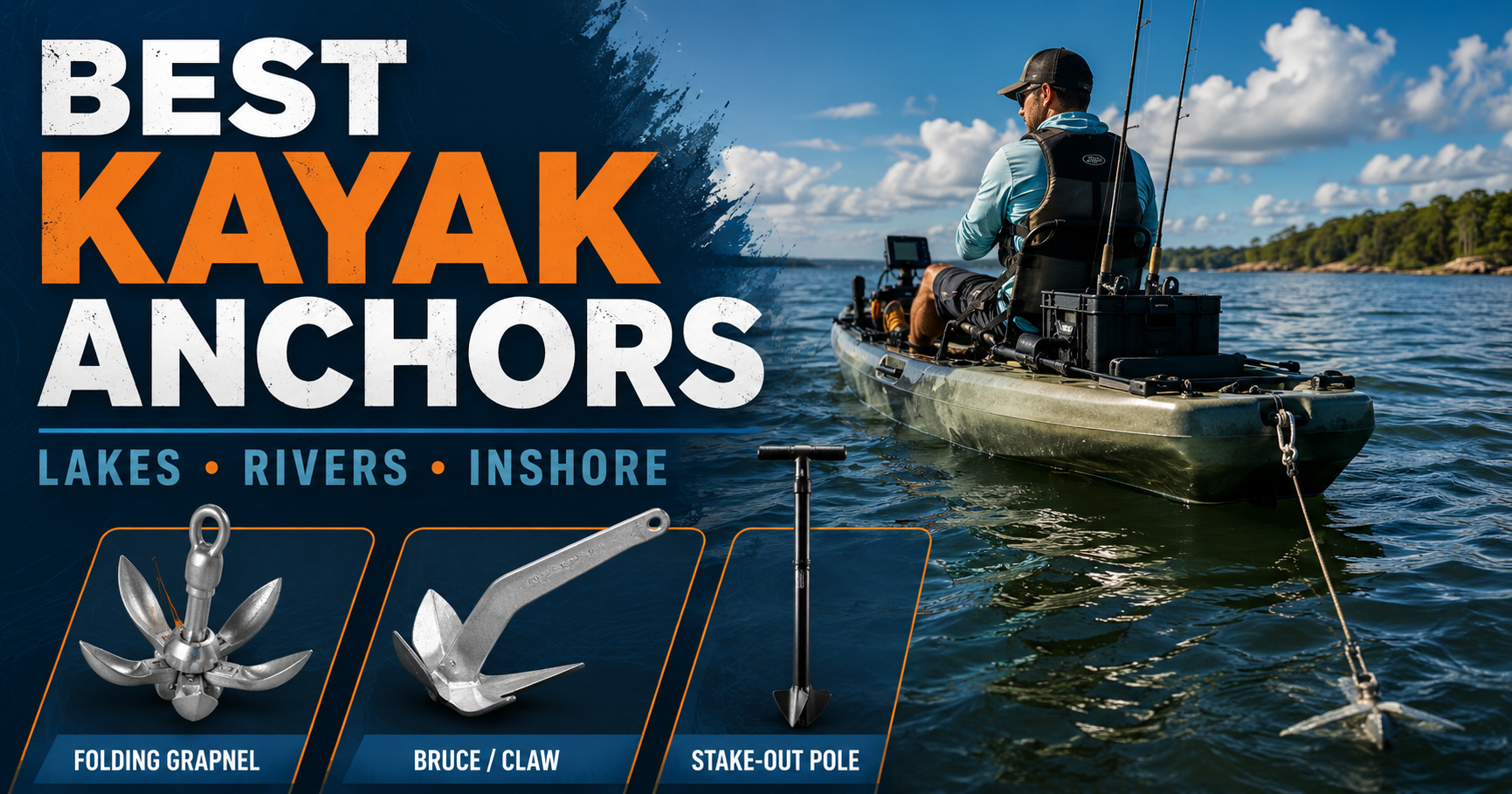
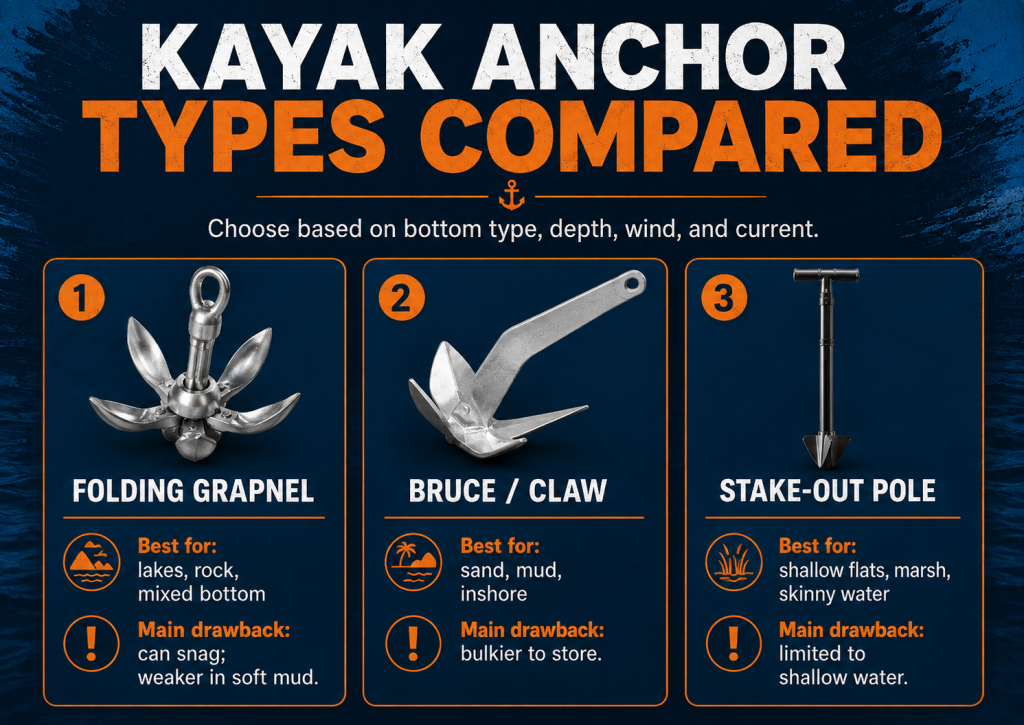
The best kayak anchor depends less on finding the heaviest piece of metal and more on matching the anchor style to the bottom, water depth, wind, current, and the way you want the kayak to sit. A compact grapnel can be a practical choice on many lakes, a Bruce-style anchor makes more sense on sand and mud, and a stake-out pole can be far simpler in shallow water.
This guide is research-based. Kayak-Fishing.com has not personally tested every product listed below. Recommendations are based on current manufacturer documentation, product design, intended use, current availability, and practical analysis of the tradeoffs that matter to kayak anglers.
Affiliate disclosure: Some links on this page are affiliate links. Kayak-Fishing.com may earn a commission if you buy through an eligible link at no extra cost to you. Manufacturer links are also included when they are the clearest current source or when retailer availability is limited.
Quick Verdict
Best all-around lake kit: Newport Vessels 3.5 lb Folding Grapnel Anchor Kit.
Best lightweight kit for calm water: YakGear 1.5 lb Grapnel Anchor Kit.
Best for sand, silt, and mud: YakGear 2.2 lb Bruce Anchor.
Best for shallow flats and marsh edges: YakAttack ParkNPole Link 8′.
Best anchor-trolley add-on: YakAttack LeverLoc Anchor Trolley.
Important river note: There is no universal “best river anchor.” Current can turn an otherwise simple anchoring setup into a capsize or entanglement hazard. In swift-moving water, do not treat an anchor trolley or fixed anchor as a default solution.
Table of Contents
- Best Kayak Anchors at a Glance
- How We Selected These Kayak Anchors
- Best All-Around Lake Kit: Newport Vessels Grapnel
- Best Lightweight Kit: YakGear 1.5 lb Grapnel
- Best for Sand and Mud: YakGear Bruce Anchor
- Best for Shallow Water: YakAttack ParkNPole Link
- Best Trolley Add-On: YakAttack LeverLoc
- Which Kayak Anchor Type Should You Choose?
- Lakes vs Rivers vs Inshore Water
- Anchor Line and Scope
- Do You Need an Anchor Trolley?
- Kayak Anchoring Safety
- Common Kayak Anchoring Mistakes
- Kayak Anchor FAQs
Best Kayak Anchors at a Glance
| Pick | Product | Best For | Main Tradeoff | Where to Check |
|---|---|---|---|---|
| Best Lake Kit | Newport Vessels 3.5 lb Folding Grapnel KitAnchor, 30′ rope, buoy, bag, shackle and carabiner | Lakes, ponds, mixed hard bottom, general freshwater use | Grapnel tines can snag badly in rock or wood | Check Amazon PriceManufacturer details |
| Best Lightweight | YakGear 1.5 lb Grapnel Anchor Kit1.5 lb folding anchor, 30′ rope and storage bag | Smaller kayaks, ponds, calm lakes and sheltered water | Less margin when wind or current increases | View at YakGear |
| Best Soft Bottom | YakGear 2.2 lb Bruce AnchorGalvanized, self-orienting plow-style anchor | Sand, silt and mud in protected inshore water or lakes | Bulkier than a folding grapnel | Check Amazon AvailabilityManufacturer details |
| Best Shallow Water | YakAttack ParkNPole Link 8′Two-piece stake-out / push pole, 1.8 lb | Shallow flats, marsh edges and soft-bottom shorelines | Only useful where the pole can reach and penetrate bottom | View at YakAttackCheck Amazon availability |
| Best Trolley | YakAttack LeverLoc Anchor TrolleyLine clamp, Stealth Pulleys and 35′ reflective cord | Changing kayak angle in wind or manageable current where anchoring is appropriate | Requires installation and is not a reason to anchor in swift water | View at YakAttackCheck Amazon availability |
River safety note: This table intentionally does not name a fixed anchor as “best for rivers.” Current changes the risk. YakGear specifically warns against deploying an anchor on a trolley in swift-moving water, and any fixed line can create snag, entanglement, or capsize hazards if the kayak loads sideways.
How We Selected These Kayak Anchors
This is not a list of six similar folding anchors with different logos. Each recommendation has a distinct job.
- Current manufacturer documentation: Weight, included rope, hardware, construction and intended use were checked against current product documentation.
- Bottom type: Grapnels, Bruce-style anchors and stake-out poles solve different holding problems.
- Kayak practicality: Storage space, weight, line management and ease of deployment matter more on a kayak than they do on a larger boat.
- Use-case separation: Each top pick is intended for a different buyer or water type rather than being ranked with an arbitrary numerical score.
- Safety: A product does not earn a recommendation simply because it holds hard. The consequences of a snagged line, broadside loading or anchoring in strong current matter more than holding power alone.
Best All-Around Lake Kit: Newport Vessels 3.5 lb Folding Grapnel
The Newport Vessels 3.5 lb Folding Grapnel Anchor Kit is the easiest recommendation here for anglers who mainly fish lakes and want a complete system rather than sourcing every component separately.
Newport lists a 3.5-pound galvanized-steel grapnel, 30 feet of anchor rope with a buoy, a carrying/storage bag, stainless-steel shackle and carabiner hardware. The folding tines make the anchor compact enough for a crate or tankwell.
Main advantage: It is a complete, compact package that is easy to understand and store.
Main drawback: Grapnel anchors hold by hooking or catching. That is useful around mixed hard bottom, but the same tines can become difficult to recover from rock, timber or other snaggy structure.
Who should buy it: Lake and pond anglers who want one general-purpose kit for relatively manageable conditions.
Who should skip it: Anglers who mainly fish featureless sand or mud, or anyone routinely anchoring around heavy current where a fixed anchor can create additional risk.
Best Lightweight Kit for Calm Water: YakGear 1.5 lb Grapnel
The YakGear 1.5 lb Grapnel Anchor Kit makes more sense when storage and low carried weight matter more than maximum holding margin.
YakGear lists a 1.5-pound galvanized-steel anchor with four folding 3.5-inch tines, 30 feet of 3/16-inch nylon diamond-braid rope and a storage bag. The company positions the lighter model for calmer conditions.
Main advantage: It is compact, light and simple enough for small sit-on-top kayaks, recreational kayaks used for occasional fishing, ponds and sheltered lakes.
Main drawback: The lower weight provides less margin as wind, chop or current increases. More anchor weight is not automatically the answer, but a light kit should not be stretched into conditions it was not chosen for.
Closest alternative: The Newport 3.5 lb kit is the better choice when you want a more substantial general-purpose lake setup and do not mind carrying additional weight.
Best for Sand and Mud: YakGear 2.2 lb Bruce Anchor
A grapnel is not automatically the best choice just because it is common on kayaks. When the bottom is mostly sand, silt or mud, the YakGear 2.2 lb Bruce Anchor is the more purpose-built option.
YakGear describes this as a 2.2-pound galvanized-steel, self-orienting plow-style anchor designed to dig into sand, silt and muddy bottoms. That makes it especially relevant to protected inshore water, tidal creeks with manageable current, soft-bottom coves and similar areas.
Main advantage: The plow shape is designed to bury into soft bottom rather than wait for a tine to catch structure.
Main drawback: It does not fold, so it is less tidy to store than a grapnel. It also does not eliminate the need for enough anchor line or a safe attachment system.
Who should buy it: Anglers who repeatedly anchor on sand, silt or mud in conditions where anchoring itself is appropriate.
Who should skip it: Anglers who mainly fish shallow flats where a stake-out pole would be faster, quieter and simpler.
Best for Shallow Water: YakAttack ParkNPole Link 8′
For shallow flats, marsh edges and soft-bottom shorelines, an anchor and a pile of rope can be more equipment than you need. The YakAttack ParkNPole Link 8′ uses a stake-out pole approach instead.
YakAttack lists the ParkNPole Link at 8 feet long and 1.8 pounds. Its two-piece construction is the key practical advantage: the pole breaks down for easier transport and storage, and an optional extension can increase total length to 12 feet.
Main advantage: Fast, quiet shallow-water positioning without deploying a long anchor line.
Main drawback: A stake-out pole only works when it can reach the bottom and the bottom will accept the pole. Deep water, hard rock and many open-water situations are outside its job description.
Who should buy it: Anglers who spend a large percentage of their time on flats, marsh edges and other shallow water.
Closest alternative: A Bruce anchor is the more versatile choice once you move deeper than practical stake-out depth.
Best Anchor-Trolley Add-On: YakAttack LeverLoc
An anchor trolley does not increase an anchor’s holding power. Its job is to move the effective anchor point toward the bow or stern so the kayak can sit at a more useful angle to wind or current.
The YakAttack LeverLoc Anchor Trolley includes a LeverLoc line clamp, Stealth Pulleys, PadHooks, an anchor-trolley ring and 35 feet of reflective 550 paracord. The line clamp is the distinguishing feature because it locks trolley position without requiring a separate tie-off point.
Main advantage: Better fore-and-aft control over the anchor point and cleaner line management than simply clipping an anchor line to whatever fitting is within reach.
Main drawback: Installation takes time, and a trolley adds more line and hardware to the kayak. Most importantly, it is not a safety upgrade for swift water. YakGear explicitly advises against deploying an anchor on a trolley in swift-moving water.
Which Kayak Anchor Type Should You Choose?
Folding grapnel anchor
Best fit: General lake use, mixed bottom, compact storage.
A grapnel has folding tines that open around the anchor shank. It is compact and widely used on kayaks, but its strength is also its weakness: the tines can hook rock, wood or debris hard enough to make recovery difficult.
Bruce / plow-style anchor
Best fit: Sand, mud and silt.
A Bruce-style anchor is designed to dig rather than catch a branch or rock. It is a strong match for soft-bottom inshore water and similar lake bottoms, but it is bulkier to store than a folding grapnel.
Mushroom anchor
Best fit: Very protected ponds and calm soft-bottom areas.
Mushroom anchors rely more on weight and bottom contact than on a digging or hooking shape. They are simple and relatively snag-resistant, but they generally need more weight for comparable holding power and are a weak choice when wind or current builds.
Stake-out pole
Best fit: Shallow water with a penetrable bottom.
A stake-out pole can be faster and quieter than dropping an anchor in shallow water. The obvious limitation is depth: once the bottom is out of reach, the pole stops being an anchoring tool.
Drag chain
Best fit: Specialized drift control in some slow-current situations—not a beginner default.
A drag chain is intended to slow rather than completely stop a kayak. It can also snag. Because moving water increases the consequences of any snagged line or hardware, this guide does not recommend a drag chain as a universal river solution. If you are inexperienced with current, choose protected water and learn boat control before adding a moving-water anchoring system.
Best Kayak Anchor for Lakes vs Rivers vs Inshore Water
Lakes and ponds
For most lakes, wind and bottom type are the main variables. A folding grapnel is the most versatile starting point when the bottom includes rock, gravel, vegetation or mixed structure. On predominantly soft bottoms, a Bruce-style anchor may set more predictably.
The Newport 3.5 lb kit is the stronger general-purpose pick. The YakGear 1.5 lb kit makes more sense for smaller kayaks and sheltered water where low weight and storage matter more.
Wind can change conditions quickly on a small kayak. Before anchoring, make sure the return paddle remains realistic. See the kayak fishing in wind guide for additional boat-control and safety considerations.
Rivers
Rivers deserve a different mindset. The force on the kayak continues even after the anchor catches, and the consequences of a snagged anchor or a broadside kayak can escalate quickly.
In slow, predictable current, experienced paddlers may use specialized systems. In swift-moving water, YakGear advises against deploying an anchor on a trolley. For a newer angler, drifting, eddying out, using protected shoreline features, or simply choosing slower water is often the better answer than trying to force a fixed anchor system to work.
Protected inshore water
Protected inshore water often requires two different tools. A Bruce-style anchor suits deeper sand, mud and silt. A stake-out pole suits shallow flats and marsh edges where the bottom is reachable.
Tide and wind can combine to create more current and chop than expected, so “inshore” does not automatically mean calm. Check the current forecast and local tide/current information before relying on any anchoring plan.
How Much Anchor Line Does a Kayak Need?
Anchor weight gets most of the attention, but scope—the relationship between water depth and the amount of anchor line deployed—is often just as important.
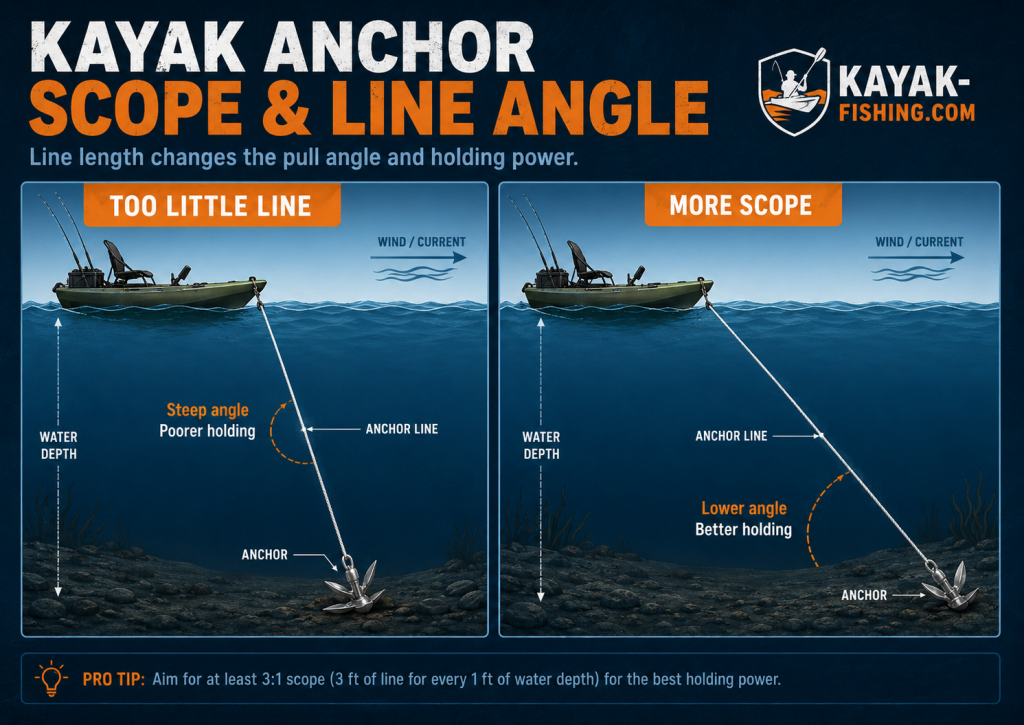
Both YakGear and Newport package 30 feet of line with common kayak anchor kits. YakGear recommends roughly three times the water depth in calm conditions and four to five times the depth in choppy or windy conditions for its grapnel and Bruce products.
That means a 30-foot kit can be perfectly useful in shallow water but may not provide enough line for deeper water once conditions demand additional scope. More line also means more loose material that must be stored safely.
- Use line that is comfortable to handle rather than extremely thin cord that can bite into wet or cold hands.
- Keep unused line on a reel, spool or in a dedicated bag instead of loose around your feet.
- Do not deploy more line than the area safely allows; more scope also creates a larger swing radius.
- Account for changing tide in saltwater when estimating how much line you may need.
Do You Need an Anchor Trolley?
An anchor trolley is useful because it changes where the anchor load reaches the kayak. Moving the trolley ring toward the bow or stern changes the way the kayak faces relative to wind or current without forcing you to reconnect the anchor line at a different point.
For calm ponds, an anchor trolley may be unnecessary. On windy lakes and protected inshore water, it can make positioning much easier. The YakAttack LeverLoc is the strongest current recommendation here because its line clamp, reflective cord and pulley system are designed as a complete kayak-specific setup.
But a trolley should never create false confidence. YakGear’s own guidance says not to deploy an anchor on a trolley in swift-moving water. If conditions make fast release, capsize recovery or line management questionable, do not anchor simply because the kayak has a trolley installed.
Kayak Anchoring Safety
Anchoring adds line, load and another connection between the kayak and the environment. That makes a clean safety plan more important than squeezing out a little more holding power.
- Wear a properly fitted, U.S. Coast Guard-approved wearable PFD. The U.S. Coast Guard recommends wearing a life jacket while underway, and a kayak is still a recreational vessel.
- Avoid anchoring broadside in current or waves. Side loading can make a kayak much less forgiving.
- Do not deploy an anchor trolley in swift-moving water. YakGear explicitly warns against it.
- Keep a quick-release plan. If your setup uses a releasable connection and float, practice releasing it in benign conditions before assuming you can do it under stress.
- Control loose line. NRS notes that anchoring and gear leashes introduce potentially life-threatening entanglement hazards.
- Keep a suitable cutting tool accessible. Do not bury the only knife under gear where it cannot be reached during a line entanglement.
- Stay out of navigation channels and high-traffic routes. Being anchored reduces your ability to move quickly.
- Be willing to abandon the anchor. A stuck piece of gear is cheaper than a capsize or an unsafe recovery attempt.
If you are still building your core safety kit, start with the best PFDs for kayak fishing and the kayak fishing beginner guide before treating an anchor system as essential equipment.
Common Kayak Anchoring Mistakes
Choosing by weight alone.
An anchor’s shape, bottom type and scope matter. A heavier anchor can still drag if it is poorly matched to the bottom or pulled almost vertically.
Using too little line.
If an anchor that should match the bottom will not set, insufficient scope may be the problem.
Using a grapnel in severe snag country without accepting the recovery risk.
The same tines that catch structure can become difficult to free from structure.
Letting rope collect around the cockpit.
Loose line creates tangles around feet, rods, pedals and other gear. Line management is part of the anchoring system, not an optional extra.
Treating a trolley as permission to anchor anywhere.
A trolley improves positioning where anchoring is already appropriate. It does not make swift current safe.
Overlooking the return trip.
An anchor can make fishing comfortable enough that wind, tide or current changes go unnoticed. Conditions at retrieval may be very different from conditions at deployment.
Which Kayak Anchor Setup Should You Buy?
Choose the Newport Vessels 3.5 lb Grapnel Kit if you primarily fish lakes and want the simplest complete all-around setup.
Choose the YakGear 1.5 lb Grapnel Kit if you fish calm, sheltered water from a smaller kayak and value low weight and compact storage.
Choose the YakGear Bruce Anchor if sand, silt and mud are your normal bottom types and you do not need the compact storage of a folding anchor.
Choose the YakAttack ParkNPole Link if shallow flats and marshes make up a large share of your fishing and a stake-out pole can replace a rope-and-anchor system much of the time.
Add the YakAttack LeverLoc trolley when fore-and-aft anchor positioning will materially improve how your kayak sits in manageable wind or current. Do not add it because you want to anchor in conditions that are otherwise unsafe.
Kayak Anchor FAQs
What is the best anchor for kayak fishing?
For general lake fishing, a compact folding grapnel kit is a practical starting point. For sand, silt and mud, a Bruce-style anchor is better matched to the bottom. In shallow flats or marshes, a stake-out pole may be simpler than a conventional anchor.
How heavy should a kayak anchor be?
There is no single correct weight because anchor design, bottom type, kayak size, wind, current and scope all matter. Common kayak products range from about 1.5 pounds for light grapnel kits to roughly 3.5 pounds for more substantial general-purpose grapnel kits. Choose for the conditions rather than buying the heaviest anchor you can carry.
How much anchor line should I use on a kayak?
YakGear recommends about three times the water depth in calm conditions and four to five times the depth in choppy or windy conditions for its grapnel and Bruce anchors. Always account for local conditions, available swing room and changing tide.
Do I need an anchor trolley for kayak fishing?
Not always. A trolley is most useful when you need to move the anchor point toward the bow or stern to control kayak angle. It can be valuable on windy lakes and protected inshore water, but YakGear advises against deploying an anchor on a trolley in swift-moving water.
What is the best kayak anchor for river fishing?
There is no universal river-anchor recommendation because current changes the safety risk. In slow, predictable water, experienced paddlers may use specialized systems. In swift water, avoid treating a fixed anchor or trolley as a default solution; drifting, eddying out or choosing slower protected water may be safer.
Should a kayak be anchored from the bow or stern?
When anchoring is appropriate, positioning the load near the bow or stern generally keeps the kayak aligned more predictably than loading it broadside. An anchor trolley can move the effective anchor point fore or aft, but it should not be used in swift-moving water.
Build the rest of your kayak-fishing setup:
Final Recommendation
For most lake anglers who want one conventional anchor system, the Newport Vessels 3.5 lb Folding Grapnel Kit is the most straightforward starting point because it packages the anchor, rope, buoy and storage together. If your normal bottom is sand or mud, the YakGear Bruce Anchor is the better design match. If you mostly fish shallow flats, the YakAttack ParkNPole Link can eliminate the need to deploy a conventional anchor much of the time.
The bigger buying lesson is that the best kayak anchor is the one that matches the bottom and conditions without creating more risk than it solves. On moving water especially, boat control and a conservative decision about whether to anchor at all matter more than owning the strongest anchor in the catalog.