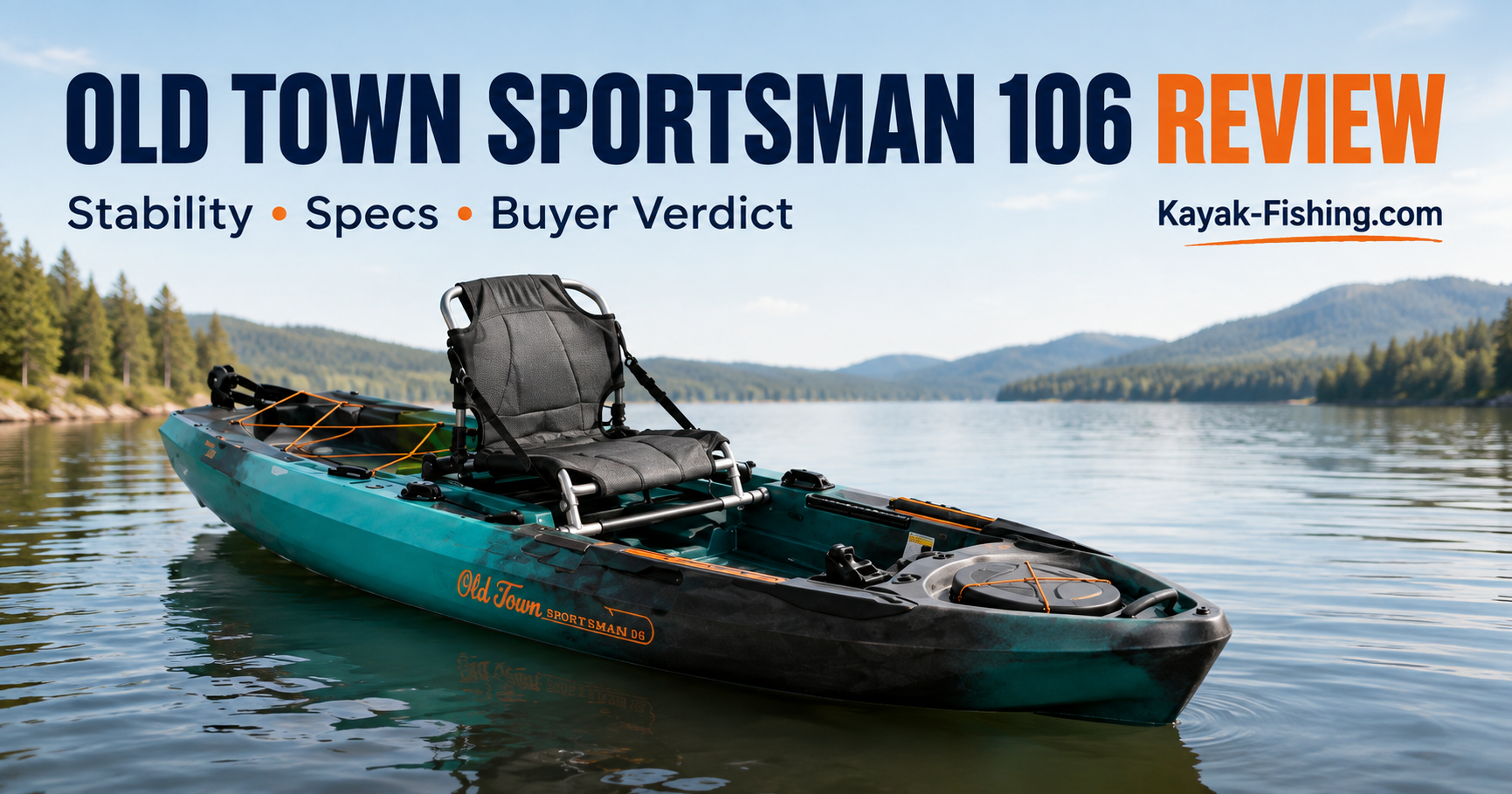
Old Town Sportsman 106 Review: Specs, Stability & Verdict
The Old Town Sportsman 106 is a compact paddle fishing kayak built around a simple trade-off: prioritize stability, fishing space, and usable capacity in a 10’6″ hull, even if that means giving up some speed and easy lifting.
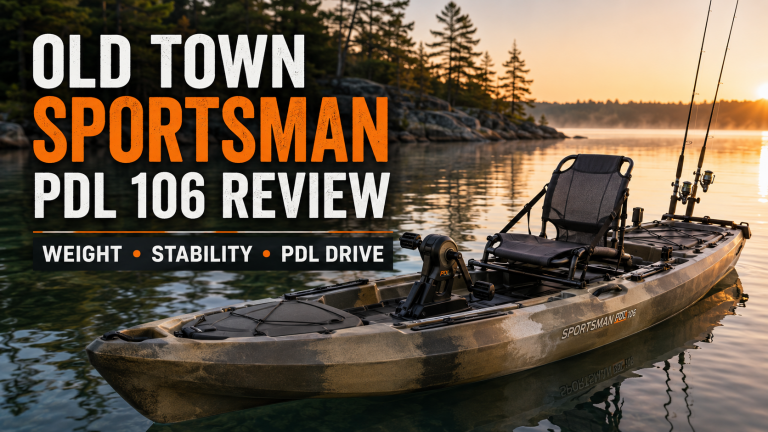
This Old Town Sportsman 106 review looks at the current paddle-powered model: its specifications, stability, paddling characteristics, fishing layout, transport requirements, owner-feedback patterns, and how it compares with the Sportsman 120, PDL 106, and motorized Sportsman 106 Powered by Minn Kota.
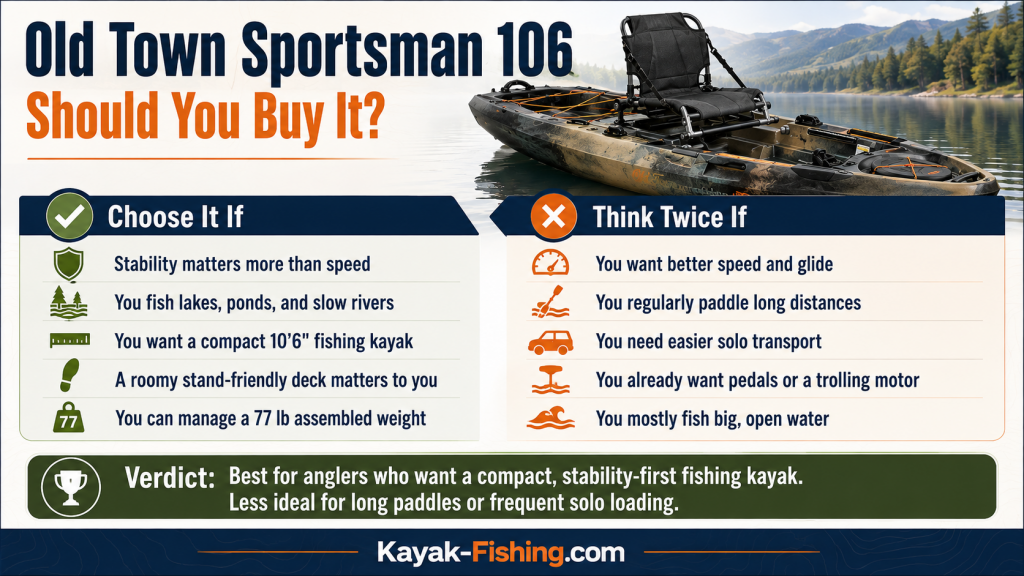
Our verdict: the Sportsman 106 makes the most sense for anglers who want a stable, fishing-specific sit-on-top for lakes, protected water, and slower rivers without moving up to a 12-foot kayak. Its biggest compromises are a substantial 77-pound assembled weight and a short, wide hull that prioritizes stability over long-distance paddling efficiency.
Research note: Kayak-Fishing.com has not personally tested or owned the Old Town Sportsman 106. This review is based on current manufacturer specifications and documentation, retailer information, recurring owner feedback, and our analysis of what those details mean for kayak anglers.
Affiliate disclosure: Kayak-Fishing.com may earn a commission from qualifying purchases through some links on this page at no extra cost to you.
PADDLE-POWERED SPORTSMAN 106
Looking for the kayak reviewed on this page? Make sure the listing says Sportsman 106 with paddle propulsion—not the PDL or Minn Kota model.
Exact paddle model at Eco Fishing Shop
Jump to:
Quick Take: Is the Old Town Sportsman 106 Right for You?
The Sportsman 106 is strongest when you want stand-up stability and a serious fishing layout in a compact paddle kayak.
Best fit for:
- Small and midsize lakes
- Ponds and protected backwaters
- Slow rivers and mild current
- Protected bays and marshes in reasonable conditions
- Anglers who value stability more than speed
- People who need a shorter kayak for storage or transport
- Heavier anglers who need more capacity than many entry-level 10-foot fishing kayaks provide
Think twice if:
- You routinely paddle several miles between fishing spots
- You frequently cross exposed, wind-prone water
- You need a genuinely lightweight kayak for solo roof loading
- You already know you want pedal or electric propulsion
- You regularly fish technical, fast-moving rivers where quick acceleration and maneuverability are priorities
The important question is not whether the Sportsman 106 is a capable fishing kayak. It clearly has the capacity, layout, stability-focused hull, and rigging features for that job. The question is whether its particular compromises match your fishing.
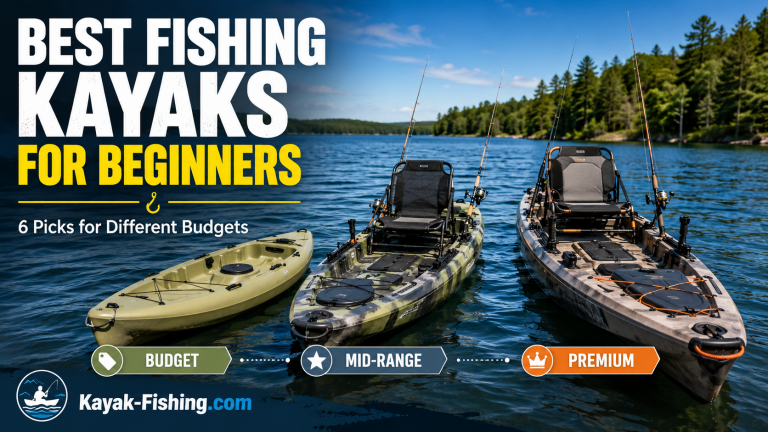
Buying your first fishing kayak? See our Best Fishing Kayaks for Beginners guide to compare the Sportsman 106 with lighter and lower-cost alternatives before deciding whether its extra weight and more complete fishing layout are worth it.
Old Town Sportsman 106 Specs
This page covers the paddle-powered Old Town Sportsman 106. It should not be confused with the Sportsman PDL 106 pedal kayak or the Sportsman 106 Powered by Minn Kota.
| Length | 10′ 6″ |
| Width | 34.5″ |
| Assembled boat weight | 77 lb |
| Removable seat weight | 6 lb |
| Usable capacity | 363 lb for paddler, gear and pets |
| Total capacity | 440 lb including the assembled kayak |
| Propulsion | Paddle |
| Style | Sit-on-top |
| Material | Single-layer polyethylene |
| Rudder | None |
| Seat | Element Seating System |
| Accessory tracks | Two 18″ tracks |
| Rod holders | Three included |
| Hatch | Bow |
| Fish finder setup | Universal transducer mounting system |
Why the capacity numbers can be confusing: Old Town currently lists both a 440-pound total capacity and a 363-pound usable capacity. The usable number is the more helpful one when deciding how much paddler and gear weight you can bring because the total-capacity figure includes the assembled kayak itself.
You may see some retailer pages showing slightly different weight and capacity figures. For consistency, this review uses the current specifications published by Old Town.
Beyond the raw dimensions, the Sportsman 106 includes several features that make it substantially more fishing-specific than a basic recreational sit-on-top: a large open cockpit, EVA deck pads, an oversized rear tankwell, sealed bow hatch, adjustable foot braces, accessory tracks, three flush-mounted rod holders, and an integrated transducer mounting system.
Want to compare the exact paddle model with the specs above?
What Owners Commonly Say About the Sportsman 106
Manufacturer specifications tell you what a kayak is built to do. Owner reports are useful for identifying where those design choices become noticeable in everyday use.
Across the owner discussions and retailer feedback reviewed for this update, several themes repeat:
- Stability is the most consistent positive. Owners frequently describe the hull as confidence-inspiring and suitable for standing once the paddler is comfortable.
- The deck feels roomy for a 10’6″ kayak. Storage, rod staging, and the open standing area receive repeated praise.
- The seat is generally regarded as a strength. The elevated frame-style position is a meaningful upgrade from basic molded kayak seating.
- Weight is the most obvious everyday drawback. Even without a pedal drive or motor, moving and roof-loading a 77-pound fishing kayak can be inconvenient.
- Paddling performance is viewed through the lens of stability. Owners generally buy this kayak for fishing confidence and space, not because they expect touring-kayak speed.
Those patterns line up with the design itself: the Sportsman 106 is short, relatively wide, and built around Old Town’s pontoon-style DoubleU hull. Stability is not a bonus feature here; it is one of the main reasons to choose the boat.
Old Town Sportsman 106 Stability: Can You Stand in It?
Old Town Sportsman 106 stability is arguably the kayak’s main selling point.
Old Town uses what it calls a DoubleU hull, a pontoon-style hull intended to provide a stable stand-up fishing platform. The 34.5-inch width, open cockpit, and EVA-covered deck reinforce that purpose.
The design should particularly appeal to anglers who want to turn around for gear, reach into the tankwell, make casts from a higher position, or eventually stand to fish without choosing an extremely long kayak.
That does not make the Sportsman 106 impossible to capsize. Standing comfort depends on paddler size, balance, gear placement, wind, wakes, current, and experience. A wide fishing kayak can give you more margin for error, but it cannot eliminate the consequences of poor balance or bad conditions.
Is the Sportsman 106 stable for a 250-pound angler?
From a capacity standpoint, a 250-pound paddler fits within the current 363-pound usable-capacity rating. That leaves approximately 113 pounds for tackle, electronics, safety equipment, food, water, and other gear.
Capacity and stability are not identical, though. Heavier anglers should consider their complete fishing load rather than body weight alone. Staying comfortably below maximum capacity also gives you more margin for gear and changing water conditions.
If standing is important to you, the best approach is to learn the kayak’s limits in warm, shallow, protected water while wearing a properly fitted PFD. Practice standing, sitting, leaning, and re-entry before making those movements while distracted by fishing.
Paddling Performance: Speed, Tracking and Wind
A 10’6″, 34.5-inch-wide fishing kayak with a stability-focused pontoon hull is not designed around maximum speed. That is the central trade-off to understand before buying the Sportsman 106.
For fishing relatively close to the launch—working shorelines, moving between nearby points, crossing a cove, or drifting a slow river—the compact hull makes sense. If your normal trip involves repeatedly covering long distances, the same width and short waterline that help the kayak feel stable become less attractive.
How hard is the Old Town Sportsman 106 to paddle?
There is no useful universal effort rating because paddler size, technique, load, paddle length, wind, and current all matter. The better way to frame it is that the Sportsman 106 prioritizes fishing stability and compact maneuverability ahead of paddling efficiency.
That is not necessarily a flaw. A kayak that spends most of its life fishing within a mile or two of the ramp has different priorities than one used for long crossings.
What is the Sportsman 106 top speed?
Old Town does not publish an official top speed for the paddle Sportsman 106, and we would not trust a single number as a universal answer. Maximum paddle speed changes dramatically with paddler strength, technique, load, paddle choice, current, and wind.
If outright speed is one of your top buying criteria, the more useful conclusion is that the Sportsman 106 probably should not be your first choice. Its design priorities lie elsewhere.
How does it handle wind?
Wind deserves respect in any fishing kayak, particularly a wide sit-on-top carrying an elevated seat, rods, crate, and other gear. A compact stability-oriented kayak gives the wind plenty to work with compared with a low, narrow touring hull.
Check the forecast before launching, understand which direction you will need to paddle on the return trip, and do not use the kayak’s stability as a reason to stay out when conditions exceed your ability.
Fishability and Storage Layout
The Sportsman 106 fits a substantial amount of fishing-specific organization into a compact hull.
Accessory tracks: Two 18-inch tracks give you mounting space for compatible rod holders, electronics, cameras, lights, or other accessories without immediately drilling into the kayak.
Rod storage: Old Town includes one forward-facing and two rear-facing flush-mounted rod holders. That gives you useful rod management before adding a crate or aftermarket track-mounted holders.
Standing area: The open cockpit and EVA foam deck pads create an uncluttered place for your feet while providing traction and helping dampen deck noise.
Rear tankwell: The oversized stern storage area is the natural place for a fishing crate, dry bag, small cooler, or a properly secured kayak cart once you’re on the water.
Bow storage: A sealed bow hatch provides enclosed storage and access inside the hull for rigging.
Electronics: Old Town includes a universal transducer mounting system intended to simplify fish-finder installation.
Sportsman 106 storage ideas
A compact kayak usually fishes better when you resist the urge to fill every available mounting point. A practical setup might include two or three rods, one tackle crate or bag, a net, safety equipment, an anchor system where appropriate, and a small fish finder if you use one.
Keeping the standing area and your paddle path clear usually matters more than adding another accessory. Line snagging and clutter become increasingly irritating as available deck space shrinks.
If you fish water where anchoring makes sense, see our kayak anchor guide for lakes, rivers and inshore fishing.
Can you camp out of a Sportsman 106?
Its bow hatch, rear tankwell, and 363-pound usable capacity make light overnight gear possible for some paddlers, but this is still a compact 10’6″ fishing kayak rather than a touring or expedition boat. Calculate the combined weight of your body, fishing gear, food, water, camping equipment, and safety gear before treating the capacity figure as unused cargo space.
Seat and Comfort
The Sportsman 106 uses Old Town’s Element Seating System. The removable frame-style seat has high and low positioning and uses breathable materials rather than a basic molded seat pan.
Adjustable foot braces move along rails so paddlers can set a useful leg position for both comfort and paddling.
Owner discussions we reviewed generally treat the elevated seating position as one of the Sportsman’s strengths. That said, comfort over several hours is highly individual. Hip mobility, leg length, back support preferences, and the distance from the seat to the foot braces all matter.
If you can sit in one at a dealer before buying, do it. Make sure you can comfortably reach the foot braces, paddle without striking the gunwales, stand if that matters to you, and access your most-used gear without awkward twisting.
Transport, Storage and Durability: Living With 77 Pounds
The Sportsman 106 is compact, but it is not especially light.
Old Town lists the assembled kayak at 77 pounds, including a removable seat that weighs 6 pounds. Taking the seat out before loading helps, but you still have a large polyethylene hull to move.
That makes transportation part of the purchasing decision rather than something to figure out later.
- Truck bed: Often the simplest option if your vehicle and local transport rules allow it.
- Trailer: Adds equipment and storage requirements but greatly reduces lifting.
- Roof rack: Completely possible for the right person and vehicle, but repeatedly lifting a wide 70-plus-pound hull onto a tall SUV can become the least enjoyable part of owning it.
- Kayak cart: Very useful when the launch is farther from the vehicle—but cart design matters.
What kayak cart should you use with the Sportsman 106?
Do not assume a scupper-style cart is the right answer. Old Town specifically says it does not recommend scupper carts because of potential hull damage and wear around the scuppers. The company recommends cradle-, bunk-, or strap-style carts that distribute the kayak’s weight over a larger area.
That is particularly important on a 77-pound fishing kayak that may be considerably heavier once you add gear.
How should you store a Sportsman 106?
Old Town recommends storing its kayaks deck-side down on padded supports positioned roughly 30% of the kayak’s length from each end. The company also advises protecting the kayak from unnecessary UV exposure and avoiding a tarp laid directly over the boat outdoors, where trapped heat can contribute to hull distortion.
Whatever storage system you choose, the goal is to support the hull broadly instead of concentrating its weight on a narrow bar or small pressure point for months at a time.
Are Old Town Sportsman kayaks durable?
The Sportsman 106 uses single-layer polyethylene, and Old Town backs its kayak hulls with a limited lifetime hull warranty. That does not make the kayak indestructible.
Normal scratches and cosmetic wear are different from deep gouges, scupper damage, concentrated storage pressure, heat deformation, or damage caused by accessories. Treat it like a durable fishing tool—not something that can be abused without consequence.
Old Town Sportsman 106 Pros and Cons
Where it stands out:
- Stability-focused DoubleU hull
- 363-pound usable capacity
- Compact 10’6″ overall length
- Open fishing-focused cockpit
- High/low Element seating system
- Two 18-inch accessory tracks
- Three built-in rod holders
- Large rear tankwell for its length
- Bow hatch with hull access
- Universal transducer mounting system
- EVA standing-area deck pads
Where the compromises show:
- 77-pound assembled weight is substantial for solo transport
- Short, wide stability-focused hull is not optimized for maximum speed
- No hands-free propulsion
- No rudder on the paddle model
- Long-distance and big-water anglers may prefer more length and efficiency
- Buyers already planning an electric motor should compare the purpose-built Minn Kota version before heavily modifying the paddle model
Old Town Sportsman 106 vs Other Popular Options
Old Town Sportsman 106 vs 120
| Sportsman 106 | Sportsman 120 | |
|---|---|---|
| Length | 10’6″ | 12′ |
| Width | 34.5″ | 33.5″ |
| Assembled weight | 77 lb | 85 lb |
| Usable capacity | 363 lb | 415 lb |
| Rudder | None | Compatible |
| Main advantage | Compact size | More capacity and longer waterline |
The Sportsman 106 saves 18 inches of length and about 8 pounds of assembled weight. That difference can matter in a garage, short truck bed, tight launch, or vehicle-loading routine.
The Sportsman 120 adds 52 pounds of usable capacity while being one inch narrower and 18 inches longer. From a hull-design standpoint, the additional waterline favors the 120 when covering distance and holding a line become more important.
Choose the 106 if storage, maneuverability, and keeping overall size down matter most.
Choose the 120 if you regularly carry a heavier load or spend more time covering open water between fishing spots.
For a closer look at the larger paddle model, read our Old Town Sportsman 120 review. It covers the 120’s 85-pound transport burden, 415-pound usable capacity, stability, tracking, and whether the extra size is worth it.
Which is easier to paddle: Sportsman 106 or 120?
The 120’s longer, slightly narrower hull gives it the better basic dimensions for paddling efficiency and tracking. The 106’s advantage is that its shorter hull is easier to maneuver and easier to fit into limited storage and transport situations.
Sportsman 106 Paddle vs PDL 106 vs Minn Kota 106
The word “106” appears on three substantially different Old Town fishing kayaks. Do not shop by the number alone.
| Model | Propulsion | Width | Assembled Weight |
|---|---|---|---|
| Sportsman 106 | Paddle | 34.5″ | 77 lb |
| Sportsman PDL 106 | Pedal | 36″ | 107 lb |
| Sportsman 106 Powered by Minn Kota | 12V electric motor | 37″ | 121 lb before battery |
The paddle 106 is the simplest and lightest of the three. It makes sense for anglers who prefer a conventional paddle kayak, want to minimize complexity, or often launch in very shallow or unimproved areas.
The PDL 106 adds Old Town’s pedal drive with instant forward and reverse, along with a rudder. The trade-off is a jump to 107 pounds assembled.
The Sportsman 106 Powered by Minn Kota goes substantially further. It uses a 45-pound-thrust, 12V Minn Kota motor with throttle control and foot-steered rudder control. The assembled kayak weighs 121 pounds before adding the required battery.
If you already know that electric propulsion is part of the plan, the purpose-built Minn Kota model deserves serious consideration before buying the paddle 106 and then adding aftermarket motor mounts, steering, wiring, and controls.
Want the motorized Sportsman 106 instead?
This Amazon listing is for the Sportsman 106 Powered by Minn Kota, not the paddle kayak reviewed on this page.
Amazon affiliate link
Sportsman 106 vs Similar-Sized Fishing Kayaks
When comparing the Sportsman 106 with other compact fishing kayaks, do not focus on length alone. Compare at least four numbers:
- Hull or assembled weight
- Usable or working capacity
- Overall width
- Overall length
Then consider propulsion, seat design, storage layout, electronics mounting, and—most importantly—how far you typically travel from the launch.
A lighter or narrower competing kayak may be easier to move and paddle. A wider kayak may give you more confidence standing. There is no universal winner without knowing which compromise matters least to you.
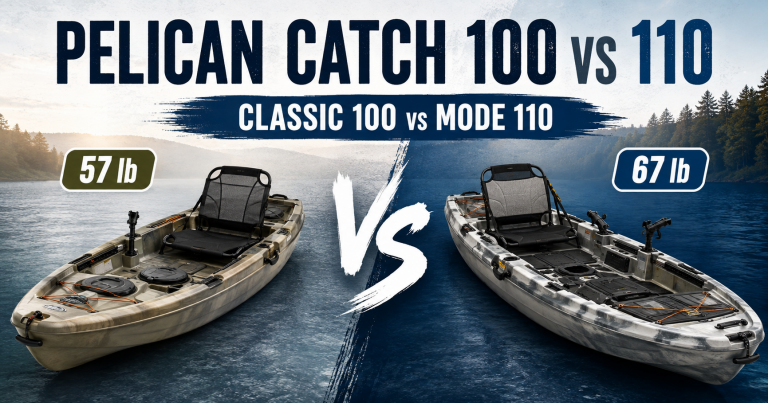
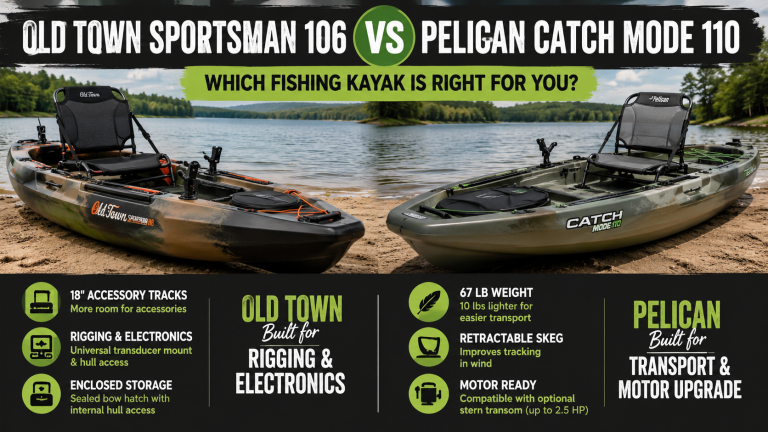
If the Pelican Catch Mode 110 is also on your shortlist, see our Old Town Sportsman 106 vs Pelican Catch Mode 110 comparison for a direct look at weight, stability, rigging, storage, tracking, motor options, and value.
Who Should Buy the Old Town Sportsman 106?
Buy the Sportsman 106 if:
- Your usual fishing water is a lake, pond, protected bay, marsh, or slower river
- You value stability and stand-up capability
- You want a fishing-specific deck without moving to a 12- or 13-foot kayak
- Your total paddler-and-gear load fits comfortably within the 363-pound usable capacity
- You have a realistic plan for transporting and loading a 77-pound kayak
- You prefer paddle propulsion for its simplicity
Compare alternatives if:
- Your normal fishing day involves long open-water paddles
- You commonly encounter strong wind or fast current
- Solo roof loading 70-plus pounds is impractical for you
- You want hands-free propulsion from day one
- You need more than 363 pounds of usable paddler-and-gear capacity
- You primarily fish technical moving water that rewards quick acceleration and maneuverability
For the right angler, the 106’s compromises make sense because they are the direct result of the features that make it appealing: a short footprint, wide hull, high capacity, and stable fishing platform.
Does that sound like the way you fish?
Check the delivered price, current colors, availability, and return terms for the paddle-powered Sportsman 106.
Buying a Used Sportsman 106 and Setting It Up
If you’re considering a used Old Town Sportsman 106, separate normal cosmetic wear from damage that could affect the boat.
Inspect:
- The keel and bottom for unusually deep gouges or impact damage
- The hull for obvious deformation
- Scupper areas for cracking or excessive wear
- The seat frame, fabric, hardware, and adjustment points
- The bow hatch and seal
- Accessory tracks and mounting hardware
- Rod holders
- Carry handles and transport attachment points
- The transducer-mount area if electronics have previously been installed
For your first setup, resist the temptation to fill every accessory track immediately.
- Properly fitted PFD
- Correctly sized paddle
- Two or three rods
- Basic tackle storage
- Whistle and other locally required safety equipment
- Pliers and cutting tool secured within reach
- Anchor system only if appropriate for the water you fish
- Fish finder only if it adds useful information to your normal fishing
Our kayak fishing beginner guide covers first-trip planning, safety, basic setup, and launch preparation in more detail.
Old Town Sportsman 106 FAQs
How much does the Old Town Sportsman 106 weigh?
Old Town currently lists the paddle-powered Sportsman 106 at 77 pounds assembled. The removable Element seat weighs 6 pounds.
What is the Old Town Sportsman 106 weight capacity?
The current manufacturer specifications list a 440-pound total capacity and a 363-pound usable capacity. Use the 363-pound number when calculating how much paddler and gear weight the kayak can carry because the total figure includes the assembled kayak.
Can you stand in an Old Town Sportsman 106?
Yes, the Sportsman 106 is specifically designed around stand-up fishing stability. It uses Old Town’s DoubleU hull and has an EVA-covered standing area. Whether an individual paddler is comfortable standing depends on body size, balance, load distribution, and water conditions.
What paddle length is best for an Old Town Sportsman 106?
There is no single correct paddle length for every Sportsman 106 owner. Old Town recommends selecting a kayak paddle based on paddler height or torso length, boat width, and paddling style.
Because the Sportsman 106 is 34.5 inches wide and uses an elevated fishing seat, many paddlers will prefer a longer paddle than they would use with a narrow recreational or touring kayak. Use a paddle-sizing chart or get fitted at a paddle shop rather than choosing solely by kayak length.
Is the Sportsman 106 or 120 easier to paddle?
The Sportsman 120’s longer, slightly narrower hull gives it the advantage when paddling efficiency and tracking matter. The Sportsman 106 is shorter, lighter, and easier to maneuver and store.
Can you put a trolling motor on the Old Town Sportsman 106?
Aftermarket motor setups exist for fishing kayaks, but anyone who already knows electric propulsion is important should first compare the purpose-built Sportsman 106 Powered by Minn Kota. A motor conversion introduces a mount, battery, wiring, steering or control decisions, extra weight, and potentially registration requirements depending on where you operate the kayak.
Is the Sportsman 106 good for rivers?
It makes the most sense on slower rivers where fishing stability and deck space matter more than rapid acceleration and technical maneuvering. A specialized river kayak may be a better choice for fast, obstacle-heavy current.
How durable is the Old Town Sportsman 106?
The Sportsman 106 is made from single-layer polyethylene, and Old Town backs its kayak hulls with a limited lifetime hull warranty. It should still be transported and stored correctly. Avoid concentrated pressure, excessive heat, damaging accessories, and unnecessary abuse simply because the hull is polyethylene.
Can you use a scupper cart with the Sportsman 106?
Old Town does not recommend scupper-style kayak carts because they can create hull damage and wear around the scupper holes. Use a cradle-, bunk-, or strap-style cart that supports the hull instead.
Why does my Sportsman 106 measure less than 34.5 inches wide?
Old Town lists 34.5 inches as the kayak’s maximum overall width. A measurement taken elsewhere along the hull can be narrower because the kayak does not remain at maximum beam from bow to stern. Measure across the widest part of the hull when comparing your kayak with the published specification.
How much water should come through the scuppers?
There is no fixed amount that applies to every Sportsman 106. How wet the cockpit becomes depends on total load, weight distribution, water conditions, and whether scupper valves or plugs are being used. Some water around the scuppers can be normal on a sit-on-top kayak. Unexpectedly high water levels deserve further inspection rather than assuming a specific amount is normal.
Is the Old Town Sportsman 106 available with a trolling motor?
Yes, but it is a separate model called the Old Town Sportsman 106 Powered by Minn Kota. It has integrated 12V electric propulsion, foot-controlled steering, a 37-inch width, and substantially more assembled weight than the paddle Sportsman 106.
Final Verdict
The Old Town Sportsman 106 is easiest to understand when you stop asking whether it is the “best” fishing kayak and instead ask what it is optimized to do.
It is a compact, stability-first paddle fishing kayak with a legitimate fishing layout, substantial usable capacity, frame-style seating, accessory tracks, built-in rod storage, and electronics-friendly rigging.
Its compromises are equally clear. At 77 pounds assembled, it is not a lightweight kayak just because it is only 10’6″ long. And a short, 34.5-inch-wide pontoon-style hull is fundamentally aimed more at stability than maximum paddling efficiency.
If your normal fishing day means staying relatively close to the launch on lakes, ponds, protected bays, marshes, or slower rivers—and you care more about stability and fishing space than speed—the Sportsman 106 deserves a place near the top of your shortlist.
If you regularly cover more water, compare the Sportsman 120. If hands-free propulsion is already high on your priority list, compare the PDL 106 before buying the paddle model. And if you already know you want electric power, compare the factory-built Sportsman 106 Powered by Minn Kota before planning an aftermarket motor conversion.
Ready to compare current availability?
The link below goes to the paddle-powered Sportsman 106 reviewed on this page.
Primary research sources: Old Town Sportsman 106 specifications and Old Town support and care guidance. Retailer specifications can occasionally lag current manufacturer data, so manufacturer specifications are given priority in this review.