Pelican Catch Review: Which Model to Buy?
Shopping for a Pelican Catch kayak can get confusing fast. You start by looking for one boat, then suddenly you are comparing the Catch Classic 100, Catch Classic 120, Catch Mode 110, Catch Mode 110 TR, Catch PWR 100, Catch 110HDII, and Catch Kicker 110 HDII.
This Pelican Catch review looks at the lineup as a whole, not just one model. The goal is simple: help you figure out which Catch makes sense for your fishing, your water, your truck or garage situation, and your budget.
Pelican’s current Catch lineup spans paddle, pedal, and motor-compatible fishing kayaks. The useful differences are practical: stability, seat design, transport weight, capacity, propulsion, storage, and whether the layout fits the water you actually fish.
Disclosure: This article may contain affiliate links. If you buy through these links, Kayak-Fishing.com may earn a commission at no extra cost to you.
Comparison basis: dimensions, weights, capacities, seating systems, propulsion, and feature lists were checked against current Pelican/Confluence Outdoor product documentation. Retailer bundles and older model years can differ, so verify the exact model and SKU before buying.
Quick Verdict: Is the Pelican Catch Worth It?
Yes, a Pelican Catch can be worth considering if you fish calm lakes, ponds, slow rivers, protected bays, or quiet inshore water and want a stable fishing-focused layout. The right model depends heavily on whether you want paddle simplicity, pedal control, or motor compatibility.
It is not the right lineup for every angler. If you regularly paddle long distances, fish rough offshore water, deal with strong current, or prioritize speed and efficiency over deck stability, compare other designs before buying. For calm-water anglers who value a stable sit-on-top layout, the Catch family has several distinct options. If you are still learning the basics, start with this kayak fishing for beginners guide before loading the boat with extra gear.
| Best For | Calm-water anglers who want stability, comfort, and fishing features without premium pricing |
| Not Best For | Offshore fishing, long-distance paddling, heavy current, or speed-focused paddlers |
| Main Strength | Stable fishing platforms with useful layouts |
| Main Weakness | Wide hulls give up speed and can catch wind |
| Best Water Type | Ponds, lakes, slow rivers, protected bays, calm inshore water |
| Best Skill Level | Beginner to intermediate |
| Overall Value | Depends on model; compare propulsion, transport weight, capacity, and current price |
Pelican Catch Models Explained
Pelican has sold several Catch-branded fishing kayaks over time, and model names can vary by retailer, year, country, and listing. Some older listings may use names like Catch 100 or Catch 120, while current pages use names such as Catch Classic 100 and Catch Classic 120. The plain “Pelican Catch 110” name is especially tricky because listings may refer to a Catch Mode 110, Catch 110HDII, or an older variant. Pelican’s current Catch collection also includes the motor-ready Catch PWR 100.
Before buying, confirm the exact model name, product code, year, length, weight, capacity, drive type, and included seat. This matters even more if you are buying used or looking at a retailer closeout.
| Model | Length | Width | Weight | Capacity | Drive Type | Best Use | Best Buyer |
|---|---|---|---|---|---|---|---|
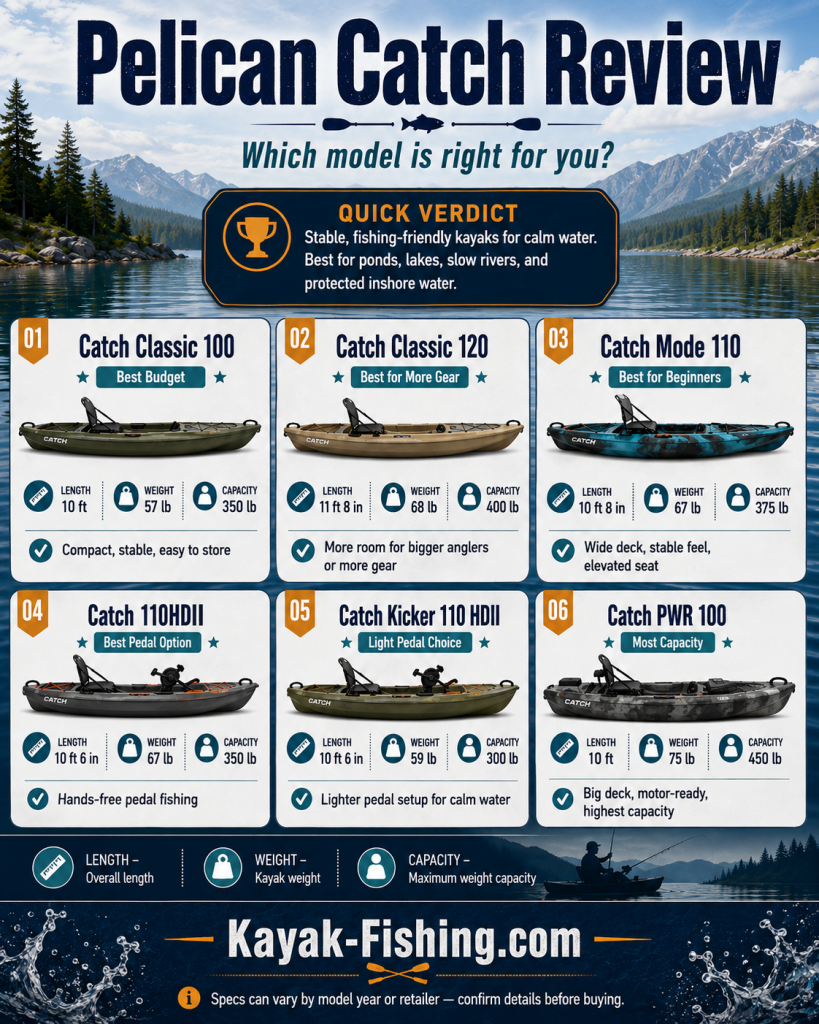
| Pelican Catch Classic 100 | 120 in / 10 ft | 34 in | 57 lb | 350 lb | Paddle | Small lakes, ponds, simple bass and panfish trips | Budget-minded anglers who want a shorter, easier-to-store fishing kayak |
| Pelican Catch Classic 120 | 140 in / 11 ft 8 in | 34 in | 68 lb | 400 lb | Paddle | More gear, longer calm-water trips, standing and casting | Anglers who want more capacity and a longer paddle platform |
| Pelican Catch Mode 110 | 128 in / 10 ft 8 in | 34.5 in | 67 lb | 375 lb | Paddle; compatible with Pelican’s optional stern transom system | Stable pond, lake, and slow-water fishing | Beginners who want a wide deck and elevated seating |
| Pelican Catch Mode 110 TR | 128 in / 10 ft 8 in | 34.5 in | 67 lb | 375 lb | Paddle; included stern transom rated to 2.5 hp | Calm water where a small motor setup may be useful | Anglers who want a paddle kayak with an included motor transom |
| Pelican Catch PWR 100 | 117 in / 9 ft 9 in | 39.63 in | 75 lb | 450 lb | Motor-ready / pre-wired; stern transom rated to 2.5 hp | Motor-focused fishing on calm lakes and protected water | Anglers building the kayak around a small electric or gas motor |
| Pelican Catch 110HDII | 126 in / 10 ft 6 in | 34 in | 67 lb | 350 lb | HyDryve II pedal system | Hands-free boat control in calm water and vegetation | Anglers who want a full-featured Catch pedal kayak |
| Pelican Catch Kicker 110 HDII | 125.5 in / about 10 ft 6 in | 33 in | 59 lb | 300 lb | HyDryve II pedal system | Light pedal fishing on calm waterways | Lower-load anglers who prioritize a lighter pedal kayak |
| Pelican Catch 110 | Verify by listing | Verify by listing | Verify by listing | Verify by listing | Verify by listing | Name may refer to Mode 110 or 110HDII depending on seller | Buyers should confirm the exact product before comparing |
Note: Product listings can occasionally contain conflicting details or vary by model year. Before ordering, confirm the exact included drive, seat, weight, capacity, color, product code, and model year with the retailer or manufacturer.
Best Pelican Catch Model by Use Case
| Use Case | Best Model to Consider | Why |
|---|---|---|
| Best budget choice | Catch Classic 100 | Shorter, lighter, simpler, and usually easier to store and transport |
| Best paddle model for more gear | Catch Classic 120 | 400-pound capacity and a longer platform than the Classic 100 |
| Best beginner-friendly deck | Catch Mode 110 | Wide platform, elevated seat, traction pads, and a simple paddle setup |
| Best paddle-first motor-compatible option | Catch Mode 110 TR | Includes a stern transom rated for motors up to 2.5 hp |
| Best dedicated motor-ready option | Catch PWR 100 | Pre-wired battery compartment, pre-installed transom, 450-pound capacity, and a 39.63-inch beam |
| Best full-featured pedal option | Catch 110HDII | HyDryve II pedal system, rudder, gear rails, and 350-pound capacity |
| Best lighter pedal option | Catch Kicker 110 HDII | 59-pound listed weight, with a lower 300-pound capacity |
Which Pelican Catch Model Should You Buy?
The best Pelican fishing kayak is not automatically the biggest or most expensive one. The right choice depends on how you fish and how you move the kayak when you are not fishing.
Best Budget-Friendly Option
For anglers trying to keep the price down, the Catch Classic 100 is usually the first model to compare. It is shorter and lighter than several other Catch models while keeping the 34-inch beam that makes the lineup appealing.
This is the model that makes sense if you fish farm ponds, neighborhood lakes, small reservoirs, or slow creeks where you are not covering miles. The trade-off is glide. Short, wide kayaks are rarely fast, and the Catch Classic 100 is more of a fishing platform than a distance paddler.
Best for Beginners
For a true beginner, compare the Catch Classic 100 and Catch Mode 110 first. The Classic 100 is easier to store and manage. The Mode 110 adds a slightly wider deck, elevated seating, traction pads, and more open standing room.
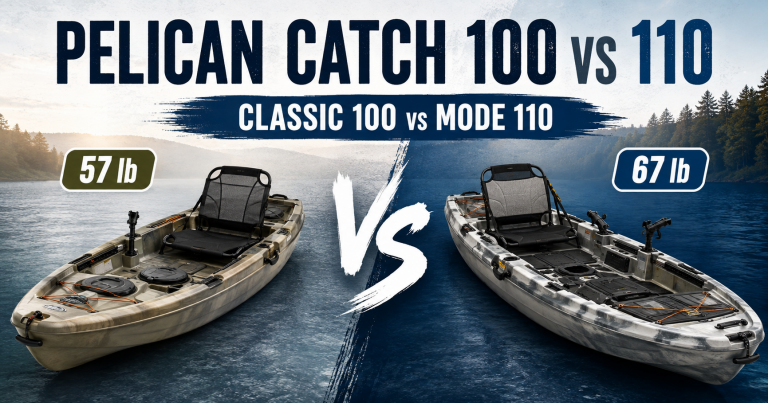
If those are the two models you have narrowed it down to, see our Pelican Catch 100 vs 110 comparison for the full breakdown of weight, transport, stability, seating, storage, capacity, tracking, and motor compatibility.
For short fishing trips, stability and seat comfort may matter more than outright hull speed. Buyers who regularly need to cover longer distances should put more weight on paddling efficiency instead of choosing by deck width alone.
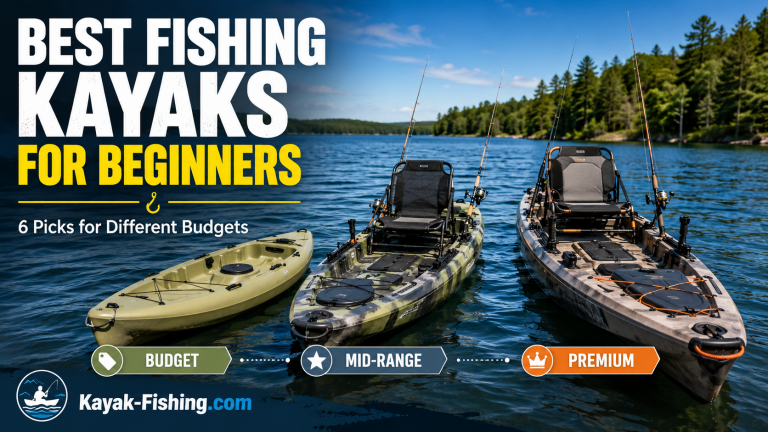
If you are comparing Pelican against Lifetime, Perception, or Old Town, see our Best Fishing Kayaks for Beginners guide for the broader buying decision.
Best for Standing and Casting
The Catch Mode 110, Catch Mode 110 TR, Catch Classic 100, Catch Classic 120, and Catch PWR 100 all use standing-friendly deck designs in Pelican’s current documentation. That does not make standing risk-free: your balance, size, gear load, wind, wake, and water conditions still matter.
Standing in a kayak is not just about width. Wind, boat wake, a half-submerged stump, or a tackle crate that shifts behind your seat can change the feel quickly. Practice in warm, shallow water before trying to sight-cast around docks or grass edges.
Best for Motor Use
The Catch PWR 100 is the dedicated motor-ready model in the current lineup. Pelican lists it with a pre-wired battery compartment, pre-installed stern transom rated to 2.5 hp, a 39.63-inch beam, and a 450-pound capacity. It is also the heaviest model covered here at 75 pounds before adding a motor, battery, and fishing gear.
The Catch Mode 110 TR is the better fit if you still want a paddle-first kayak with an included 2.5 hp-rated transom. The standard Mode 110 can accept Pelican’s optional stern transom system. Motorized kayaks may trigger registration, equipment, or operating requirements, so check the rules that apply where you plan to use the boat.
Best for Pedal-Drive Fishing
If you want pedal power, compare the Catch 110HDII and the Catch Kicker 110 HDII. Both are aimed at anglers who want hands-free control while fishing. Pedals are a big help when you are holding position along a weed edge, working a windy bank, or trying to keep your bow pointed while landing a fish.
The Catch 110HDII has the higher verified capacity of the two. The Kicker is lighter and has a lower verified capacity, so it is better suited to anglers who travel lighter.
Best for Small Ponds and Lakes
For small ponds and lakes, the Catch Classic 100 is hard to ignore. You do not need a long kayak to fish a 20-acre pond with laydowns, bluegill beds, and a few weed patches. A shorter boat turns easily, stores easier, and is usually less annoying to launch from a rough bank.
The Catch Kicker 110 HDII can also make sense on small water if you want pedal control and do not carry much gear. Just remember that a pedal drive adds parts to rinse, store, protect, and inspect.
Best for Bigger Anglers or More Gear
If capacity is the priority, the Catch PWR 100 has the highest current manufacturer rating in this group at 450 pounds, followed by the Catch Classic 120 at 400 pounds. Capacity is not the same as comfort or on-water performance, so also consider deck space, seat fit, transport weight, and the total load of paddler plus gear.
Stability and Standing Room
Primary stability is the steady feeling you notice when the kayak is sitting flat on calm water. Wide fishing kayaks usually feel more confidence-inspiring because they resist that twitchy side-to-side motion that makes new anglers nervous.
The Pelican Catch lineup leans heavily toward primary stability. That is why these kayaks are popular with bass anglers who want to cast from a higher seat, stand occasionally, or reach behind the seat for a rod without feeling like the kayak wants to roll.
Still, no kayak makes standing automatic. A 140-pound angler on a glass-calm pond will have a different experience than a 240-pound angler in boat wake with a loaded crate and a crosswind. If standing matters to you, test the boat carefully and keep your deck clean. Loose pliers, crankbait boxes, and anchor rope underfoot are how people end up swimming. That is one of the common beginner kayak fishing mistakes worth avoiding early.
Seat Comfort
Seat comfort is one of the biggest reasons to buy a real fishing kayak instead of trying to make a basic recreational kayak work. A low, molded seat feels fine for a short paddle. It gets old fast when you are skipping docks, changing lures, and leaning forward to unhook fish all morning.
Pelican uses different seating systems across the Catch lineup, including Ergocast Classic, Ergoboost, Ergocast G2, and the sliding/swiveling Ergo360 system on the PWR 100. The useful differences are seat height, back support, adjustability, under-seat access, and how the seat affects standing room and cockpit space.
Elevated seating can improve visibility, casting position, and ease of standing because your hips start higher. The trade-off is a higher center of gravity, so balance still matters when wind, wake, or awkward reaches introduce side-to-side movement.
Storage and Fishing Layout
A good fishing layout is not just about having a lot of storage. It is about having the right storage where you can actually reach it.
Look closely at the rear tankwell, front hatch or storage area, rod holders, accessory tracks, paddle parks, crate compatibility, and places to keep small tackle boxes. If you fish with one rod, a small tray, and a pair of pliers, you do not need the same layout as someone carrying six rods, a graph, a crate, anchor trolley, camera arm, and a soft cooler.
The Catch Classic 100 keeps the layout relatively simple, while the Classic 120 adds a longer platform and more capacity. The Catch Mode 110 models emphasize open deck space, side tackle storage, traction pads, and rigging tracks. The PWR 100 adds a battery compartment, pre-wiring, a transom, and four flush-mount rod holders. The HDII pedal models use the center cockpit for the drive, so their storage and foot space are arranged differently from the paddle models.
Before drilling or adding permanent accessories, use the kayak with only the basics first. That makes it easier to see where tackle is naturally reached, where the paddle lands during a cast or hookset, and whether a crate or rod holder interferes with movement.
Paddling and Pedaling Performance
Wide fishing kayaks trade speed for stability. That is not a flaw, but it is something to understand before buying. A Pelican Catch is generally more about fishability than covering long distances.
The paddle models are best when your launch is close to the fishing area. Think cove hopping, working a shoreline, fishing around docks, or sliding across a pond to a weed edge. If your normal trip involves paddling two miles into a headwind before you make your first cast, a longer, faster hull may be a better match. For more on boat control, see this guide to kayak fishing in the wind.
Pedal models help when you want boat control while fishing. Being able to move with your feet while holding a rod is a real advantage when slow-rolling a spinnerbait along grass, dragging a Ned rig across a point, or keeping your bow off riprap in a breeze.
Shallow water is where you need to think ahead. Pedal systems are useful, but you still need to protect the drive, watch for stumps, and be ready to paddle or pole through skinny water. In heavy weeds, even a drive designed for vegetation needs attention.
Fishing Use and Boat Control
The Catch lineup is best matched to fishing where stability, deck space, seating, and easy tackle access matter more than outright speed. That includes many bass, panfish, crappie, pickerel, and protected inshore situations.
A wide sit-on-top platform can give an angler more room to turn, reach for fish grips, manage a landing net, or control a fish beside the kayak than a narrow recreational design. The trade-off is the same one seen throughout the Catch lineup: more width and fishing space generally come at the expense of paddling efficiency.
Anchoring and drifting can both help with boat position, but a wide kayak gives the wind plenty to push. An anchor trolley can help control kayak angle in appropriate conditions. If you are still setting up your system, this breakdown of the best kayak anchors for lakes, rivers, and inshore fishing explains the options and safety tradeoffs. On breezy days, short controlled drifts may be more practical than repeatedly correcting a wide kayak with the paddle.
Protected bay use can be reasonable in suitable conditions for anglers who understand tides, wind direction, boat traffic, and launch timing. Rough open water is a different use case, and the Catch lineup is not the first place to look for a dedicated offshore kayak.
Build Quality and Durability
Pelican Catch kayaks are polyethylene sit-on-top fishing kayaks, and several current models are listed with Pelican’s Ram-X material. In plain terms, these are budget-friendly to mid-priced fishing kayaks built to handle normal fishing use, not delicate boats that need white-glove treatment.
That said, durability still depends on how you treat the hull. Dragging over concrete ramps, storing the kayak in direct sun, leaving it strapped tight on a hot trailer, or grinding across oyster shell and riprap will shorten the life of any plastic kayak.
Inspect fittings, hatches, seat hardware, rod holders, gear tracks, scupper areas, and any drive or rudder parts. Budget-friendly kayaks can last for years, but small hardware issues are much easier to fix before they become an on-the-water problem.
Transport and Loading
Transport weight varies meaningfully across the current Catch lineup, from 57 pounds for the Classic 100 to 75 pounds for the PWR 100 before adding a motor, battery, or fishing gear. That difference matters if you car-top alone, carry the kayak down a bank, or have limited garage space.
If you are cartopping alone, think carefully before buying the biggest model. A truck bed makes life easier. A small trailer makes life easier still. A good kayak cart can be the difference between fishing often and leaving the kayak in the garage because the launch is a hassle.
The best Pelican Catch kayak may not be the largest one if you load it solo. A slightly smaller model that is easy to move, store, and launch can be a better long-term choice than a roomier kayak that turns every trip into a loading problem.
Pros and Cons of the Pelican Catch Lineup
Pros
- Stable fishing platforms
- Beginner-friendly feel
- Good value compared with many premium fishing kayaks
- Comfortable elevated seating on many models
- Paddle, pedal, and motor-compatible options in the current lineup
- Good fit for ponds, lakes, slow rivers, and protected water
Cons
- Not the fastest kayak lineup
- Wide hulls can be affected by wind
- Some models feel bulky for solo loading
- Not ideal for rough offshore conditions
- Specs and features can vary by year or listing
- Serious tournament anglers may eventually want more advanced rigging or a premium drive system
Who Should Buy a Pelican Catch Kayak?
A Pelican Catch kayak makes sense for beginner kayak anglers, bass fishermen, pond and small-lake anglers, casual weekend fishermen, and budget-conscious buyers who care more about stability than speed.
It is also a good fit for someone upgrading from a cheap recreational kayak. The difference between balancing a tackle box in your lap and fishing from a sit-on-top with a real seat, rod holders, gear tracks, and a tankwell is huge.
Who Should Not Buy a Pelican Catch Kayak?
You may want something else if you fish offshore, paddle long distances, regularly fight heavy river current, need a very lightweight grab-and-go kayak, or want a tournament-ready platform with premium rigging from day one.
Buyers who prioritize speed should also look elsewhere. The Catch lineup is stable and fishable, but it is not built to feel like a touring kayak.
Pelican Catch vs Other Fishing Kayaks
The most useful comparison is not Pelican versus another brand in the abstract. Compare the exact models that fit the same budget, transport limits, and water.
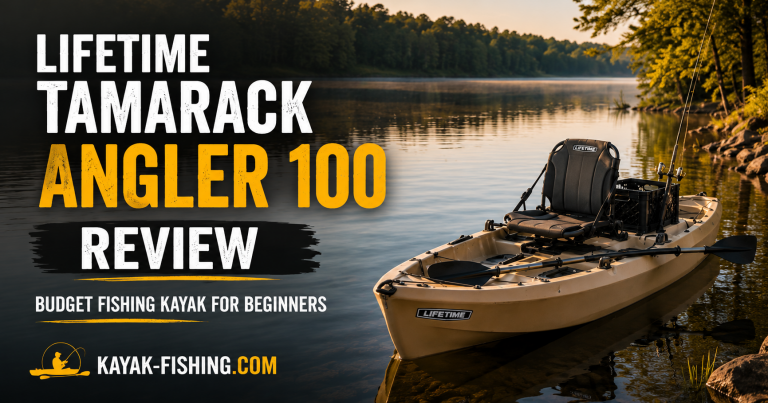
If you are cross-shopping Lifetime, the Tamarack Pro 103 and Tamarack Angler 100 vs Pro 103 comparison show what a lighter, narrower budget fishing kayak can offer. The Catch Classic and Mode models generally give you wider decks, while the Lifetime options can be easier to move and may cost less depending on the retailer.
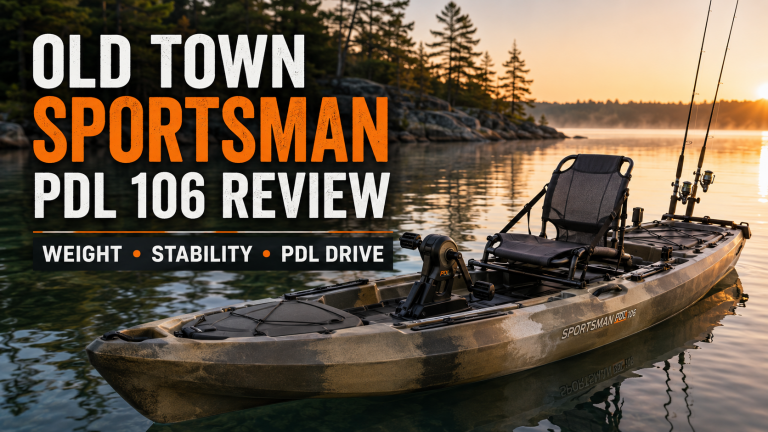
For a step up in price, the Old Town Sportsman 106 review is a useful reference point. If the Catch Mode 110 is the Pelican you’re considering, see our Sportsman 106 vs Pelican Catch Mode 110 comparison for a direct look at weight, rigging, storage, tracking, motor options, and value.
Best Accessories for a Pelican Catch Kayak
- Quality kayak paddle: Even pedal kayak owners need a paddle. Choose the right length for a wide fishing kayak.
- Kayak fishing PFD: Wear one that lets you cast, sit, and reach tackle comfortably. Here are some of the best PFDs for kayak fishing.
- Anchor or anchor trolley: Helpful for holding position on windy banks and suitable calm-water structure. Anchoring in moving current requires extra caution.
- Kayak crate: Keeps tackle, tools, and spare trays organized in the rear tankwell.
- Track-mounted rod holder: Adds a reachable rod position without drilling into the hull.
- Fish grips: Useful for toothy fish, trebles, and quick boat-side control.
- Dry bag: Protects keys, phone, wallet, spare clothing, and emergency items.
- Kayak cart: Especially useful if your launch involves distance, gravel, grass, or a steep bank.
- Safety flag or light: Important around boat traffic, low light, and protected bays.
- Paddle leash and first aid kit: Small items that solve big problems when something goes sideways.
If this is your first serious kayak setup, keep your add-ons simple at first. This kayak fishing starter guide can help you decide what is worth buying now and what can wait.
Buying a Pelican Catch New vs Used
Buying new gives you cleaner warranty expectations, current specs, and fewer surprises. Buying used can save money, but inspect carefully before handing over cash.
Check the hull for cracks, deep gouges, oil-canning, soft spots, leaks, UV fading, worn seat fabric, missing hardware, damaged rod holders, loose gear tracks, hatch seals, scupper plugs, and rough repairs. On pedal models, inspect the drive system, rudder, steering controls, cables, and mounting area. Ask for the serial number. If a motor is installed or planned, check the registration and equipment rules that apply where you will use the kayak.
Where to Check Current Price and Availability
Pelican Catch pricing and availability can change by season, retailer, color, country, and model year. Pelican currently lists the Catch Classic 100, Classic 120, Mode 110, Mode 110 TR, PWR 100, 110HDII, and Kicker 110 HDII in its Catch collection, although individual colors and variants can move in and out of stock.
Check current price and availability before choosing a model, especially if you are comparing older Catch versions against newer Mode, PWR, or HDII models. Make sure the listing photos, specifications, product name, and SKU match before buying.
Final Verdict: Should You Buy a Pelican Catch?
The Pelican Catch lineup is a strong option for anglers who want stability, comfort, and fishability at a reasonable price. It is best for calm-water fishing, especially ponds, lakes, slow rivers, protected coves, and mild inshore conditions.
Choose the exact model based on budget, transport needs, propulsion, and total load. If you want simple and affordable, start with the Catch Classic 100. If you want a longer paddle platform with more capacity, look at the Catch Classic 120. If you want a broad deck and elevated seat, compare the Catch Mode 110. If you want a kayak built around a small motor, the PWR 100 is the dedicated motor-ready option. If hands-free pedal control matters, compare the Catch 110HDII and Catch Kicker 110 HDII.
Do not buy the biggest one just because it looks impressive. Buy the one you can load, launch, control, and fish from often.
FAQs About the Pelican Catch Kayak
What is the difference between the Pelican Catch Classic 100 and Catch Mode 110?
The Catch Classic 100 is the lighter, simpler option. Pelican lists it at 10 feet long, 34 inches wide, 57 pounds, and 350 pounds of maximum capacity. The Catch Mode 110 is 10 feet 8 inches long, 34.5 inches wide, 67 pounds, and rated for 375 pounds. It also adds an elevated Ergoboost seat, traction pads, a retractable stern skeg, and compatibility with Pelican’s optional stern transom. Choose the Classic 100 if lower weight and easier storage matter more. Choose the Mode 110 if you want more deck space, elevated seating, and future motor flexibility.
Is the Pelican Catch stable enough to stand in?
Many Pelican Catch models are designed with wide, stable hulls and standing-friendly decks, but standing depends on your size, balance, water conditions, and gear load. Practice in calm, shallow water first.
Is the Pelican Catch good for beginners?
Yes, the lineup is generally beginner-friendly because it emphasizes stability, comfortable seating, and simple fishing layouts. The Catch Classic 100 and Catch Mode 110 are two good starting points.
Which Pelican Catch model is best?
There is no single best Catch for every buyer. The Catch Classic 100 is the simpler budget paddle option; the Classic 120 adds length and capacity; the Mode 110 emphasizes a wide standing-friendly deck; the PWR 100 is built around motor use; and the 110HDII and Kicker 110 HDII cover pedal-drive fishing.
Can you use a Pelican Catch in saltwater?
Yes, in protected saltwater and calm inshore areas, but rinse the kayak, hardware, seat frame, rudder parts, and pedal drive after use. Avoid rough offshore conditions unless you have the right kayak, experience, safety gear, and weather window.
Is the Pelican Catch good for bass fishing?
Yes. The stable deck, rod storage, tankwell space, and elevated seating make the Catch lineup a good fit for bass fishing on ponds, lakes, and slow rivers.
How heavy is the Pelican Catch?
Current manufacturer specifications range from 57 pounds for the Catch Classic 100 to 75 pounds for the motor-ready Catch PWR 100. The Classic 120 is 68 pounds, the Mode 110 and 110HDII are 67 pounds, and the Kicker 110 HDII is 59 pounds. Check the exact model and SKU because older listings can differ.
Can you add a trolling motor to a Pelican Catch?
Yes, but model matters. The Catch Mode 110 TR includes a stern transom rated to 2.5 hp, while the Catch PWR 100 is pre-wired and has a pre-installed transom rated to 2.5 hp. The standard Mode 110 is compatible with Pelican’s optional stern transom system. Do not assume every Catch model is motor-ready; verify the manufacturer’s rating and the registration and equipment rules where you will use it.
Is the Pelican Catch better than a Lifetime fishing kayak?
Not universally. Pelican Catch models tend to emphasize wide fishing decks and elevated seating, while Lifetime models such as the Tamarack series can be lighter, simpler, and less expensive depending on the exact model and retailer. Compare the two kayaks you are actually considering rather than choosing by brand alone.
Are Pelican Catch kayaks good for big guys?
Some models have substantially higher capacities than others. The current Catch PWR 100 is rated to 450 pounds and the Catch Classic 120 to 400 pounds, while other models are lower. Larger anglers should consider body weight, gear weight, seat fit, deck space, transport difficulty, and total load rather than capacity alone.
Should I buy a paddle or pedal-drive Pelican Catch?
Choose a paddle model if you want simplicity, lower cost, fewer moving parts, and easier shallow-water use. Choose a pedal model if hands-free boat control is worth the added cost, maintenance, and cockpit complexity.