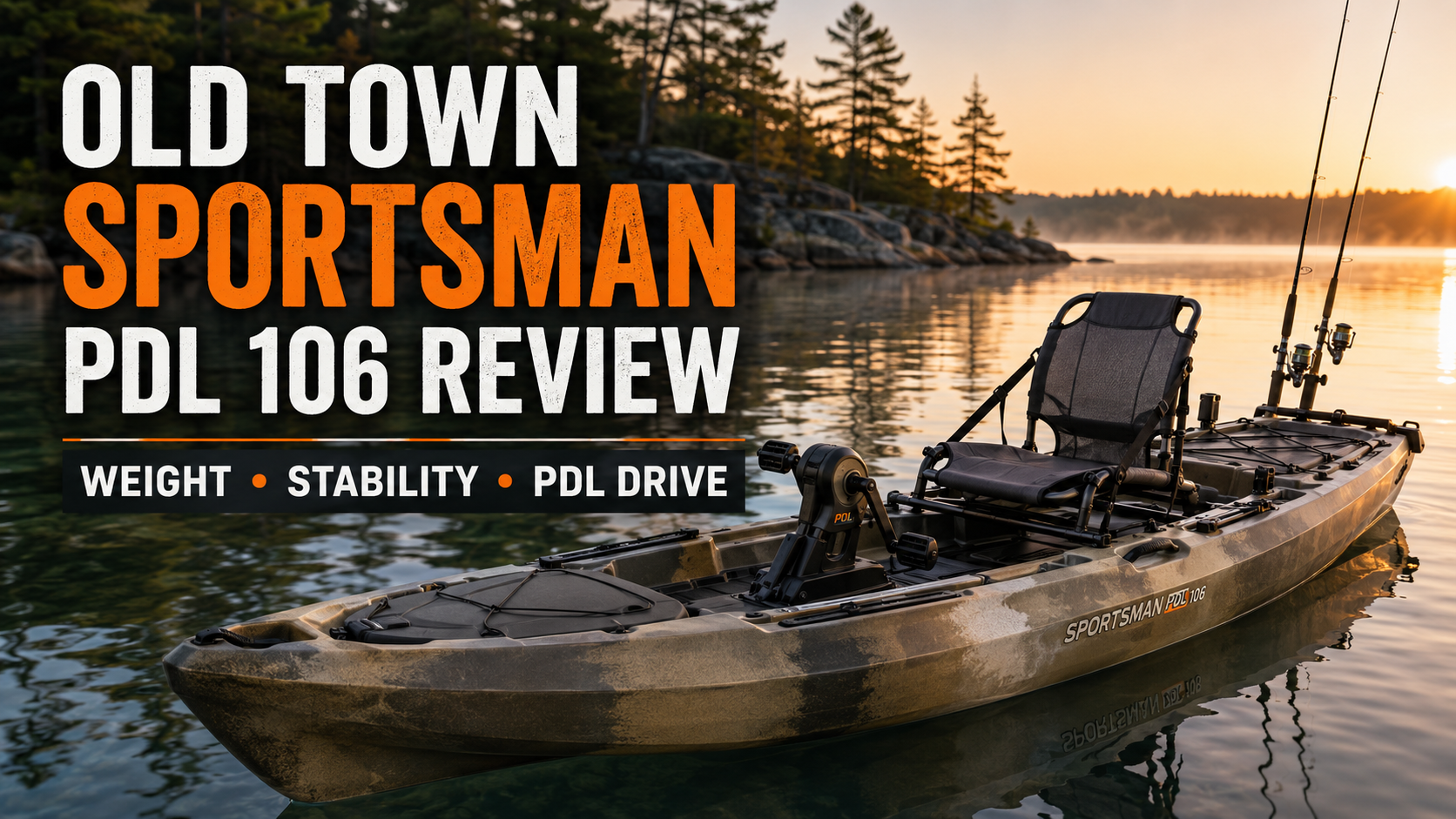
Old Town Sportsman PDL 106 Review: Weight, Stability & Buyer Verdict
This Old Town Sportsman PDL 106 review focuses on the buying decision that matters most: whether the kayak’s stability, hands-free control, and fishing layout are worth a 107-pound assembled weight. The PDL 106 is 10 feet 6 inches long and 36 inches wide, giving it a compact footprint without making it a lightweight kayak.
You will also see buyers search for this model as the Old Town Sportsman 106 PDL. Either way, the tradeoff is the same. On the water, the PDL drive, rudder, wide DoubleU hull, accessory tracks, rod holders, storage, and transducer mount make a strong case for serious fishing. On land, buyers need a realistic loading, cart, and storage plan before spending premium pedal-kayak money.
This review is not based on a personal hands-on test of this specific kayak. It is based on current Old Town specifications and support documentation, current retailer documentation, public owner-feedback patterns, independent published coverage, and Kayak-Fishing.com analysis of what those details mean for buyers.
Quick Verdict: Is the Old Town Sportsman PDL 106 Worth It?
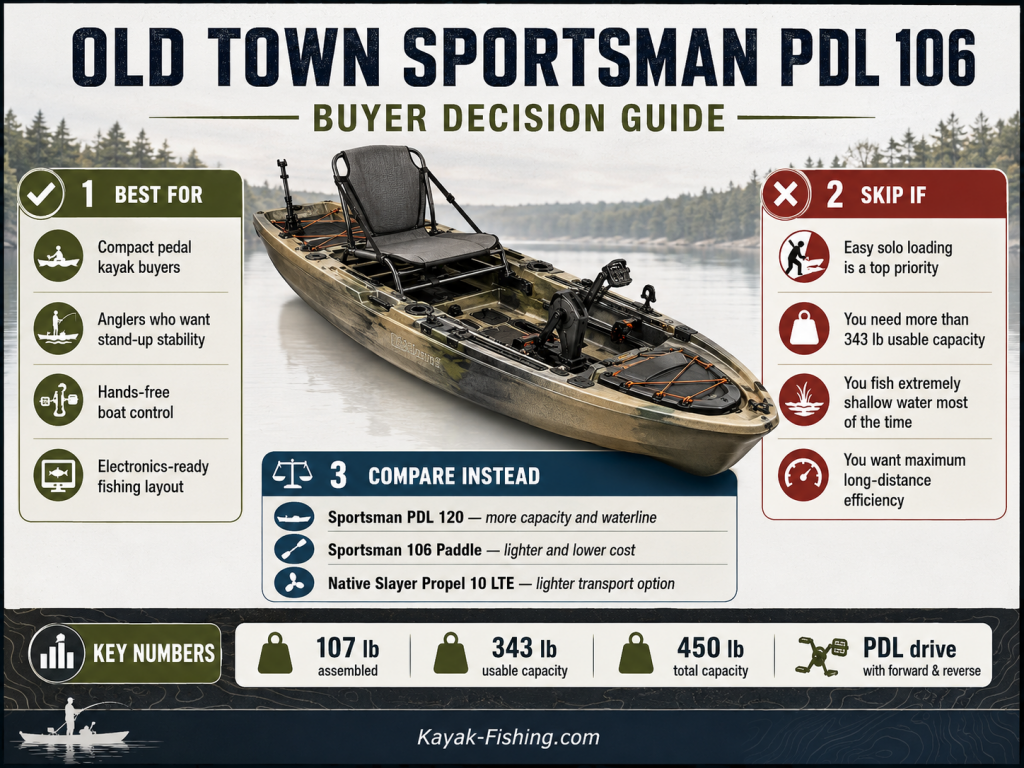
Best for: Anglers who want a compact, highly stable pedal kayak with instant forward/reverse, rudder steering, strong fishing rigging, and enough deck space to stand.
Not ideal for: Buyers who need easy solo roof loading, regularly carry a heavy combined paddler-and-gear load, or prioritize speed and long-distance efficiency over stability.
Biggest advantage: The PDL drive changes how you fish. You can make forward and reverse corrections with your feet while keeping your hands available for casting, trolling, fighting fish, or working structure.
Biggest drawback: The 107-pound assembled weight. The drive and seat are removable, but this is still a substantial kayak to move, load, and cart.
Buyer verdict: The Sportsman PDL 106 makes the strongest case for anglers who value stability, compact storage length, and hands-free control enough to accept the transport burden. If weight is your biggest concern, compare the lighter Native Slayer Propel 10 LTE before buying. If you want more waterline and usable capacity, compare the Sportsman PDL 120.
Affiliate disclosure: As an Amazon Associate I earn from qualifying purchases. Kayak-Fishing.com may earn a commission if you buy through qualifying links on this page, at no extra cost to you. This does not affect how products are evaluated.
Old Town Sportsman PDL 106 Specs
| Spec | Old Town Sportsman PDL 106 |
|---|---|
| Length | 10 ft 6 in |
| Width | 36 in |
| Assembled weight | 107 lb |
| PDL console weight | 18 lb |
| Removable seat weight | 6 lb |
| Usable weight capacity | 343 lb |
| Total weight capacity | 450 lb |
| Material | Single-layer polyethylene |
| Propulsion | PDL pedal drive with instant forward and reverse |
| Rudder | Included |
| Seat | Element Seating System |
| Hatches | Bow and center |
| Accessory tracks | Two 18-inch tracks |
| Rod holders | Three flush-mounted holders |
| Fish-finder setup | Universal transducer mounting system |
| PDL drive warranty | 5 years |
| Hull warranty | Limited lifetime |
Important capacity note: Old Town publishes both total and usable capacity. The 343-pound usable capacity is the more useful number when calculating the combined weight of the paddler, tackle, electronics, cooler, safety gear, and other items carried aboard. The 450-pound total figure includes the assembled kayak itself.
Some retailer pages show older or conflicting weight and usable-capacity language. For this review, current Old Town manufacturer specifications take priority for the core numbers.
Old Town Sportsman 106 PDL Specs: What They Mean for Buyers
The PDL 106 combines a short 10-foot-6-inch hull with a wide 36-inch beam. That tells you a lot about the design before you ever look at the feature list.
The short footprint helps with garage storage, truck-bed transport, tight launches, and maneuvering around docks, laydowns, coves, and smaller water. The 36-inch width and DoubleU hull put stability and fishing space ahead of maximum hull efficiency.
That is a useful combination for anglers who spend more time fishing structure than covering miles of open water. It is less compelling for someone whose normal day starts with a long crossing or who wants the quickest pedal kayak for moving between distant spots.
The other number that deserves attention is 107 pounds. A compact kayak is not automatically an easy kayak to load. The PDL 106 saves length compared with a 12-foot model, but the pedal drive, seat, rudder, wide fishing hull, and built-in hardware all add weight.
Old Town Sportsman PDL 106 Pedal Drive: Forward, Reverse & Shallow Water
The main reason to buy the Sportsman PDL 106 instead of the paddle-powered Sportsman 106 is the propulsion system. Old Town’s PDL drive provides instant forward and reverse, and the kayak includes rudder steering.
The practical effect is not simply that pedaling saves your arms. The bigger fishing advantage is control. With your feet providing propulsion, you can make small forward or reverse corrections while your hands stay on a rod. That can help when working a shoreline, slowing a drift, repositioning around a dock, trolling, or backing away from cover after a fish turns.
Pedal propulsion is not the same as an electronic anchoring system. You still need to react to wind and current, and there are situations where a proper anchor or other positioning method makes more sense. But compared with a paddle kayak, the ability to correct position without putting the rod down is a meaningful upgrade for fishing.
How shallow can the Sportsman PDL 106 go?
Old Town gives unusually specific guidance here. The company says the Sportsman PDL 106 can move through about 6 inches of water with the PDL drive raised. With the drive down and operating, Old Town recommends at least 21 inches of water depth.
That matters if you regularly fish shallow flats, weed-filled ponds, rocky rivers, stump fields, or launches with skinny water. The drive is removable and can be raised, but buyers should not assume the prop can stay deployed everywhere a paddle kayak can float.
Can you use the PDL 106 in saltwater?
Old Town describes the PDL drive as saltwater-ready. The company also recommends rinsing the drive with fresh water after use, especially after saltwater or brackish-water trips, and checking behind the prop for fishing line, vegetation, sand, and other debris.
Saltwater-ready does not mean maintenance-free, and it does not automatically make a 10-foot-6-inch stability-focused kayak the right choice for exposed coastal conditions. Match the kayak to the actual water, weather, current, distance, and launch rather than relying on the propulsion system alone.
Stability: Can You Stand in the Sportsman PDL 106?
Old Town specifically designs the Sportsman PDL 106 as a stand-up fishing platform. The 36-inch beam, DoubleU hull, EVA deck padding, and broad cockpit all support that purpose.
Public owner discussions repeatedly describe stability as one of the PDL 106’s strengths, including reports from larger anglers who use the kayak for seated fishing and standing in appropriate conditions. That pattern is consistent with the hull dimensions and Old Town’s intended use.
That does not mean every paddler should stand everywhere. Comfort while standing depends on body size, balance, how the kayak is loaded, seat position, wind, wake, current, and experience. A kayak that feels solid on flat water can feel very different when a boat wake arrives during a cast.
The buyer implication is straightforward: if stand-up capability is important, the PDL 106 belongs on the shortlist. If standing is not important and you would trade some width and weight for easier transport or more efficient movement, a different hull may fit better.
Seat and Pedaling Ergonomics
The PDL 106 uses Old Town’s adjustable Element Seating System, and Old Town lists the removable seat itself at 6 pounds. The manufacturer describes the seating position as adjustable so the paddler can dial in fit and comfort for pedaling.
For a pedal kayak, seat adjustment is more than a comfort feature. Leg extension affects how naturally you can pedal, how much pressure you put through the stroke, and whether your knees remain in a comfortable position during longer sessions.
Recurring owner feedback is favorable on seat comfort, although individual fit varies. A buyer with unusual leg length, hip or back concerns, or limited mobility should sit in the kayak and cycle the pedals before buying if a dealer demo is available.
Fishing Layout, Storage & Fish-Finder Setup
The Sportsman PDL 106 is not just a recreational kayak with a pedal drive added to the middle. The deck is built around fishing.
- Two 18-inch accessory tracks for rod holders, electronics, camera mounts, and other track accessories
- One forward-facing and two rear-facing flush-mounted rod holders
- Large rear tankwell for a crate, cooler, or other secured gear
- Bow hatch with internal hull access
- Center hatch
- Universal transducer mounting system
- EVA deck padding in the standing area
The combination of long accessory tracks, hull access, and a dedicated transducer solution is especially useful if a fish finder is part of the plan. It reduces the amount of improvisation required compared with kayaks that have limited track space or no built-in transducer provision.
Still, there is no need to fill every track immediately. Start with the gear you know you will use, keep the cockpit clear, and add accessories after a few trips show you where they actually belong.
Old Town Sportsman PDL 106 Weight & Transport: The Biggest Tradeoff
Old Town calls the Sportsman PDL 106 light enough to car-top. For anyone comparing Old Town Sportsman PDL 106 weight before buying, the published number that matters is 107 pounds assembled.
The PDL console weighs 18 pounds and the removable seat weighs 6 pounds, so those components can be carried separately. Old Town says both the PDL Drive and seat can be quickly removed for transportation in a trailer, truck bed, or roof rack. That helps, but it does not turn the PDL 106 into a lightweight kayak.
Owner discussions repeatedly bring up weight as a drawback. Public owner reports describe the PDL 106 as stable and comfortable on the water but heavy or cumbersome on land, with carts and truck-bed transport commonly mentioned as practical solutions.
The right transport method depends on the vehicle and the buyer:
- Truck bed: Usually the simplest solution if your vehicle, bed length, support, and local transport rules work for the kayak.
- Trailer: Adds cost and storage needs but dramatically reduces lifting.
- Roof rack: Possible for some owners, but 107 pounds assembled is a serious number. Remove the drive and seat and use a loading system that does not require a clean overhead press.
- Kayak cart: Nearly essential if the launch is more than a short carry from the vehicle.
What cart should you use?
Old Town strongly discourages scupper-style carts and landing-gear systems that are drilled into the hull because concentrated pressure can damage the kayak. The company recommends a bunk-style cart that supports the hull over a broader area.
On a kayak this heavy, the cart is part of the buying decision rather than an afterthought.
Old Town Sportsman PDL 106 Weight Capacity: 343 lb Usable vs 450 lb Total
Searches for Old Town Sportsman PDL 106 weight capacity often surface the 450-pound figure. That number needs context because Old Town separately publishes a more useful 343-pound usable-capacity rating.
Old Town defines total weight capacity as everything the kayak supports in the water, including the assembled boat. It defines usable weight capacity as the weight left for the paddler, gear, pets, and other carried load after accounting for the assembled boat.
For the PDL 106, the usable number is 343 pounds.
That means a 250-pound angler does not have another 200 pounds available for gear just because the total rating says 450. Using Old Town’s usable figure, that example leaves 93 pounds for everything else aboard.
Electronics, battery, tackle, rods, crate, cooler, water, anchor equipment, clothing, safety gear, and anything you keep all count toward the usable load. Buyers whose complete setup approaches the 343-pound figure should compare the PDL 120 or another higher-capacity platform rather than treating the published maximum as an ideal operating target.
Old Town Sportsman PDL 106 Owner Feedback: What Buyers Commonly Praise
Public owner feedback broadly lines up with what the design suggests. Across the current Eco Fishing Shop review pool and multiple owner discussions, the recurring positives are stability, seat comfort, the PDL system, and overall fishability.
Stability and comfort show up repeatedly in the owner feedback reviewed. The pedal system also gives anglers the practical advantage of making forward or reverse corrections without putting the rod down.
The fishing layout also earns positive attention because the boat is usable without immediately requiring major modifications. Tracks, rod storage, tankwell space, electronics provisions, and deck room are already built into the platform.
Owner feedback is not controlled testing, and retailer review pools can skew positive. It is most useful here for identifying repeated themes rather than proving performance claims.
Old Town Sportsman PDL 106 Complaints & Tradeoffs
The same theme comes up again and again: the PDL 106 is heavy on land.
That is not a minor complaint to wave away because the kayak is only 10 feet 6 inches long. Transport friction affects how often a kayak gets used. If getting it onto your vehicle requires help you rarely have, the PDL 106 can be the wrong kayak even if it is excellent once launched.
Another tradeoff is efficiency. The short, 36-inch-wide hull is built around stability and maneuverability. Owner discussions commonly describe it as stable but not particularly fast. Buyers regularly covering long distances should compare a longer pedal kayak before deciding that the shorter 106 is automatically more convenient.
Shallow-water management is the third tradeoff. The drive must be raised when the water becomes too shallow for the prop. That is normal for a propeller-style pedal system, but it matters if your fishing is dominated by very shallow flats, rocky rivers, stump-filled water, or heavy vegetation.
Old Town Sportsman PDL 106 vs PDL 120
| Spec | Sportsman PDL 106 | Sportsman PDL 120 |
|---|---|---|
| Length | 10’6″ | 12′ |
| Width | 36″ | 36″ |
| Assembled weight | 107 lb | 116 lb |
| Usable capacity | 343 lb | 384 lb |
| Total capacity | 450 lb | 500 lb |
| Pedal console weight | 18 lb | 19 lb |
| Current Old Town price when checked | $2,699.99 | $2,999.99 |
The PDL 120 adds 18 inches of length, 9 pounds of assembled weight, and 41 pounds of usable capacity. When checked on August 18, 2026, Old Town’s manufacturer price difference was $300.
The decision is more interesting than simply “short kayak versus long kayak.” The PDL 106 is already heavy. If you transport with a trailer or truck bed and have enough storage space, saving only 9 pounds may not be a strong reason to give up the 120’s additional waterline and usable capacity.
Choose the PDL 106 if garage length, truck-bed fit, tighter maneuvering, or keeping the overall footprint compact are genuinely important.
Choose the PDL 120 if you carry more weight, regularly cover more open water, have the storage space, and do not gain much from saving 18 inches of length.
Old Town Sportsman PDL 106 vs Sportsman 106 Paddle
The word “106” appears on multiple Old Town kayaks, but the PDL 106 is not simply the paddle Sportsman 106 with pedals added.
| Spec | Sportsman PDL 106 | Sportsman 106 Paddle |
|---|---|---|
| Propulsion | Pedal | Paddle |
| Width | 36″ | 34.5″ |
| Assembled weight | 107 lb | 77 lb |
| Usable capacity | 343 lb | 363 lb |
| Rudder | Included | No rudder on standard paddle model |
| Main advantage | Hands-free forward/reverse control | Lower weight, lower price, simpler ownership |
The PDL version is 30 pounds heavier assembled and actually has 20 pounds less published usable capacity than the paddle model. What you are paying for is not more carrying capacity. You are paying for the PDL propulsion system, rudder-controlled boat positioning, and the ability to keep your hands available while moving.
If you fish casually, stay close to the launch, or place a high value on simple transport, the paddle version may be the smarter purchase. If your fishing style involves repeated casts while working a shoreline, trolling, correcting position in wind, or moving between targets without constantly picking up a paddle, the PDL system changes the experience substantially.
For the full breakdown of the non-pedal model, read our Old Town Sportsman 106 review.
Closest Alternatives to the Sportsman PDL 106
Two current Native Watercraft models are especially useful comparison points because they compete for buyers who want a compact pedal fishing kayak but may place more value on transport weight.
Old Town PDL 106 vs Native Slayer Propel 10 LTE
The Slayer Propel 10 LTE is 10 feet long and 34.5 inches wide. Native currently lists it at 85 pounds fully rigged with a 425-pound published capacity and a $2,349 manufacturer price.
That makes it the transport-first alternative. Its published fully rigged weight is 22 pounds below Old Town’s assembled PDL 106 figure. Manufacturer weight and capacity terminology is not identical across brands, so the numbers should not be treated as perfect apples-to-apples measurements, but the weight difference is large enough to matter for a buyer who expects frequent solo loading.
Choose the Native if reducing transport burden is more important than matching the Old Town’s 36-inch stability-focused hull and Old Town-specific layout.
Old Town PDL 106 vs Native Slayer Propel 10 Max
The Slayer Propel 10 Max is closer to the Old Town in price and feature depth. Native currently lists it at $2,749, 10 feet long, 34.15 inches wide, and 97 pounds fully rigged. It adds a PivotPro swivel seat, electronics-focused bow hatch, transducer mounting, and reinforced stern motor-mount area.
It is a strong alternative for buyers who want a compact premium pedal kayak with modern electronics and motor-integration options while still trimming published rigged weight compared with the PDL 106.
Who Should Buy the Old Town Sportsman PDL 106?
- Buy it if you want pedal propulsion in a compact hull. The 10’6″ length is easier to store than a 12- or 13-foot fishing kayak.
- Buy it if stability is a major priority. The 36-inch DoubleU hull is designed around a stable fishing platform and stand-up capability.
- Buy it if boat control matters more than low weight. Forward, reverse, and rudder steering let you make fishing corrections without constantly switching between rod and paddle.
- Buy it if you plan to run electronics. The long tracks, internal hull access, and universal transducer mount create a strong starting point for a fish-finder setup.
- Buy it if you already have a realistic transport system. A truck bed, low trailer, rear-loading roof setup, and proper bunk cart make the 107-pound assembled weight much easier to live with.
Who Should Skip the Old Town Sportsman PDL 106?
- Skip it if solo loading weight is your biggest concern. A lighter compact pedal kayak such as the Slayer Propel 10 LTE deserves a serious look.
- Skip it if your loaded paddler-and-gear weight needs more than 343 pounds of usable capacity. The PDL 120 gives you additional room.
- Skip it if you regularly cover long open-water distances. A longer waterline or a model designed more heavily around efficiency may fit better.
- Skip it if you fish extremely shallow water most of the time. The propeller drive has to be raised when depth drops below its operating range.
- Skip it if you do not really need pedals. The paddle Sportsman 106 is substantially lighter and less expensive while keeping a fishing-focused Old Town platform.
A Note on Wind, PFDs, and the Limits of Pedal Control
A pedal drive makes wind management easier in many fishing situations because you can keep correcting the kayak while holding a rod. It does not remove the underlying risks of wind, current, cold water, boat traffic, or an exposed crossing.
Before using a heavy pedal kayak on larger or more exposed water, make sure you have a properly fitted PFD and a plan for changing conditions. Our kayak fishing PFD guide covers current fishing-oriented options, and our kayak fishing in wind guide explains boat-control and trip-planning considerations in more detail.
Final Verdict: Old Town Sportsman PDL 106 Review
The Sportsman PDL 106 succeeds because it solves a specific fishing problem well: it puts a stable, riggable, hands-free fishing platform into a relatively compact 10-foot-6-inch footprint.
The PDL drive, instant reverse, rudder, long accessory tracks, transducer mount, rod storage, standing deck, and adjustable seat all support the same purpose. This is a fishing kayak first.
The catch is that compact does not mean light. At 107 pounds assembled, transport needs to be part of the purchase decision from the beginning. The PDL 120 is only 9 pounds heavier while adding 18 inches of length and 41 pounds of usable capacity, and the Native Slayer Propel 10 LTE is substantially lighter on its published rigged-weight figure.
The Sportsman PDL 106 is worth buying when its exact combination of compact length, high stability, fishing layout, and PDL control matches how you fish—and when you have a transport system that makes its weight manageable.
If the transport plan is vague, solve that before ordering. A kayak that is excellent on the water but miserable to load is the wrong ownership fit.
Old Town Sportsman PDL 106 FAQs
How much does the Old Town Sportsman PDL 106 weigh?
Old Town currently lists the Sportsman PDL 106 at 107 pounds assembled. The removable PDL console weighs 18 pounds and the removable Element seat weighs 6 pounds.
What is the Old Town Sportsman PDL 106 weight capacity?
Old Town lists 450 pounds of total capacity and 343 pounds of usable capacity. Use the 343-pound usable figure when calculating the combined weight of the paddler, tackle, electronics, cooler, safety gear, and other carried items.
Can you stand in the Sportsman PDL 106?
Yes. Old Town designs the 36-inch-wide DoubleU hull as a stand-up fishing platform and adds EVA deck padding in the standing area. Individual comfort depends on balance, body size, load distribution, water conditions, and experience.
Does the Sportsman PDL 106 go in reverse?
Yes. The Old Town PDL drive provides instant forward and reverse propulsion.
How shallow can the Sportsman PDL 106 go?
Old Town says the kayak can move through about 6 inches of water with the PDL drive raised. With the drive down and operating, the manufacturer recommends at least 21 inches of water depth.
Can you use the PDL 106 in saltwater?
Old Town describes the PDL drive as saltwater-ready. The manufacturer recommends thoroughly rinsing the drive with fresh water after use, especially after saltwater or brackish-water trips, and checking the prop area for debris.
Can you car-top an Old Town Sportsman PDL 106?
Old Town markets the PDL 106 as car-top capable and recommends removing the drive and seat for transport. The assembled kayak weighs 107 pounds, so whether roof loading is practical depends on the person, vehicle height, rack, and loading-assist system. Buyers should solve the loading process before purchase rather than assuming the short hull will be easy to lift.
What kind of kayak cart should you use with the PDL 106?
Old Town recommends a bunk-style cart that spreads the load across the hull. The company strongly discourages scupper-style carts and drilled landing-gear systems because concentrated pressure can damage the hull.
Is the PDL 106 or PDL 120 better?
Choose the PDL 106 when compact storage length and maneuverability matter most. Choose the PDL 120 when you want more waterline and usable capacity and can accommodate the extra 18 inches of length. The current manufacturer specifications put the assembled-weight difference at only 9 pounds.
How long is the PDL drive warranty?
Old Town currently provides five-year warranty coverage for the PDL drive. The kayak hull is backed by a limited lifetime warranty, subject to the manufacturer’s warranty terms.
Is the Old Town Sportsman PDL 106 worth the money?
It is worth considering if you specifically value a compact 10-foot-6-inch hull, strong stability, instant forward and reverse pedal control, and a fishing-ready layout. It is a weaker value for buyers who do not need pedal propulsion or who will struggle with the 107-pound assembled weight.
What are the main Old Town Sportsman PDL 106 complaints?
The most consistent tradeoff in public owner feedback is transport weight. Other considerations include the efficiency limits of a short, wide stability-focused hull and the need to raise the propeller drive in very shallow water. Those are design tradeoffs rather than evidence of a universal product defect.
Sources
This review uses current manufacturer documentation for core specifications, with retailer documentation and recurring owner feedback used for additional buying context. Kayak-Fishing.com has not personally tested this specific kayak.