Kayak Fishing Chesapeake Bay: Best Zones, Seasons, and Setups for Stripers, Reds & Specks
Kayak fishing Chesapeake Bay can feel overwhelming at first. The Bay fishes like three different systems—upper, middle, and lower—each with its own personality, wind patterns, and boat traffic. The good news is you don’t have to fish all of it. A kayak lets you quietly pick apart shoreline structure, marsh edges, and shoals where big boats can’t or won’t sit.
This guide breaks down where to go, how to access it, what to expect by season, which species to target, and how to stay safe in a small plastic boat so you can fish the Bay with a lot more confidence.
Quick answer: Kayak fishing Chesapeake Bay is best for anglers who want protected creeks, tidal rivers, marsh edges, bridge structure, shoals, and shoreline flats instead of long open-water runs. The top kayak targets are striped bass, redfish, speckled trout, bluefish, and white perch, but your safest plan depends on choosing the right upper, middle, or lower Bay zone for the day’s wind, tide, boat traffic, and regulations.
Table of Contents
Best Kayak Fishing Zones on Chesapeake Bay
Think of the Bay in three zones:
- Upper Bay: More river influence, brackish water, and structure around bridges, creek mouths, and channels.
- Middle Bay: Classic open-Bay structure, islands, ledges, points, and shoals.
- Lower Bay: More salinity and a stronger inshore mix of redfish, speckled trout, bluefish, and stripers.
Upper Chesapeake Bay: Conowingo to Bay Bridge Area
The upper Bay and its tidal tributaries, including the Susquehanna, Elk, Sassafras, Chester, and nearby rivers, are heavily influenced by freshwater flow but still support stripers and other inshore species.
Why it’s good for kayaks:
- Plenty of shoreline, points, and creek mouths
- Large areas of manageable depth compared with more exposed open-Bay water
- Bridges, rock piles, riprap, and channel edges that hold stripers at different times of year
Targets:
- Striped bass, often called rockfish locally, along channel edges, bridge pilings, and points
- White perch and other panfish in creeks and shallows
- Mixed bluefish and schoolie stripers in open-Bay areas when bait is present
Focus on:
- Early and late light around bridge pilings, riprap, and current seams
- Outgoing tide at creek mouths where bait drains into the main Bay
- Wind-protected banks on stronger-wind days
Middle Chesapeake Bay: Bay Bridge to Around the Potomac
The middle Bay is where the estuary opens up and you see more classic Bay ledge structure, open-water fishing, island points, and bigger current seams.
Why it shines for kayaks:
- Ledges, reefs, and shoals that rise from deeper water into kayak-reachable structure
- Islands and necks on the Eastern and Western Shores that create current seams
- Consistent action for stripers plus seasonal shots at red drum, bluefish, and other species
Targets:
- Striped bass along drop-offs, shell beds, shoals, and bridge structure
- School-size red drum and speckled trout along shoreline grass and marsh edges
- Bluefish roaming bait pods in open water, especially summer and fall
Focus on:
- Edges where shallow flats or bars drop into deeper water
- Island points where tide wraps and accelerates
- Shallow water in low-light periods, then deeper edges once the sun is up
Lower Chesapeake Bay: Tangier, Pocomoke, Lower Potomac to the Mouth
The lower Bay feels more like an inshore coastal fishery: higher salinity, more seagrass and marsh, and a stronger presence of southern species.
Why kayakers love it:
- Excellent mixed fishery for stripers, slot red drum, speckled trout, and bluefish in the shallows
- Large marsh complexes, islands, and sounds such as Tangier, Pocomoke, Mobjack, and nearby lower-Bay waters
- Multiple launch options on both Maryland and Virginia shores
Targets:
- Stripers on points, marsh cuts, and pilings
- Redfish on shallow flats and around oyster bars
- Speckled trout along grass edges and shell bottom
- Bluefish and Spanish mackerel in season roaming open water
Focus on:
- Dawn and dusk on shallow flats for reds and specks
- Mid-tide periods when current is strong enough to move bait but not ripping
- Channel edges and shoals for stripers and bluefish as bait funnels past
Launch Points and Access
There are hundreds of access points across Chesapeake Bay. Rather than trying to list every ramp, it’s smarter to understand the main launch types and use regional access tools before each trip.
Using Online Access Guides and Water Trails
Both Maryland and Virginia have useful access resources, and paddling groups can also help you understand soft launches, parking, and local conditions.
- Maryland Online Water Access Guide: Useful for finding boat ramps and soft access points.
- Chesapeake Paddlers Association: A paddling community resource that can help with launch and route research.
Look for:
- Soft launches suitable for kayaks
- Parking availability and ramp fees
- Proximity to target flats, channels, river mouths, marsh drains, or bridge structure
- A safe return route if wind or tide changes
Example Launch Types by Zone
Upper Bay:
- Small town ramps and parks on tributaries, such as Rock Hall, Eastern Neck, Elk River, Sassafras River, and nearby access areas where creeks meet the Bay
- County or state park ramps that put you near bridge structure, creek mouths, riprap, or points
Middle Bay:
- Public ramps in Calvert, Dorchester, Talbot, Anne Arundel, and other mid-Bay counties
- Shoreline parks where you can hand-launch and paddle straight to ledges, marsh edges, or shoreline structure
Lower Bay:
- Waterfront parks and small marinas on the lower Potomac, Rappahannock, York, James, Pocomoke, and other tidal rivers
- Island, marsh, and protected shoreline access where short paddles get you into shallow-water habitat
Local tip: With a kayak, your first priority is protected parking and a safe launch, not being closest to the birds. Find a ramp or soft launch that lets you paddle upwind or uptide first, then drift and fish your way back.
Seasonal Patterns on Chesapeake Bay
The Bay’s fishing is driven by water temperature, salinity, bait movement, freshwater flow, and regulations. This is a broad kayak-focused overview, but always confirm current seasons and rules before targeting or keeping fish.
Regulation note: Chesapeake Bay fishing rules change often, especially for striped bass. Before each trip, check the current Maryland DNR, Virginia DWR, VMRC, and Potomac River Fisheries Commission rules for the exact waters you plan to fish.
Spring: April to May
Spring can be productive, but it is also one of the most regulation-sensitive times of year because striped bass spawning protections may apply in different parts of the Bay and tributaries.
- Upper Bay: Pay close attention to spring striped bass rules and closures. After open seasons begin, schoolie and slot fish may spread along channel edges, points, and bridge structure as water warms.
- Middle and Lower Bay: As water temperatures climb, stripers, red drum, and speckled trout begin feeding along shorelines, marsh edges, flats, and lower-Bay rivers.
- Bluefish and Spanish mackerel: These usually become more common later in the warm season, depending on bait and water temperature.
Kayak approach:
- Focus on legal areas and confirm current striped bass rules before targeting them.
- Fish creek mouths, marsh edges, and shallow shell or grass as they warm.
- Use smaller baits that match early-season forage such as grass shrimp, small baitfish, and worms.
Summer: June to August
Summer can be excellent, but heat, boat traffic, and seasonal closures can all shape your plan. Early and late sessions are usually more comfortable and safer from a kayak.
- Stripers often slide deeper during bright sun and warmer water, feeding shallow during low-light windows.
- Lower Bay shallow-water fishing for mixed stripers, slot reds, speckled trout, and bluefish can be strong around dawn, dusk, and cloudy periods.
- Bluefish, Spanish mackerel, and other roaming fish can show around bait, birds, rips, and channel edges.
Kayak approach:
- Plan early or late sessions to avoid heat and heavy boat traffic.
- In the middle and lower Bay, work shallow flats and marsh edges at first light, then slide to channel edges and ledges.
- Use faster presentations and topwater when fish are actively chasing bait.
- Carry plenty of water and watch thunderstorms closely.
Fall: September to November
Fall is a favorite season for many Chesapeake kayak anglers because bait movement and cooling water often put fish in predictable feeding lanes.
- Stripers, red drum, speckled trout, and bluefish can feed heavily in tidal tributaries and along Bay shorelines.
- Birds, bait slicks, and surface feeds become important clues.
- Points, river mouths, shoals, and current seams can all concentrate fish.
Kayak approach:
- Follow bait and birds, but do not chase feeds across unsafe open water.
- Fish points, river mouths, marsh drains, and shoals where moving fish stage.
- Keep a topwater, soft plastic, or metal ready for bluefish and striper school blitzes.
- Watch wind closely because fall fronts can change conditions quickly.
Winter: December to March
Winter fishing narrows but does not completely disappear. For most kayak anglers, though, cold-water safety becomes the main concern.
- Stripers may shift into deeper wintering areas, but regulations and catch-and-release rules vary.
- Milder stretches can produce fish in deeper tidal rivers and holes.
- Protected creeks and rivers are usually better winter kayak choices than exposed open-Bay water.
For most kayak anglers, winter is a limited, cautious season best left to those with cold-water gear, good self-rescue skills, and very conservative safety plans.
Species Overview: Stripers, Redfish, Specks, Bluefish
Striped Bass: Rockfish
- Where: Channel edges, bridge pilings, shoals, river mouths, riprap, and shorelines in low light
- Behavior: Ambush predators that often hold on the softer side of structure just outside the main current
- Kayak advantage: You can quietly position around small current seams, bridge shadow lines, and shoreline eddies that larger boats may overlook
Stripers are one of the Bay’s signature fish, but they are also heavily regulated. Check current rules before targeting or keeping them.
Red Drum: Redfish
- Where: Lower Bay shoreline grass, marshes, oyster bars, shallow flats, and deeper channels for larger drum
- Behavior: Slot reds often use skinny water, while larger drum may hold in deeper areas, shoals, and channels
- Kayak advantage: You can sight-fish tailing reds on calm flats and work marsh cuts or oyster edges quietly
Soft plastics, shrimp-style baits, popping corks, and small swimbaits all make sense around lower-Bay marshes and grass edges.
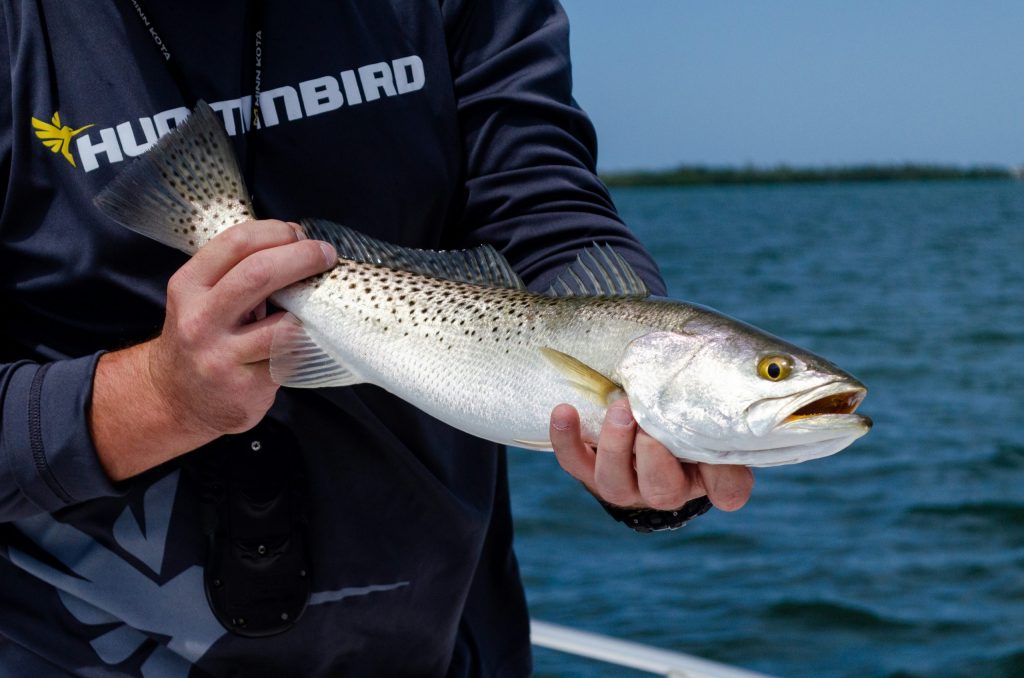
Speckled Trout: Spotted Seatrout
- Where: Lower Bay grass beds, marsh edges, shallow shell bottom, and clearer, warmer water
- Behavior: Specks often feed best at low light or on overcast days when they move shallower
- Kayak advantage: Calm mornings and evenings around marsh points and grass flats are perfect for quiet kayak approaches
Speckled trout are a great kayak target because they often use shallow water that is easy to cover with soft plastics, twitch baits, and popping corks.
Bluefish
- Where: Middle and lower Bay open water, rips, channel edges, and bait pods
- Behavior: Fast, aggressive, schooling fish that can show up suddenly around birds and surface activity
- Kayak advantage: Keep one rod rigged with a durable plug, spoon, or metal for surprise blitzes
Bluefish are fun but hard on tackle. Use tougher leader or short wire when they dominate the bite, and be careful handling them beside the kayak.
White Perch
White perch are not as glamorous as stripers or redfish, but they are one of the most kayak-friendly targets in the Chesapeake system.
- Where: Creeks, docks, grass edges, shoreline structure, and tidal tributaries
- Best approach: Small jigs, spinners, bait rigs, and light tackle
- Kayak advantage: You can work quiet creek banks and docks without needing long open-water paddles
Recommended Lures and Techniques for the Bay
You can cover most Chesapeake kayak fishing situations with a fairly tight tackle system. The goal is not to bring everything you own. It is to cover shallow flats, channel edges, current seams, and open-water feeds without cluttering the kayak.
Core Lure Box
Soft Plastics on Jigheads
- Sizes: 3–7 inches
- Styles: Paddle tails, straight tails, and jerk shads
- Colors: White, pearl, chartreuse/white, olive/white, and natural baitfish patterns
- Weights: 1/8–1/4 oz for shallow water and light current; 3/8–3/4 oz for deeper edges and stronger flow
Soft plastics are a good starting point because they can catch stripers, redfish, specks, bluefish, and white perch depending on size and presentation.
Hard Baits
- Topwater plugs: Walkers and pencils for dawn and dusk over flats and along shorelines
- Subsurface swimmers and jerkbaits: Shallow and mid-depth models over grass, bars, and shell
- Metals and spoons: Good for bluefish, Spanish mackerel, and fast-moving schools in open water
Bait Rigs
- Simple bottom rigs or fish-finder rigs with circle hooks for appropriate bait-fishing situations
- Popping cork with soft plastic, shrimp imitation, or bait for reds and specks in lower-Bay marshes
- Small bait rigs or jigheads for white perch in creeks and tidal rivers
When targeting striped bass with natural bait, hook rules and seasonal restrictions may apply. Check the current regulations before rigging bait for stripers.
Techniques That Fit Kayak Fishing
Drift and Fan-Cast
- Use wind and tide to drift across flats or along ledges.
- Fan-cast ahead with soft plastics or plugs.
- Mark bites and repeat productive drifts.
Anchor or Stake Out on Current Edges
- In narrow channels or at marsh cuts, set a light anchor or stakeout pole only when conditions are safe.
- Cast upcurrent and let lures swing through seams.
- This is ideal for stripers and reds holding in predictable ambush spots.
Shoreline and Marsh Work
- Move quietly with slow paddle strokes or subtle pedal movements.
- Cast tight to grass lines, points, docks, and drains on moving water.
- Use weedless plastics around grass and standard jigheads around shell, rock, and bare bank.
Open-Water Pods and Birds
- Approach bird activity from the side or upwind. Do not paddle straight through the feed.
- Cast metals or subsurface baits into the edges of the frenzy.
- When fish sound, count down jigs to different depths until you find the school again.
Kayak Safety on Chesapeake Bay
The Bay is big water. Kayaks fit here, but you must respect wind, waves, boat traffic, tides, visibility, and regulations.
Tides, Wind, and Fetch
- Long stretches of open water mean even moderate winds can build steep chop.
- Wind against tide is a red flag because waves can get short, steep, and uncomfortable fast.
- Conditions can change as you move from protected creeks to open-Bay shorelines.
Practical approach:
- Check marine forecasts, not just general weather apps.
- Plan to paddle upwind or uptide first, then return with conditions helping you.
- Stay inside breaks, creeks, and shorelines on days with higher wind forecasts.
- Read my guide to kayak fishing in wind before planning open-Bay trips.
Boat Traffic
Chesapeake Bay is busy: commercial ships, tugs, barges, charter boats, crabbers, sailboats, and recreational traffic all share the water.
- Stay out of main shipping channels and marked navigation lanes.
- Cross channels quickly at 90 degrees if you must cross.
- Use a bright kayak and PFD plus a tall flag for visibility.
- Avoid anchoring or long drifts in narrow channel throats where larger boats cannot easily maneuver around you.
PFDs, Whistles, and Lights
At minimum, check the current boating requirements for the state waters you are using and carry the required safety equipment for paddlecraft.
- Wear a U.S. Coast Guard-approved PFD sized correctly for you.
- Carry a whistle or other sound-producing device.
- Use proper lights if you are on the water at dawn, dusk, night, or in restricted visibility.
- Carry waterproof communication, such as a phone in a dry case or a VHF radio for bigger-water trips.
For kayaks, the safest practice is to wear a properly fitted PFD at all times and keep your whistle attached to it.
For clothing and weather protection, see my guide on what to wear kayak fishing.
Anchoring and Boat Positioning
Anchors, stakeout poles, and positioning tools can help around marsh drains, creek mouths, bridge structure, and ledges, but they need to be used carefully.
- Do not anchor in navigation channels, ferry routes, or tight boat lanes.
- Avoid anchoring broadside to wind, tide, waves, or boat wakes.
- Use a quick-release setup if anchoring in current or around traffic.
- For setup ideas, read my guide to the best kayak anchors.
Regulations and Licensing
Fishing rules can change by state, river, tributary, season, species, and even specific management zone. That is especially true for striped bass.
Before each trip, confirm:
- Whether you need a Maryland license, Virginia license, Potomac River license, or another permit
- Current striped bass targeting, harvest, slot, and closure rules
- Size and bag limits for red drum, speckled trout, bluefish, cobia, Spanish mackerel, and other species
- Whether special hook rules apply to your bait or rigging method
Use official Maryland DNR, Virginia DWR, VMRC, and Potomac River Fisheries Commission sources before keeping fish or crossing jurisdiction lines.
FAQs: Kayak Fishing Chesapeake Bay
Do I need a fishing license to kayak fish Chesapeake Bay?
Yes. You need a valid recreational fishing license for the state or jurisdiction whose waters you’re fishing. That may mean Maryland, Virginia, Potomac-specific rules, or another applicable license depending on where you launch and fish. Always verify with Maryland DNR, Virginia DWR, VMRC, or the Potomac River Fisheries Commission before your trip.
What is the best time of year to kayak fish Chesapeake Bay?
Most kayak anglers focus on late spring through fall. Late spring can bring strong shallow-water fishing after legal openings, summer can produce good early and late bites, and fall is often one of the most consistent seasons for stripers, redfish, speckled trout, bluefish, and bait movement.
Always match your target species and area to the current regulations before planning the trip.
Is Chesapeake Bay too big or rough for a kayak?
It can be if you choose the wrong day or route. The Bay is large, but protected creeks, tidal rivers, coves, and shorelines offer very manageable kayak water when the forecast is right.
- Start in protected creeks and rivers.
- Stay close to shore until you understand local wind and tide.
- Avoid open-Bay crossings, strong rips, and heavy shipping channels until you have more experience.
If you are newer to the sport, start with my kayak fishing for beginners guide.
How many rods should I bring?
Two or three rods are enough for most Chesapeake Bay kayak fishing:
- Medium inshore spinning rod: 10–20 lb braid for plastics, plugs, and general casting.
- Medium-heavy rod: 20–30 lb braid for heavier jigging, structure, larger fish, or stronger current.
- Optional lighter rod: Good for finesse plastics, white perch, or a dedicated topwater setup.
More rods usually add clutter and increase tangle risk in wind, current, and boat wake.
What line and leader should I use for stripers, reds, and specks?
A simple setup that covers most scenarios is 10–20 lb braided mainline with a 20–30 lb fluorocarbon or mono leader. You can go lighter for speckled trout and finesse work or heavier around bridge structure, sharp shell, bluefish, or bigger red drum.
A 2–4 foot leader is a good starting point for many lure-fishing situations.
Can I fish at night from a kayak on the Bay?
Many anglers do, especially for stripers around bridges and light lines, but night fishing adds risk. If you try it, use full required lighting, extra visibility gear, and short conservative routes in areas you already know well.
- Stay close to your launch.
- Avoid shipping lanes and heavy boat traffic.
- Use a headlamp, required navigation light, bright clothing, and a whistle.
- Do your first night trips with another experienced angler if possible.
Plan your Chesapeake Bay kayak fishing setup:
Final Thoughts
Kayak fishing the Chesapeake Bay is all about matching your plan to the size and complexity of the system. The Bay can be as forgiving as a quiet marsh creek or as intense as an open-water rip line with stripers and blues slashing bait at your bow.
If you:
- Choose upper, middle, or lower Bay zones that match your skill and the day’s conditions
- Use water-access tools to find safe launches close to productive structure
- Build a lean tackle kit around soft plastics, a few plugs, and a jig game you trust
- Make safety and regulations part of your routine, not an afterthought
…you’ll be ready to fish the Chesapeake like a local from a small plastic boat. Start with shorter shoreline and river sessions, learn how wind and tide shape each area, and each trip will open up more flats, ledges, and marshes that become part of your personal kayak milk run on the Bay.