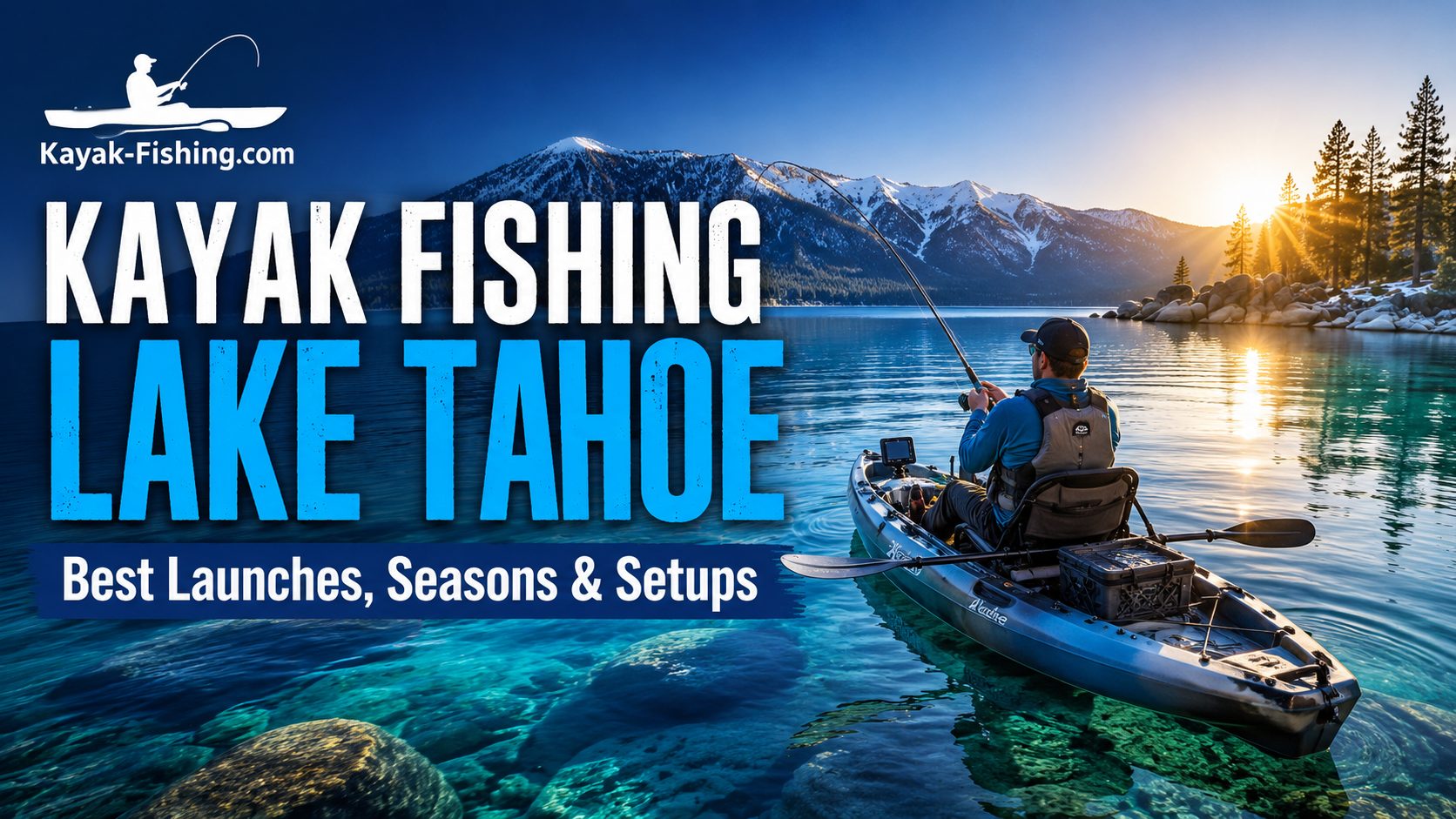
Kayak Fishing Lake Tahoe: Best Shores, Seasons, and Setups for Trout, Kokanee & Bass
Kayak Fishing Lake Tahoe is one of the most scenic freshwater fishing experiences in the country, but it is not a casual paddle-and-cast lake. Tahoe is deep, cold, clear, windy at times, and surrounded by steep mountain shoreline. That makes it beautiful, but it also means kayak anglers need to plan carefully.
The good news is that Lake Tahoe can be a great kayak fishing destination if you choose the right launch, fish early, stay weather-aware, and match your setup to the species you are targeting.
This guide covers the best Lake Tahoe kayak fishing areas, launch points, seasonal patterns, target species, lure choices, safety tips, and a simple trip plan for getting started.
Important: Lake Tahoe is not a casual small pond. The water is cold, the lake is deep, and calm mornings can turn into rough, windy conditions quickly. Wear a PFD, dress for immersion, stay close to shore, and avoid long open-water crossings from a kayak.
Table of Contents
Kayak Fishing Lake Tahoe: Quick Trip Plan
If you are planning a kayak fishing trip on Lake Tahoe, start simple. Pick a protected launch, fish early, stay near shore, and avoid long open-water crossings. Tahoe can be calm and glassy in the morning, then windy and rough later in the day.
| Goal | Best Area | Best Season | Best Approach |
|---|---|---|---|
| Beginner-friendly kayak fishing | South Shore shelves | Summer mornings | Stay near shore and target smallmouth or trout |
| Best chance at mackinaw | West Shore drop-offs | Spring through fall | Deep trolling or vertical jigging |
| Scenic protected trip | Emerald Bay | Calm shoulder-season mornings | Shoreline casting and cautious trolling |
| Smallmouth bass | Rocky north and west shorelines | Summer to early fall | Tubes, drop-shots, small crankbaits, and finesse jigs |
| Kokanee | Deeper basin and drop areas | Summer and fall | Trolling with depth control |
For most first-time Tahoe kayak anglers, the best plan is not to chase the entire lake. Choose one launch, fish a manageable stretch of shoreline, and keep your route close enough to turn back quickly if the wind starts building.
If you are newer to the sport, start with our kayak fishing for beginners guide before taking on a big, cold mountain lake like Tahoe.
Best Kayak Fishing Areas on Lake Tahoe
Lake Tahoe is large enough that you should think in zones instead of trying to cover everything. The North Shore, South Shore, West Shore, and Emerald Bay all fish differently from a kayak.
North Shore
The North Shore, roughly from Kings Beach toward Tahoe City, offers a mix of rocky points, steeper drop-offs, and some flatter shelves. It can be a good zone for smallmouth bass, rainbow trout, and trolling passes near deeper water.
Why it works for kayaks:
- Access to deeper water fairly close to shore.
- Rocky areas and points that hold smallmouth during warmer months.
- Reasonable paddles to depth changes for mackinaw trolling when conditions are calm.
Kayak focus: Fish points and rocky stretches near Kings Beach and Carnelian Bay for smallmouth in summer, or troll near breaks where moderate depths quickly fall into deeper water.
North Shore can be exposed to wind. Pick calmer mornings, check the forecast closely, and do not count on an easy paddle back if afternoon chop builds.
South Shore
South Shore includes areas around Stateline, Nevada Beach, Camp Richardson, Baldwin Beach, and the Tahoe Keys. Compared with some parts of the lake, it has broader shelves, more access points, and plenty of summer activity.
Why it works for kayaks:
- Broad shelves that can fish well for trout and smallmouth.
- Access to deeper water outside the shelves when you are equipped for trolling.
- More launch and parking infrastructure than some steeper shoreline areas.
Kayak focus: Work shallows and shoals near Nevada Beach, Baldwin Beach, and the broader South Shore shelves for seasonal trout and summer smallmouth. If you have sonar and deep trolling gear, you can also explore drop lines outside the shelves for mackinaw.
The tradeoff is traffic. South Shore can get busy in summer, especially around beaches, marinas, rental zones, and high-use weekends.
West Shore
The West Shore, from Tahoe City down through Homewood, Tahoma, and Meeks Bay, has steep rocky banks, small shelves, boulder areas, and quick access to deeper water.
Why it works for kayaks:
- Fast access from shore to deeper water for mackinaw and kokanee trolling.
- Rock and boulder fields that can attract smallmouth in summer.
- Good structure without always needing a long paddle.
Kayak focus: Fish points and rocky structure around Sunnyside, Homewood, Tahoma, and Meeks Bay for smallmouth in summer and early fall. For mackinaw, look for trolling routes that follow contours rather than paddling straight into open water.
This side of the lake can be very productive, but the steep shoreline and cold water make safety planning important. Stay close enough to shore that you can make a controlled return if wind increases.
Emerald Bay
Emerald Bay is one of Tahoe’s most iconic areas and a unique kayak fishing zone. It is smaller, more protected than the open lake in some conditions, and surrounded by dramatic structure.

Why it works for kayaks:
- Scenic, defined water with shoreline edges, rock, and drop-offs.
- More protected than the main lake during some wind directions.
- Good fit for short, early trips when you do not want to commit to open-water paddling.
Kayak focus: Work shoreline edges and rock for bass and trout when conditions line up. Near the mouth of the bay, pay attention to deeper transitions where fish may move between the bay and the main lake.
Emerald Bay is extremely popular with sightseeing boats, rental craft, and paddlers. Go early, stay alert for wakes, and avoid assuming “protected” means “risk-free.”
Best Lake Tahoe Kayak Fishing Launches
Exact parking rules, fees, hours, and launch access can change by season, jurisdiction, and water level. Always check local signage before launching.
| Launch Area | Best For | Kayak Notes |
|---|---|---|
| Kings Beach State Recreation Area | North Shore smallmouth, rainbows, and nearby drop-offs | Sandy beach launch; watch wind exposure and summer crowds |
| Tahoe City / Commons Beach Area | West Shore access and nearshore structure | Check local rules, parking, and beach access before launching |
| Nevada Beach | South Shore shelves and beginner-friendly shoreline sessions | Wide sandy beach; paid parking may apply; can be busy in summer |
| Camp Richardson / Baldwin Beach | South Shore trout, bass, and access to deeper water | Good early launch option; very busy during peak season |
| Homewood / Obexer’s Area | West Shore rocky structure and nearby depth changes | Check marina and beach access rules before planning around this area |
| Meeks Bay | Protected bay fishing, nearby rocks, and West Shore drop-offs | Good mix of shallower water and deeper structure; seasonal access varies |
| Emerald Bay State Park | Scenic paddling, shorter trips, and shoreline structure | Access can be limited and parking fills quickly; many paddlers launch nearby and paddle in |
For a first trip, choose a launch that lets you fish productive water without making a long crossing. Short, controlled routes are better than ambitious open-water paddles on Tahoe.
If you are deciding what to bring, keep the kayak simple and organized. Too much gear makes re-rigging, landing fish, and handling wind harder. Our guide to beginner kayak fishing mistakes covers this problem in more detail.
Fishing Rules, Licenses, and AIS Check
Before fishing Lake Tahoe, check current regulations, license rules, and aquatic invasive species requirements. Tahoe is split between California and Nevada, and rules can vary depending on where you fish and what species you target.
For license and regulation reminders, start with the U.S. Forest Service Lake Tahoe fishing page, then verify current California and Nevada fishing regulations before your trip.
Before launching, make sure your kayak, paddle, pedal drive, anchor line, net, waders, and fishing gear are clean, drained, and dry. Lake Tahoe has strict aquatic invasive species prevention efforts, and non-motorized watercraft can still spread invasive species between lakes.
For current non-motorized watercraft guidance, see the Tahoe Keepers Clean, Drain, Dry guidance before you launch.
Do not treat this section as legal advice. Regulations, launch access, closures, and inspection rules can change, so check official sources close to your trip date.
Seasonal Patterns on Lake Tahoe
Tahoe’s high elevation, cold water, and deep structure make seasonal timing important. The best season depends on whether you want smallmouth, rainbow trout, kokanee, or mackinaw.
Winter: December Through February
- Water: Very cold, with snow, storms, icy shoreline conditions, and serious cold-water risk.
- Fish: Mackinaw can be caught year-round, but kayak access is the limiting factor.
- Kayak reality: Winter is not recommended for most kayak anglers on Tahoe.
If you do attempt winter fishing from a kayak, treat it as a full cold-water trip. This is drysuit-level risk, not casual fair-weather paddling.
Spring: March Through May
- Rainbow trout: Often more accessible around shorelines, points, and slightly warmer shallow zones.
- Mackinaw: Still relate to deeper structure, but low-light windows can move fish shallower.
- Kayak reality: Good fishing windows exist, but the water is still extremely cold.
Spring can be productive for early-morning trolling near shoreline breaks, but it is not the time to cut corners on clothing, PFD use, or weather planning. For layering and cold-water clothing ideas, read our guide on what to wear kayak fishing.
Summer: June Through August
- Smallmouth bass: Prime season around rocky banks, points, shelves, and boulder fields.
- Rainbow trout: Better early and late; many fish move deeper as light and temperatures rise.
- Mackinaw: Often deep and structure-oriented.
- Kokanee: Suspended schools may require precise depth control.
Summer is the most comfortable season for most kayak anglers, but it also brings boat traffic and predictable afternoon wind. Fish early, use visibility gear, and plan a conservative route back to your launch.
Fall: September Through November
- Kokanee: May stage near tributaries and spawning areas, but regulations can be sensitive during this period.
- Rainbow trout and mackinaw: Cooling water can create better shallow and low-light opportunities.
- Smallmouth bass: Can remain active until water temperatures drop too far.
Fall can be one of the best times for Kayak Fishing Lake Tahoe if you hit stable weather. Crowds are lighter, fish can be active, and the scenery is hard to beat. The tradeoff is colder water and shorter weather windows.
Lake Tahoe Fish Species for Kayak Anglers
Mackinaw Lake Trout
Mackinaw, or lake trout, are one of Tahoe’s signature fish. They are usually associated with deep water, steep breaks, underwater humps, rocky edges, and main-lake structure.
- Kayak approach: Deep trolling with downriggers, leadcore, or weighted systems.
- Alternative approach: Vertical jigging when you can mark fish or bait on sonar.
- Best fit: More experienced kayak anglers with electronics, depth control, and stable weather.
Mackinaw can be rewarding from a kayak, but deep trolling on Tahoe is not the easiest starting point. Learn the lake, wind patterns, and launch areas before committing to longer deep-water programs.
Rainbow Trout
Rainbow trout are often more accessible to kayak anglers than deep mackinaw, especially during spring, fall, and low-light summer windows.
- Kayak approach: Flatline trolling small spoons, plugs, and spinners near shoreline breaks.
- Best areas: Points, cooler inflow zones, shelves, and nearshore breaks.
- Best windows: Early morning, evening, and shoulder seasons.
Rainbows are a good target if you want to fish moving baits without committing to the deepest parts of the lake.
Kokanee Salmon
Kokanee are landlocked sockeye salmon that often suspend over deeper water. They can be very depth-specific, which makes electronics and controlled trolling especially helpful.
- Kayak approach: Trolling small dodgers with hoochies, flies, or small spoons.
- Key detail: Depth control matters more than simply dragging a lure behind the kayak.
- Regulation note: Check current rules carefully around tributaries and spawning periods.
Kokanee can be a fun kayak target, but they are usually better for anglers who already understand trolling speed, line angle, and depth.
Smallmouth Bass
Smallmouth bass are one of the most practical kayak targets on Lake Tahoe during summer and early fall. They relate to rock, boulders, shelves, points, and depth transitions that can often be reached without long open-water paddles.
- Kayak approach: Cast tubes, drop-shots, small jigs, craw baits, crankbaits, and jerkbaits around rock.
- Best areas: North Shore, West Shore, and rocky South Shore stretches.
- Best windows: Summer into early fall, especially mornings and evenings.
Smallmouth are a great way to enjoy Lake Tahoe from a kayak without needing a full deep-water trolling setup.
Recommended Lures and Techniques
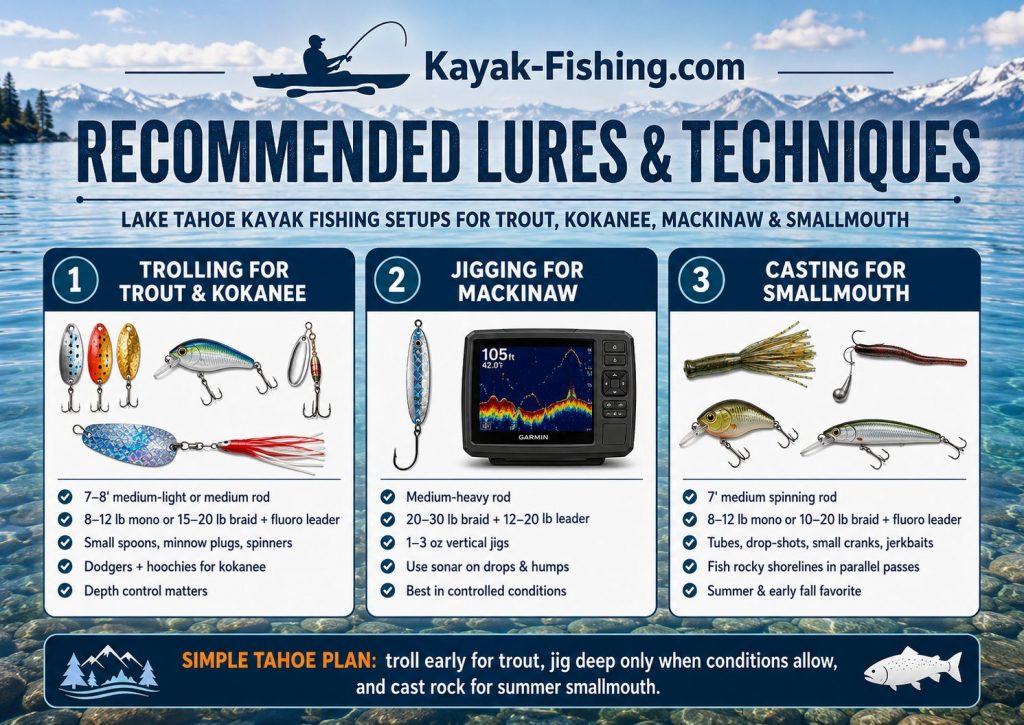
You do not need a giant tackle box for Tahoe, but you do need to match your technique to depth, species, and conditions.
Trolling for Trout and Kokanee
Light to moderate trolling for rainbows and shallower trout:
- 7–8 foot medium-light or medium spinning/trolling rod.
- 8–12 lb mono or 15–20 lb braid with a fluorocarbon leader.
- Small spoons in silver, silver/blue, silver/chartreuse, or baitfish colors.
- Small minnow plugs, spinners, and subtle trout-style hard baits.
Flatline trolling can work early and late near shoreline breaks. Inline weights, snap weights, leadcore, or small downriggers can help reach deeper fish.
Deep trolling for mackinaw and kokanee:
- Heavier trolling rod with enough backbone for downriggers or weighted systems.
- Downrigger, leadcore, or other depth-control setup.
- For kokanee: small dodgers with short leaders to hoochies, flies, or small spoons.
- For mackinaw: larger spoons, plugs, or bait-style presentations fished deeper and slower.
On Tahoe, depth control often matters more than the exact brand of lure. If you are consistently above or below the fish, you are out of the game.
Jigging for Mackinaw
- Medium-heavy spinning or baitcasting rod.
- 20–30 lb braid with a 12–20 lb fluorocarbon leader.
- 1–3 oz vertical jigs, heavy plastics, or metal jigs.
- Fish drops, humps, bait schools, and marks on sonar.
Kayaks can be excellent for vertical jigging when wind is manageable. If the kayak is sliding too fast, your presentation will be hard to control and your line angle will suffer.
Good knots matter when fishing deep water or braid-to-leader setups. If you need a refresher, see our kayak fishing knots guide.
Casting for Smallmouth Bass
Tackle:
- 7 foot medium spinning rod.
- 8–12 lb mono or 10–20 lb braid with a fluorocarbon leader.
- Simple, compact tackle selection that is easy to manage from a kayak.
Lures:
- Tubes and craw-style baits around rock.
- Drop-shot rigs with small worms or minnow-style plastics.
- Small crankbaits along points and ledges.
- Jerkbaits when fish are chasing bait near rock or open edges.
Work shorelines in parallel passes instead of constantly casting straight at the bank. Smallmouth often hold along specific depth contours, especially in clear water.
If you like destination-style clear-water smallmouth fishing, you may also enjoy our Lake Erie kayak fishing guide.
Lake Tahoe Kayak Fishing Safety Tips
Lake Tahoe is deep, cold, and capable of changing quickly. Safety should be part of your fishing plan, not something you think about after launching.
Wind and Weather
Calm mornings can turn into rough, whitecapping conditions later in the day. This is one of the biggest risks for kayak anglers on Tahoe.
Plan around wind by doing the following:
- Fish early and set a hard off-the-water time.
- Check detailed marine-style wind forecasts, not just general weather apps.
- Avoid long open-water crossings.
- Choose launch areas that allow you to stay close to shore.
- Turn back before conditions become uncomfortable.
For more boat-control advice, see our guide to kayak fishing in wind.
Cold-Water Shock and Hypothermia
Even in warm weather, Tahoe’s water can be dangerously cold. Falling in without the right gear can cause cold-water shock, panic, loss of breathing control, and rapid loss of strength.
Reduce the risk:
- Always wear a properly fitted PFD.
- Dress for the water temperature, not just the air temperature.
- Consider a wetsuit or drysuit in colder months or shoulder seasons.
- Practice self-rescue and re-entry in controlled conditions.
- Carry a whistle, communication device, and basic emergency gear.
The U.S. Forest Service Lake Tahoe water activities page has helpful cold-water safety reminders for paddlers and other lake users.
A comfortable PFD is easier to wear all day. See our guide to the best PFDs for kayak fishing if you are still choosing one.
Boat Traffic
Lake Tahoe can be busy with powerboats, sightseeing tours, rental craft, and personal watercraft, especially around South Shore and Emerald Bay.
Visibility habits:
- Use a bright PFD and visibility flag.
- Avoid main boating lanes whenever possible.
- Be careful around marinas, tour boat routes, and rental zones.
- Cross open areas quickly and directly when you must cross.
- Assume larger boats may not see you in chop or glare.
Keep Your Route Short
The best Tahoe kayak fishing plan is often a conservative one. Fish a smaller area well instead of trying to cover miles of shoreline. This keeps you closer to the launch, reduces fatigue, and gives you more options if wind or boat traffic increases.
FAQs: Kayak Fishing Lake Tahoe
Do I need a fishing license to kayak fish Lake Tahoe?
Yes. Lake Tahoe sits on the California/Nevada state line, so you need to understand the license and regulation rules for the area you plan to fish. Check the current California and Nevada fishing regulations before your trip.
What is the best time of year to kayak fish Lake Tahoe?
Summer is usually the most comfortable season for most kayak anglers and is a good time for smallmouth bass. Spring and fall can be excellent for trout opportunities, but the water is colder and weather windows can be shorter. Winter is not recommended for most kayak anglers because of cold-water risk and storms.
Is Lake Tahoe good for beginner kayak anglers?
Lake Tahoe can work for beginners only if they choose calm summer mornings, stay near shore, avoid long crossings, and use conservative routes. A beginner should not treat Tahoe like a small warm-water pond.
Do I need a fish finder for Lake Tahoe?
You can catch fish without a fish finder, especially when casting for smallmouth near shoreline rock. For mackinaw, kokanee, deep trolling, and vertical jigging, electronics are a major advantage because depth and structure matter so much.
What fish can you catch from a kayak on Lake Tahoe?
Kayak anglers commonly target mackinaw lake trout, rainbow trout, kokanee salmon, and smallmouth bass. The easiest target depends on season, launch area, water depth, and your gear.
How many rods should I bring?
Two or three rods are usually enough. A simple setup would be one trolling rod, one spinning rod for smallmouth and shoreline casting, and an optional heavier rod for deep jigging. More rods often create clutter in a kayak.
What is the safest way to kayak fish Lake Tahoe?
The safest approach is to fish early, stay near shore, wear your PFD, dress for cold water, avoid long crossings, watch wind forecasts, and turn back before conditions become difficult. Tahoe rewards conservative planning.
Final Thoughts
Kayak Fishing Lake Tahoe is a mix of deep, clear-water strategy and mountain-lake safety. The same clarity, depth, and scenery that make Tahoe special also demand respect for wind, cold water, boat traffic, and changing conditions.
If you break the lake into manageable zones, choose launch points that keep you close to structure, match your tactics to the season, and treat safety as part of your fishing setup, Tahoe becomes much less intimidating.
Start simple. Pick one shoreline zone, fish early, keep a log of wind and water conditions, and pay attention to where you mark or catch fish. Over time, a huge lake starts to feel like a set of repeatable routes, patterns, and small windows you can fish with confidence from a kayak.