Kayak Fishing in Wind: Safe, Smart Tactics to Stay in Control and Catch Fish
Kayak Fishing in the Wind can be either miserable or magical. I still remember one Saturday on a local reservoir when I thought a “little breeze” would not matter. Ten minutes after launching, my kayak was sideways, my line was bowing halfway to the next county, and I was drifting right over the point I was trying to fish. By the time I got turned around, I was already 60 yards past it.
If that sounds familiar, you are not alone.
Wind magnifies every weakness in your boat control, but it can also turn on some of the best bites. The trick is learning to predict what the wind will do to your kayak and using that movement instead of fighting it all day.
This guide walks through how I actually handle Kayak Fishing in the Wind: choosing when it is safe to go, rigging for control, setting up drifts, making better casts, and staying calm when it starts to honk.
Table of Contents
Why Windy Days Feel So Chaotic From A Kayak
From the bank or from a big boat, 10 mph of wind feels like a gentle breeze. From a 12 foot plastic bathtub with rods sticking up in every direction, it can feel like you launched in a leaf blower.
A kayak is light, with a lot of you and your gear sitting above the water. You are the sail. The hull below the surface is relatively small, so the wind tends to beat the water when it comes to which force wins.
That is why:
- Your kayak spins every time a gust hits the side.
- You stop paddling for 10 seconds and suddenly you are 30 yards off your line.
- Your line makes a big curve on the surface instead of going straight to your lure.
The funny part is that the same wind that makes your boat misbehave is often what stacks bait and fish where you are trying to go. A light chop breaks up the surface, hides the kayak, and pushes food into points, shorelines, grass edges, and any kind of irregular structure.
Kayak Fishing in the Wind is not the problem by itself. The problem is being surprised by what it does.
Knowing When The Wind Is Actually Safe
Before you think about fancy drift tactics for Kayak Fishing in the Wind, you need a simple, honest way to decide if it is a good idea to launch at all.
A Simple Wind Scale For Most Fishing Kayaks
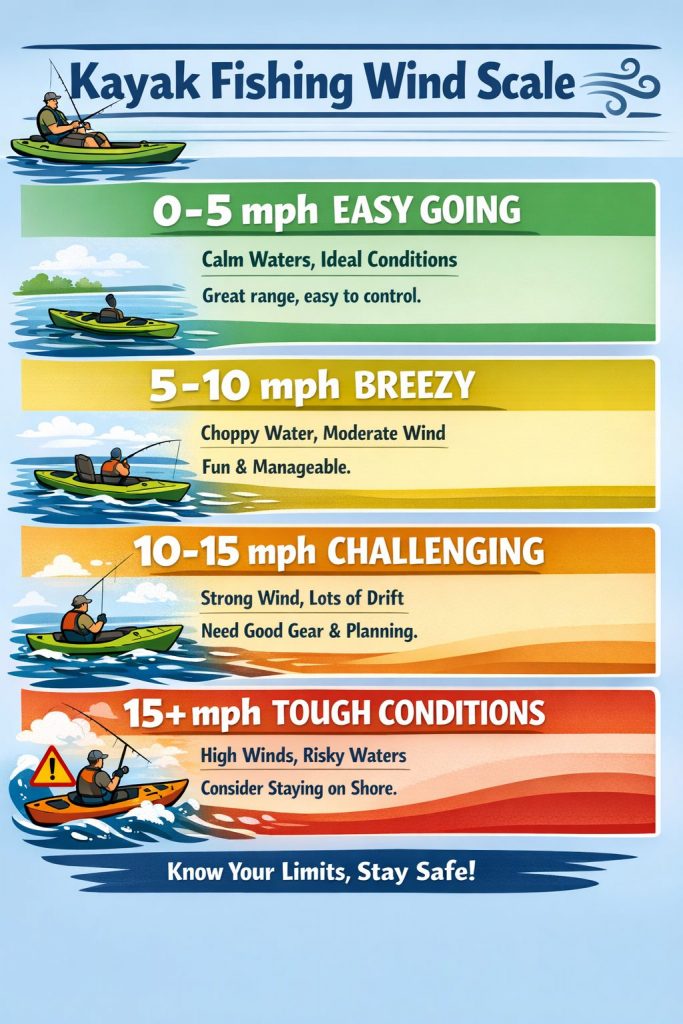
Everyone’s comfort level is different, but for a typical sit-on-top fishing kayak:
- 0 to 5 mph: Easy mode. You can position almost anywhere without thinking too hard. Great range and very forgiving.
- 5 to 10 mph: Often my favorite. Enough wind to put a chop on the water and move the kayak, but still very manageable with basic boat control.
- 10 to 15 mph: Fishable if you have a plan. You will be drifting and correcting a lot. Good gear and smart positioning matter here.
- 15+ mph: This is where things get “advanced.” Short, protected paddles can be fine. Long open water crossings or cold water are where I start thinking about staying home or fishing from shore.
Those numbers are just a starting point. The big thing is context.
Reading The Forecast Like A Kayak Angler
Wind apps and marine forecasts are your friend, but you have to read them with kayak eyes.
A few things I pay close attention to:
- Gusts vs steady wind
A forecast of “10 mph, gusting 20” is a very different day than “10 mph, gusting 12.” Gusts are what spin you and shove you off a line. - Wind direction changes
Morning calm followed by a stiff afternoon wind out of the opposite direction can make the paddle back serious work. I like my return trip to be cross wind or downwind, not straight into the strongest part of the day. - Fetch and open water
A 12 mph wind on a small cove is one thing. The same wind blowing down 3 miles of open lake builds waves that can easily come over your bow, especially if they are quartering across you. - Wind and tide together on saltwater
In bays or marshes, wind can fight or help the tide. Wind pushing against strong current stands waves up and makes washing-machine chop. When they flow together, it can really speed up the water moving over a point or flat.
The Ramp Drift Test
One of my favorite real-world checks happens right after I launch.
I paddle 20 or 30 yards off the ramp, point the kayak the direction I think I will be fishing, then:
- Put the paddle down.
- Do absolutely nothing for 30 seconds.
- Watch how quickly and in what direction I drift.
If I cover a surprising amount of water in that short time, or drift toward hazards like boat lanes or rock walls, that is my cue to either adjust where I fish or rethink the day completely.
Quick Safety Reality Check
No fish is worth being genuinely scared on the water. On windy days in particular:
- Wear a PFD every second you are on the water.
- Let someone know where you are launching, where you plan to fish, and when you expect to be back.
- Check local rules for any required safety gear where you fish.
I treat feeling “a little nervous” as a yellow light. Feeling dread or playing out “what if” rescue scenarios in my head is a red light, and I listen to it now.
Setting Your Kayak Up For Windy Conditions
Windy days will expose every weak spot in your rigging. A few simple tweaks make a big difference when you are Kayak Fishing in the Wind.
Seat Height, Hull Profile, And Clutter
High seats are comfortable and easier on your knees, but they also raise your center of gravity and your wind profile. On seriously breezy days, I will drop my seat to the lower position even if it is less comfortable.
Some things that catch more wind than you expect:
- Tall milk crates with big tackle boxes sticking up.
- Long-handled nets stored upright.
- Multiple rods pointed straight up.
- Huge flags or camera poles.
I am not saying strip your kayak bare, but the more you can keep rods angled back, nets laid down when not needed, and crates reasonably low, the less your boat behaves like a sailboat with no keel.
Anchors, Poles, Socks, And Other Control Tools
You do not need every gadget in the catalog, but a couple of basic tools will make Kayak Fishing in the Wind far less frustrating.
A Simple Anchor Setup
On lakes and calm bays, a small folding or grapnel anchor with appropriate rope is plenty for most situations.
What matters more than the model is:
- Enough rope to let out a decent scope without having a mountain of loose line on deck.
- A way to quickly deploy and quickly retrieve without tangles.
One thing many new kayak anglers do is tie on 100 feet of rope “just in case” and then throw more line into the water than they need. In wind, that loose line can catch on brush, rocks, or your feet at exactly the wrong time.
For normal depths where I fish, I like to have maybe 40 to 60 feet of rope neatly managed and only let out what I actually need.
Why An Anchor Trolley Is Worth It
An anchor off the side of the kayak is a good way to get yourself in trouble in waves or strong wind. An anchor trolley lets you slide the anchor point toward the bow or stern.
That matters because:
- Anchor toward the bow and your kayak will naturally point into wind or current.
- Anchor toward the stern and you will sit facing downwind or down current.
Being able to change your angle to the wind without re-tying everything is a huge plus in gusty conditions.
Stakeout Pole In Shallow Water
If you fish marshes, flats, or shallow shorelines, a simple stakeout pole is pure magic on a windy day. Jam it into the bottom through a ring on your trolley or a dedicated mount, and your kayak stops right now without all the anchor fiddle.
I fish a lot of shallow grass and shell. Half the time I do not even bother with a traditional anchor unless I know I am sitting in one deeper spot for a long time. A push pole or stakeout pole is much quieter and faster.
Drift Socks And Drag Chains
The first time I used a drift sock on a windy lake, I watched my speed on the fish finder drop from around 1.6 mph to just under 0.8. Suddenly I could actually work a jig down a rocky bank instead of feeling like I was trolling it at warp speed.
A drift sock is just a small underwater parachute. You clip it off to a cleat or trolley and it creates drag that slows your drift.
On rocky rivers, some folks use a small drag chain instead, but that is more of a moving water trick. For open water lakes and bays, a compact drift sock is usually enough.
Understanding Wind, Current, And Your Drift
Once you have the basic tools, the real magic of Kayak Fishing in the Wind is learning how to predict where the breeze will push you and how the water will move you.
Wind Above, Water Below
A simple way to think about it:
- Wind pushes everything above the waterline.
- Current pushes everything below it.
Your kayak mostly lives above the surface. The hull and maybe your fins (on a pedal drive) are below. On lakes with no real current, wind almost always wins. In tidal water, the two forces can cancel each other out, add together, or pull you in different directions.
On a windy incoming tide in a bay, for example, I have had my kayak pointed into the wind but still sliding sideways because the current was doing one thing under the surface while the wind did another on top.
You do not have to be a scientist. You just need to get in the habit of watching:
- Which way the ripples and little waves move.
- Which way your kayak sits when you stop paddling.
- Which way your line is drifting while your lure sinks.
Think In Drift Lines, Not Just Spots
A big mindset shift for me was to stop thinking, “I want to fish that exact rock” and start thinking, “I want to drift along that entire edge.”
For example:
- Wind blowing down a riprap bank? Instead of trying to sit still on one stretch of rocks, I will set up just upwind and let the kayak slide along, making casts as I go.
- Grass line in a bay with wind running parallel to it? I aim for a drift that takes me 10 or 20 yards off the grass and just ride it like a slow trolley motor pass.
Once you catch a fish, drop a waypoint or pick a visual marker on shore so you can restart the same drift from the top.
It will not be perfect. I still overshoot or end up a little farther out than I planned, but that habit of treating drifts like “runs” instead of random chaos makes windy days much more productive.
Real-World Positioning Scenarios
Let’s walk through a few common setups I see over and over on lakes and inshore water when I am Kayak Fishing in the Wind.
Wind Pushing Straight At The Bank
Picture a main lake point or a stretch of rocky shoreline with the wind blowing directly into it. Baitfish and plankton get pushed into that bank, and predators are often waiting there.
How I usually set up:
- I paddle or pedal into the wind until I am 20 to 40 yards off the bank.
- If it is not too strong, I might just keep the bow pointed into the wind and make repeated casts toward shore, using occasional correction strokes to hold my general position.
- If the wind is stronger, I will drop a small anchor off the bow so the kayak stays pointed upwind and I can work a “fan” of casts across the structure.
Often I will let the anchor drag just a little, so I slowly creep down the shoreline instead of sitting frozen in one spot.
Wind At Your Back On A Point Or Hump
Wind at your back feels like a treat when you are paddling, but when you start fishing it can push you too fast.
On offshore points or humps, I like to:
- Approach from downwind so the wind is behind me as I get in position.
- Stop upwind and slightly off to one side of the structure instead of right on top of it.
- Use a drift sock or slow correction strokes to stay over the “upwind shoulder” of the structure and cast downwind across it.
If I line things up right, the kayak drifts slowly across the top or along the side of the hump, and my casts sweep right through the sweet spot.
When I first tried this, I blew over my favorite hump three times in a row before I finally dropped a sock and realized how much easier it is when your speed is under control.
Cross Wind Along A Grass Line Or Docks
Inshore, I fish a lot of long grass edges where the wind is blowing parallel to the shoreline. The temptation is to tuck right against the grass, but if you do that, the first gust tends to slam you into it or spin you sideways.
My routine now:
- Set up 10 to 20 yards off the grass on the upwind side.
- Point the bow slightly off the shoreline, not straight at it.
- Let the wind slide me down the edge while I cast slightly ahead of the kayak, almost like slow trolling.
On dock lines, same idea. I set up so the kayak drifts just outside the dock ends. Cross wind drifts let you work each piece of cover once, cleanly, instead of ping-ponging in and out of it.
Paddling And Pedaling That Actually Help In Wind
You do not have to be an athlete to handle Kayak Fishing in the Wind, but there are a few tricks that save a lot of energy.
Moving Upwind Efficiently
When I was newer to kayak fishing, I would sprint hard upwind, completely burn out my arms, then flop the paddle across my lap and try to fish while my heart pounded. Now I keep it a lot smoother.
A few habits:
- Shorter, more frequent strokes are more efficient than huge sweeping strokes.
- I hug wind breaks whenever I can: shorelines, islands, tall reeds, or even big docks.
- Instead of charging straight into the teeth of the wind for a mile, I break it into legs and take quick “fish breaks” in slightly protected pockets.
On pedal kayaks, constant light pedaling works better than the sprint-and-coast routine. Think “steady walking pace” instead of “wind sprint.”
Micro-Positioning Without Spinning The Boat
Sometimes you only need to move a few feet without changing the direction you are facing.
Two little tricks:
- Crab walk: A couple of draw strokes on one side of the kayak will move you sideways. I use this all the time to shift closer to or farther from a bank without turning 90 degrees.
- Tiny reverse strokes: Two or three gentle reverse strokes on one side can pull you back off a dock or stump without completely changing your heading.
On a calm day, you can be sloppy and still land where you want. In wind, those small adjustments are what keep you from feeling like you are constantly fighting the boat.
A Hard-Learned Lesson On The Paddle Back
One spring afternoon I launched with a light breeze at my back and spent a few hours chasing fish along a windblown shore. The bite was great. I did not really think about the fact that the wind was steadily building.
By the time I turned around to head back, whitecaps were setting up on the main lake. The paddle that had taken 15 minutes in the morning took nearly an hour going home. I was never in real danger, but I was tired enough that I would not call it fun.
Since then, I always:
- Look at what the forecast says about wind speed later, not just at launch time.
- Try to plan my day so the longest paddle is earlier, not right before dark when the wind may be strongest.
Lure Choices And Presentations That Work In Wind
The right boat control makes a huge difference, but you still have to get bites. Wind changes how your lures behave too, and good lure choices are a big part of Kayak Fishing in the Wind.
Slightly Heavier, Slightly Louder
Wind creates surface chop and moves your line around, which makes it harder to feel bites and keep contact with your bait.
I often adjust by:
- Bumping jig heads up one size so I can still feel bottom clearly.
- Going from a weightless soft plastic to a light Texas rig.
- Leaning more on lures with vibration, rattles, or strong thump when visibility drops.
On windy shell bars for redfish and trout, for example, a 1/8 or 3/16 ounce jighead with a paddle tail can be much easier to control than a super light one that gets picked up and tossed by every little wave.
Casting Angles To Avoid The Line Belly Problem
In wind, your line wants to form a big bow on the surface. That steals feel and makes hooksets mushy.
A few casting angles help:
- Casting downwind keeps the line mostly straight. This is my favorite when I can manage it. The lure and line are traveling the same direction, so there is less drag and bow.
- Casting cross wind works if you keep the rod tip high or to the downwind side and are ready to pick up slack faster.
- Avoiding long upwind casts with light lures if possible. You will be reeling almost as much slack as lure most of the time.
Another habit: I pay attention to whether my kayak is drifting toward or away from my lure.
- If I am drifting toward it, I slow my retrieve or pause more. The kayak is already taking up slack.
- If I am drifting away, I speed up a touch so I do not leave the bait dragging behind in a giant bow.
Topwater, Moving Baits, And Finesse Pockets
There is a sweet spot with topwater and wind. Dead flat calm can make fish spooky. A little chop breaks things up and hides the hardware.
On breezy mornings around points or grass, I have had some of my best topwater bites. I just:
- Choose a lure with a strong sound or profile.
- Shorten my casts a little to keep control.
- Keep the rod a bit higher so the line does not dig into every wave.
When the wind really cranks, I lean more on moving baits like spinnerbaits, chatterbaits, and paddletails on lakes, or spoons and swimbaits in saltwater. Cover water along windblown edges and let the wind help you move.
Finesse still has a place on windy days, but often in micro-sheltered spots: pockets just inside a cove, behind a point, or on the downwind side of a little island. Same day, same wind, but you are tucking inside the main flow where you can actually feel a light bait.
Staying Safe, Calm, And Confident When It Blows
There is a big difference between “good tired” and “scared tired.”
Good tired is when your shoulders burn a bit on the paddle back, but you are smiling and planning your next trip. Scared tired is when every wave looks bigger than the last and you are just hoping you make it back without flipping.
Here are a few habits that keep me on the right side of that line when I am Kayak Fishing in the Wind:
- Always have a downwind exit plan.
Before I drift far from the launch or cross open water, I picture what happens if my paddle snaps or I lose a pedal. Can I simply drift to a shoreline and walk out, or will I end up in trouble? - Stay near shore when in doubt.
Let the wind move you along a shoreline instead of launching into the middle of a big lake and letting the gusts push you wherever they want. - Dress for spray and water, not just air temperature.
Wind pushes more water over your bow and into your lap. Even light waves can leave you soaked. Staying reasonably warm and dry helps you think clearly and make good choices. - Know when to pull the plug.
If I notice I am spending more time thinking about the paddle back than the fishing, that is often my cue to start working back toward the ramp.
As always, wear that PFD, keep your paddle or pedal drive secure, leash critical gear you do not want to lose, and carry a whistle or some way to signal for help. Check your local regulations to make sure you meet any specific requirements where you fish.
Some of my favorite stories do come from windy days, but none of them are worth rolling the dice on a situation where I feel in over my head.
Simple Practice Drills To Get Better In Wind
You do not have to wait for “perfect conditions” to get comfortable with Kayak Fishing in the Wind. You can practice boat control on purpose.
A few easy drills:
- Light wind “stay put” game
On a mild day, pick a buoy, stump, or dock post and see how long you can keep your kayak within a small imaginary circle around it using only gentle strokes and angle changes, not full repositioning. - Short upwind and crosswind runs near the ramp
On breezier days, stay close to the launch and practice paddling upwind for a couple hundred yards, then drifting back. Learn how your boat behaves in that wind without committing to a long crossing. - One drift, one lesson
After each drift line, before you paddle back to reset, ask yourself:- Did I start in the right place?
- Did I pass over the best structure at the right distance?
- How would I adjust my starting point or angle next time?
A couple of weekends of intentionally playing with this stuff will change the way windy days feel. Instead of chaos, it starts to feel like you know what is going to happen before you even lift the anchor.
Letting Wind Work For You
Wind is never going to stop moving a kayak. The goal is not to overpower it. The goal is to predict it and put that movement on your side.
If you only do one thing differently on your next windy trip, try this: pick a single drift line you want to fish, set up upwind of it on purpose, and pay attention to where you actually end up. Make notes. Adjust. Repeat.
Over time, you will catch yourself smiling when you see a decent breeze in the forecast, because you know the fish will be feeding and you will be ready for it.
Some of my best fish came on days when most folks stayed home because it “looked too windy.” Once you learn how to read it, rig for it, and ride it, those are the days that stick in your memory.