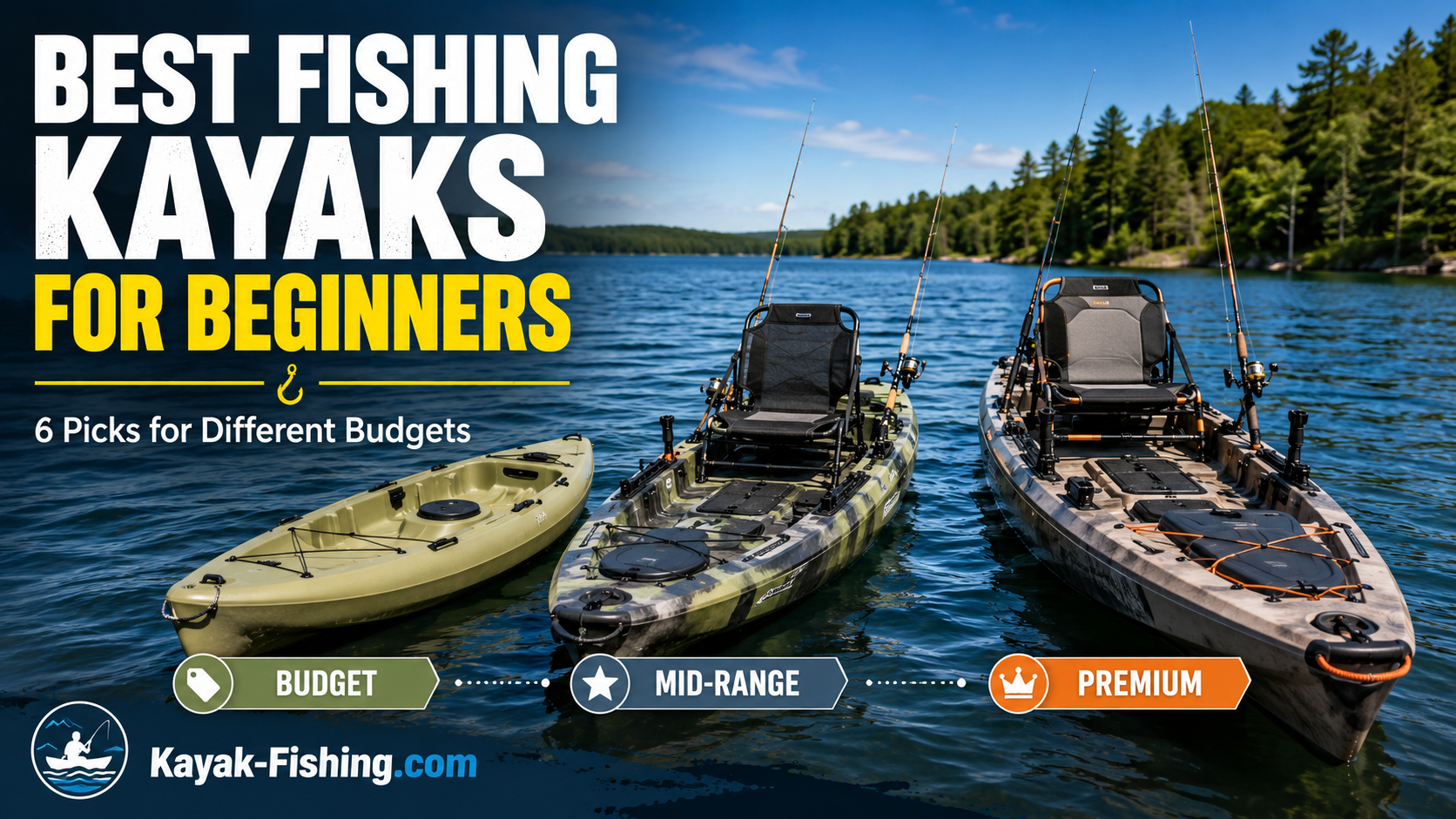
Best Fishing Kayaks for Beginners: 6 Picks for Different Budgets
The best fishing kayak for a beginner is not automatically the cheapest boat, the widest boat, or the one with the most rod holders. A good first fishing kayak should fit the water you actually fish, the amount of gear you carry, your transport setup, and the way you want to fish.
For many beginners, the most useful starting point is a stable sit-on-top paddle kayak with a comfortable seat, enough capacity for the paddler plus gear, and a layout that works without a pile of aftermarket accessories. The six kayaks below cover different budgets and priorities instead of pretending one model is best for everyone.
If you are still learning launches, PFDs, boat control, and simple gear, start with the kayak fishing for beginners guide. If you are ready to choose the actual boat, this guide focuses on the buying decision.
Disclosure: This article may contain affiliate links. Kayak-Fishing.com may earn a commission from qualifying purchases at no extra cost to you. Some merchant links are non-affiliate links. Affiliate relationships do not determine which kayaks are selected or how they are evaluated.
Research note: Kayak-Fishing.com has not personally tested every kayak in this guide. Recommendations are based on manufacturer documentation, product research, owner-feedback patterns, and practical buyer tradeoffs.
Table of Contents
Best Fishing Kayaks for Beginners at a Glance
| Kayak | Best For | Length | Weight | Capacity | Main Tradeoff |
|---|---|---|---|---|---|
| Lifetime Tamarack Pro 103 | Most beginners who want better seat comfort without premium weight or price | 10’3″ | 57.5 lb | 300 lb max | Not designed for stand-up fishing; capacity is modest |
| Lifetime Tamarack Angler 100 | Lowest-cost simple starter for calm water | 10′ | 49.8 lb | 275 lb max | Basic seat and limited capacity |
| Pelican Catch Classic 100 | Compact kayak with a wider, standing-friendly fishing platform | 10′ | 57 lb | 350 lb max | Short, wide hull favors stability over paddling efficiency |
| Pelican Catch Mode 110 | Stable deck, elevated seat, and future stern-motor flexibility | 10’8″ | 67 lb | 375 lb max | Bulkier than lightweight starters |
| Perception Outlaw 11.5 | Bigger anglers and buyers who want more deck room | 11’6″ | 77 lb | 425 lb max | Longer and heavier to store and load solo |
| Old Town Sportsman 106 | Premium paddle-kayak buyer who wants a compact, refined fishing platform | 10’6″ | 77 lb assembled | 363 lb usable / 440 lb total | Premium cost and substantial loading weight |
Capacity note: The numbers above are not perfectly apples-to-apples. Lifetime, Pelican, and Perception publish maximum weight capacities for these models. Old Town separately publishes a 440-pound total capacity and a 363-pound usable capacity for the Sportsman 106. Always check how the manufacturer defines capacity before comparing two kayaks by one number.
How We Chose These Beginner Fishing Kayaks
A beginner buyer guide should not be six similar kayaks with different labels. Each recommendation here has a distinct reason to exist.
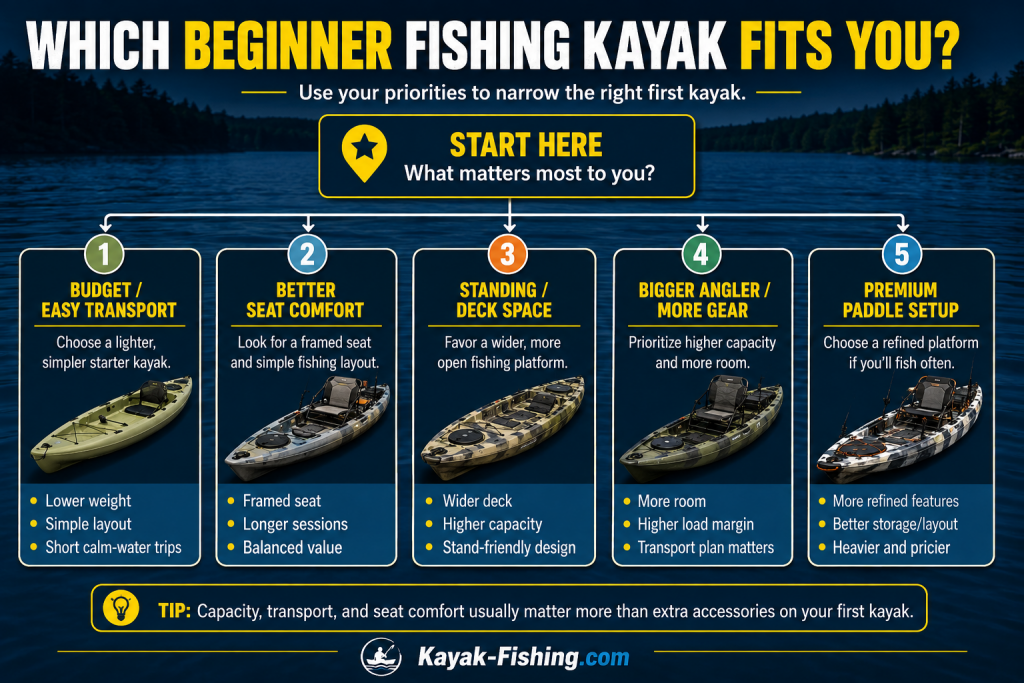
- Transportability: A kayak that is miserable to load, carry, or store often gets used less. Length and weight matter before the boat ever reaches the water.
- Stability-oriented design: New kayak anglers generally benefit from a hull that feels predictable while seated, reaching for tackle, landing fish, and learning boat control.
- Capacity: The paddler is only part of the load. A PFD, paddle, crate, tackle, water, anchor, rods, dry bag, cooler, electronics, battery, and other accessories all count.
- Seat comfort: A framed seat or well-designed high/low seat can matter more during a three-hour fishing session than another pair of rod holders.
- Fishing layout: Useful tankwell space, rod storage, accessory mounting, open deck room, and accessible storage matter more than a long list of cosmetic features.
- Beginner fit: A kayak can be a good product and still be the wrong first kayak if it is too heavy, too specialized, too expensive, or intended for more demanding water than the buyer is ready to fish.
We also avoided arbitrary numerical ratings. The useful question is not whether one kayak is an 8.7 and another is a 9.1. The useful question is which tradeoff fits your water, body-and-gear load, storage, transport, and budget.
Specification sources used for this guide
- Lifetime Tamarack Angler 100 manufacturer documentation
- Lifetime Tamarack Pro 103 manufacturer documentation
- Pelican Catch Classic 100 manufacturer documentation
- Pelican Catch Mode 110 manufacturer documentation
- Perception Outlaw 11.5 manufacturer documentation
- Old Town Sportsman manufacturer documentation
1. Lifetime Tamarack Pro 103 — Best for Most Beginners
Best for: Beginners who want a manageable paddle kayak with a framed seat and more useful fishing layout than the cheapest starter boats.
Main advantage: The adjustable framed seat is a meaningful quality-of-life upgrade while the kayak stays compact at 10 feet 3 inches and 57.5 pounds.
Main drawback: The 300-pound capacity is not generous for bigger anglers with gear, and Lifetime does not design the Pro 103 as a stand-up fishing kayak.
Closest alternative: Lifetime Tamarack Angler 100 if minimum cost and lower weight matter more; Pelican Catch Classic 100 if standing-friendly deck space matters more.
The Tamarack Pro 103 is the strongest all-around starting point in this guide because it solves one of the biggest problems with bargain fishing kayaks: the seat. Lifetime lists an adjustable framed seat, adjustable footrests, accessory tracks, a rear tankwell, center storage hatch, paddle keeper, rod holders, and under-seat tackle storage.
The practical effect is a kayak that can support longer seated fishing sessions without jumping into the size and loading weight of the Outlaw or Sportsman. The 31-inch width and 300-pound capacity still define its limits. This is a compact calm-water fishing kayak, not a stand-up platform or a heavy-load boat.
Kayak-Fishing.com’s full Tamarack Pro 103 review found recurring retailer-owner feedback strongest around the framed seat, seated stability, value, and tracking. The same research also reinforces the tradeoff: it is a stability-focused compact kayak, not a speed-focused design.
Buyer implication: Choose the Pro 103 if you fish ponds, small lakes, protected coves, and slow rivers and expect to stay out long enough for seat comfort to matter. Skip it if your loaded weight will push close to 300 pounds or if standing is a major part of the plan.
2. Lifetime Tamarack Angler 100 — Best Low-Cost Starter
Best for: A first-time buyer who wants a simple, low-cost kayak for short calm-water fishing trips.
Main advantage: At about 49.8 pounds and 10 feet long, it is the lightest and easiest-to-manage kayak in this group.
Main drawback: The basic padded seat and 275-pound capacity make it easier to outgrow than the other picks.
Closest alternative: Tamarack Pro 103 if you can spend more for the framed seat and higher capacity.
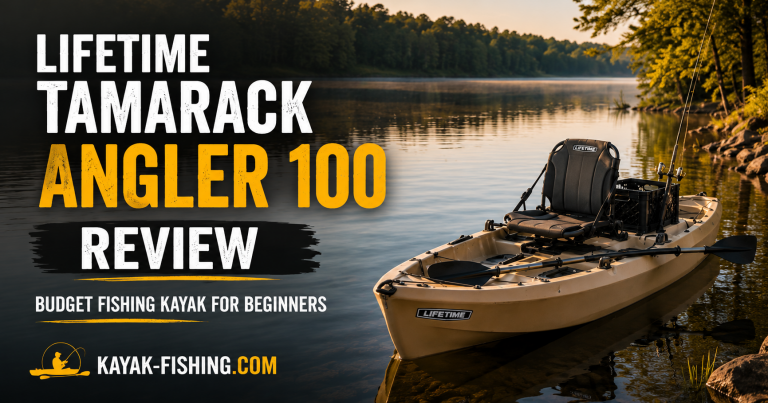
The Tamarack Angler 100 earns a place because not every beginner needs a 70-plus-pound fishing platform. Lifetime lists it at 120 inches long, 31 inches wide, about 49.8 pounds, and 275 pounds of maximum capacity. The layout includes the basic fishing features most new anglers need without demanding a complicated rigging plan.
Its advantage is not premium fishability. Its advantage is that it lowers the barrier to actually getting the kayak to the water. A lighter 10-foot hull is easier to store, slide into a truck bed, move around a garage, or handle with a basic kayak cart than many larger fishing kayaks.
The compromises are equally clear. Lifetime does not recommend standing in this model. The seat is a low padded design rather than a framed fishing chair, and 275 pounds disappears quickly once a bigger angler adds a crate, tackle, water, anchor, rods, paddle, PFD, and other gear.
Buyer implication: Buy the Angler 100 when price, weight, storage, and short calm-water trips are the priorities. Do not spend heavily modifying it to do jobs better handled by a wider or higher-capacity kayak. The full Tamarack Angler 100 review and Angler 100 vs Pro 103 comparison show where the upgrade becomes worthwhile.
3. Pelican Catch Classic 100 — Best Compact Standing-Friendly Option
Best for: Beginners who want a compact 10-foot kayak but do not want the narrow deck and seated-only focus of the Tamarack models.
Main advantage: Pelican combines a 34-inch beam, 350-pound maximum capacity, dual-position Ergocast Classic seat, gear rails, and a standing-friendly deck in a 57-pound kayak.
Main drawback: The short, wide hull is built around stability and fishability rather than efficient long-distance paddling.
Closest alternative: Catch Mode 110 if you want more open deck space, an elevated seat, and a stern-motor upgrade path.
The Catch Classic 100 fills an important gap between basic budget kayaks and heavier premium platforms. Pelican lists it at 10 feet long, 34 inches wide, 57 pounds, and 350 pounds of maximum capacity. The tunnel hull, high/low seat, accessory rails, rod storage, bow hatch, and rear tankwell create a much more fishing-specific platform than the simplest starter kayaks.
Pelican specifically describes the deck as providing room to stand and cast. That does not mean every beginner should immediately stand in a kayak; balance, body size, wake, wind, and load still matter. But the Classic 100 gives buyers who care about standing a factory-designed platform for it instead of asking a narrow budget kayak to do something it was not designed to do.
Buyer implication: Choose the Classic 100 if you want a short kayak with more capacity and deck confidence than the Tamaracks and do not expect to paddle long distances. If your usual fishing requires covering miles or crossing exposed water, a longer, more efficient hull may fit better.
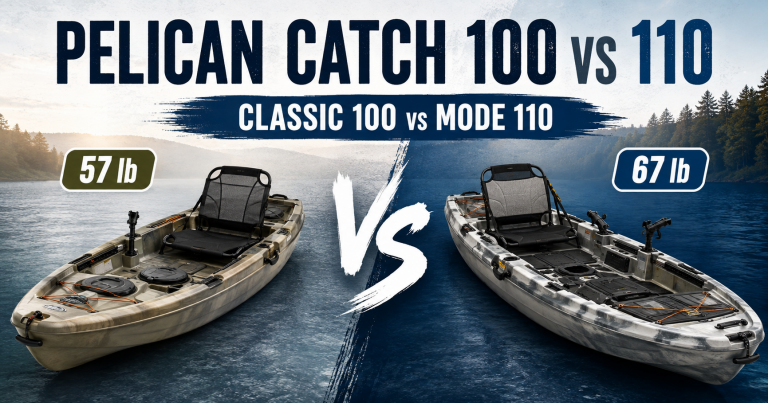
If you are deciding between Pelican’s two compact paddle options, see our Pelican Catch 100 vs 110 comparison for a direct breakdown of the Catch Classic 100 and Catch Mode 110 on weight, transport, stability, seating, storage, capacity, tracking, and motor compatibility.
4. Pelican Catch Mode 110 — Best for Stability With a Motor Upgrade Path
Best for: Beginners who want a wide standing-oriented deck, elevated seating, and the option to add Pelican’s supported stern transom later.
Main advantage: The 10-foot-8-inch Mode 110 combines a 34.5-inch beam, 375-pound maximum capacity, Ergoboost seat, traction pads, gear tracks, retractable skeg, and stern motor-mount compatibility.
Main drawback: At 67 pounds, it is noticeably more boat to carry and load than the Lifetime models.
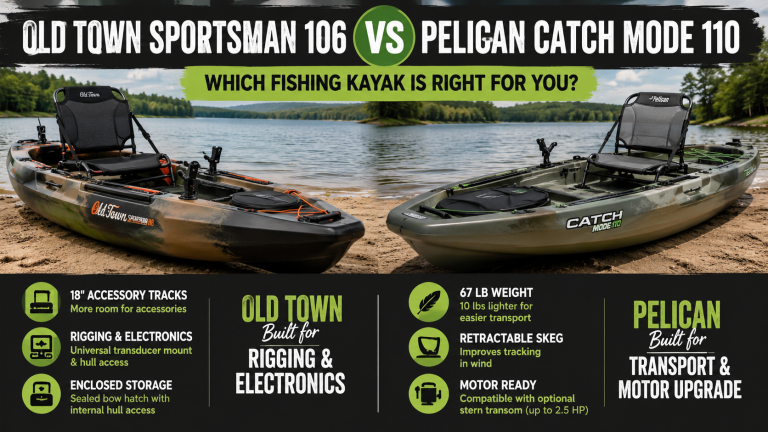
Closest alternative: Old Town Sportsman 106 if you want a more refined premium paddle platform and are willing to accept more weight and cost.
The Mode 110 makes sense for the beginner who already knows deck space and standing confidence matter. Pelican lists a tunnel hull, wide flat standing area, anti-slip pads, an adjustable elevated seat, accessory tracks, side tackle storage, three flush-mount rod holders, rear tankwell, and retractable skeg.
The standard Mode 110 is also compatible with Pelican’s optional stern transom system. That gives a buyer a manufacturer-supported path toward small-motor use instead of immediately improvising a mount. A motor can trigger registration and equipment requirements, so verify the rules where you use it.
The tradeoff is transport. A 67-pound, 34.5-inch-wide fishing kayak is still manageable for many owners, but it is a bigger solo-loading job than a 50- to 58-pound starter. The Mode 110 should be chosen because you want the deck and capacity, not simply because a wider kayak looks more impressive.
Buyer implication: Choose the Mode 110 if you fish ponds, lakes, slow rivers, and protected water and want a broad fishing platform you are less likely to outgrow. If you are comparing it directly with the Old Town, the Sportsman 106 vs Catch Mode 110 comparison breaks down the tradeoff.
5. Perception Outlaw 11.5 — Best for Bigger Anglers and More Deck Room
Best for: Larger beginner anglers, heavier gear loads, and buyers who value deck space and elevated seating more than easy solo loading.
Main advantage: Perception lists a 425-pound maximum capacity, 35-inch width, expansive standing platform, removable elevated Pro seat, bow and stern tankwells, and multiple accessory mounting points.
Main drawback: The 11-foot-6-inch hull weighs 77 pounds, which raises the transport and storage commitment considerably.
Closest alternative: Old Town Sportsman 106 for a shorter premium platform, or Catch Mode 110 for lower weight.
The Outlaw 11.5 belongs here because bigger beginners should not have to pretend a 275- or 300-pound capacity is enough once fishing gear is added. Perception lists the Outlaw at 138 inches long, 35 inches wide, 77 pounds, and 425 pounds of maximum capacity.
Its removable Pro seat sits five inches above the deck, and Perception builds the kayak around an open standing platform, two double-barrel rod holders, Solo Mount recesses, and large bow and stern storage areas. That creates more working room than compact budget kayaks and gives the buyer more margin for a crate, cooler, tackle, and other gear.
Capacity alone should not make the decision. A 77-pound, 11-foot-6-inch kayak needs a realistic transportation plan. A truck bed or trailer can make the Outlaw practical; repeated solo roof loading may make it the wrong first kayak even if the on-water layout looks ideal.
Buyer implication: Choose the Outlaw if you need more body-and-gear capacity or simply want a larger deck and raised seating. Skip it if the kayak has to be carried far, stored in a tight space, or loaded overhead every trip.
6. Old Town Sportsman 106 — Best Premium Paddle Kayak for a Beginner
Best for: A beginner who already knows kayak fishing will be a regular hobby and wants to buy a refined paddle platform instead of starting at the budget end.
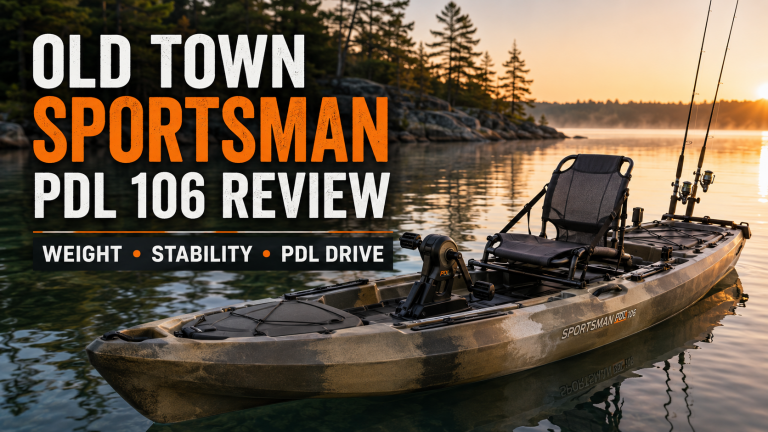
Main advantage: Old Town combines a compact 10-foot-6-inch hull with a 34.5-inch beam, high/low Element seat, stand-up DoubleU hull, sealed bow storage, oversized tankwell, accessory tracks, three rod holders, and a universal transducer mount.
Main drawback: The assembled boat weighs 77 pounds, and the premium feature set costs substantially more than an entry-level Lifetime.
Closest alternative: Pelican Catch Mode 110 for lower weight and a lower-cost path to a wide standing deck.
The Sportsman 106 is the buy-once paddle option in this guide. Old Town lists it at 10 feet 6 inches, 34.5 inches wide, 77 pounds assembled, 440 pounds total capacity, and 363 pounds usable capacity. That capacity terminology matters: Old Town already subtracts the boat’s own weight when it reports usable capacity.
The fishing layout is more complete than the budget models. The Element seat can be positioned high or low and removed for transport. The open cockpit uses EVA deck pads, the stern has an oversized tankwell, the bow has sealed storage, and the hull includes accessory tracks, horizontal rod storage, flush rod holders, adjustable foot braces, and a transducer-mounting system.
In Kayak-Fishing.com’s Sportsman 106 review, recurring owner feedback was especially positive about stability, deck room, and the seat. Weight was the clearest repeated everyday drawback. That matches the spec-sheet tradeoff: the Sportsman is compact by fishing-kayak standards, but 77 pounds is still a serious object to put on a roof.
Buyer implication: Choose the Sportsman 106 if you want a compact paddle kayak with premium seating, fishing storage, stand-up capability, and enough usable capacity for a substantial load. Skip it if a 77-pound kayak will make every trip harder to start.
What Beginners Should Prioritize Before Buying
1. Buy the kayak you can transport
Transport is not a side issue. It is part of the product. A stable 77-pound fishing kayak may be a better boat on the water, but a 50- to 58-pound kayak may be the better purchase if you fish alone and have to lift it onto a tall vehicle.
Before buying, decide whether you will use a truck bed, roof rack, small trailer, or another rated transport system. Practice the loading motion mentally—and preferably physically—before choosing the heaviest model you can afford.
2. Treat capacity as a loaded-system number
Your body weight is only the start. Add the PFD, paddle, crate, rods, tackle, water, anchor, dry bag, electronics, battery, cooler, landing net, and anything else that comes aboard. If the kayak is near its published maximum before you finish packing, move up in capacity rather than assuming the number on the spec sheet is an ideal operating target.
3. Seat comfort deserves more attention than beginners give it
A low-cost kayak can look like the bargain until the seat becomes the first thing you replace. That is why the Tamarack Pro 103 ranks above the cheaper Angler 100 for most buyers. A better factory seat can be more valuable than several small accessories added later.
4. Stability and speed trade against each other
Wide, flat, tunnel, and pontoon-style fishing hulls can feel reassuring at rest and create useful casting decks, but they are not touring kayaks. Buyers who plan to paddle long distances should care more about hull efficiency than buyers who fish a cove 200 yards from the launch.
Wind also matters more than many new anglers expect. A wide kayak with a high seat, crate, rods, and gear gives the wind plenty to push. Review the kayak fishing in wind guide before assuming a very stable kayak automatically solves difficult conditions.
5. Do not buy accessories before you learn the boat
A PFD and proper transport setup come before a fish finder, camera arm, extra rod holder, or elaborate anchor system. Fish the kayak with a simple crate and minimal tackle first. The first few trips will show where gear naturally belongs and which upgrades solve a real problem.
The beginner kayak fishing mistakes guide covers overpacking, clutter, wind, anchors, and other problems that are easier to prevent than fix on the water.
How Much Should a Beginner Spend on a Fishing Kayak?
There is no useful universal dollar target because kayak pricing changes by season, color, retailer, shipping method, and model year. A better way to set the budget is to decide which upgrades actually change the fishing experience.
- Spend less if you mainly fish short sessions on ponds and small lakes, need low transport weight, and are comfortable with a basic seat and simple layout.
- Spend more for the seat if you know you will fish several hours at a time. The Pro 103 is the clearest example of a modest step up buying a meaningful everyday improvement.
- Spend more for deck space and capacity if you are a bigger angler, carry more gear, or strongly value standing. That is where the Catch models, Outlaw, and Sportsman earn their added size.
- Do not pay for propulsion you do not need. Pedal and motor systems can be excellent, but they add cost, weight, storage, and maintenance. A simple paddle kayak remains a rational first boat for many anglers.
Should Your First Fishing Kayak Have Pedals?
Not necessarily. All six primary picks in this guide are paddle-first kayaks because paddle propulsion keeps the first purchase simpler.
A paddle kayak usually costs less, weighs less, has fewer moving parts, and handles very shallow water without worrying about a drive hanging below the hull. It also forces the beginner to learn basic boat control, which remains useful if a pedal kayak comes later.
Pedals become attractive when hands-free positioning is central to the way you fish. Holding the bow on a grass edge, adjusting around docks while a lure is in the water, or fighting wind while keeping both hands on the rod are real advantages.
The tradeoff is that a pedal drive adds cost, weight, cockpit complexity, storage, and maintenance. If you already know hands-free propulsion is a requirement, shop specifically for a pedal platform rather than buying a paddle kayak you immediately plan to replace.
10-Foot vs 12-Foot Fishing Kayaks for Beginners
A 10-foot fishing kayak is often the easier first purchase because it stores in less space, fits many truck beds more conveniently, turns easily on small water, and can weigh less. That is why the Tamarack Angler 100, Pro 103, Catch Classic 100, and Sportsman 106 all make sense for beginners.
Moving toward 11.5 to 12 feet usually buys more deck room, better tracking, and potentially more capacity. It also creates a longer object to store and transport. The Outlaw 11.5 is a good example: the extra room is useful, but it is a materially bigger kayak to handle than the compact Lifetimes.
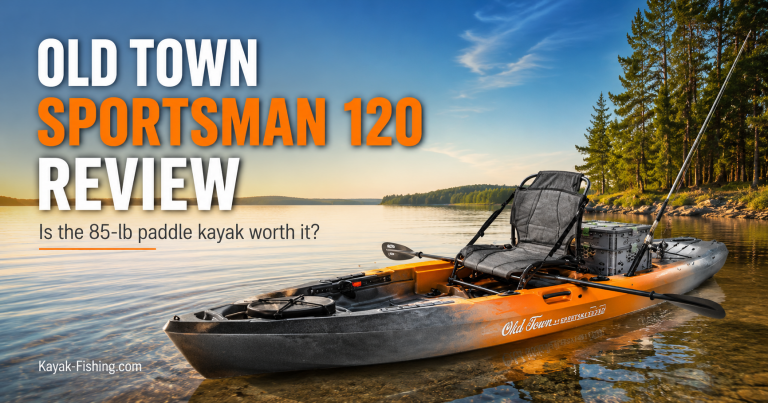
If you are considering that move within the Old Town lineup, our Old Town Sportsman 120 review shows the tradeoff clearly: the 12-foot model adds capacity and hull length, but its 85-pound assembled weight makes transport part of the buying decision.
Do not choose length in isolation. Width, hull shape, weight, seat height, capacity, and the water you fish matter just as much.
Fishing Kayak Capacity: Count More Than Body Weight
Capacity is one of the easiest specifications to misuse. The published number has to account for the loaded system, not just the angler.
| Load Item | Easy to Forget? |
|---|---|
| Angler | No |
| PFD and clothing | Often |
| Paddle | Often |
| Crate and tackle | No |
| Rods and net | Often |
| Anchor and line | Often |
| Water, food, cooler | Often |
| Fish finder, battery, wiring | Often |
| Motor and battery, if added | Critical |
Also note how manufacturers label the number. Old Town’s 363-pound usable capacity for the Sportsman 106 is not directly equivalent to a competitor’s maximum-capacity figure. Compare definitions, not just numbers.
Should a Beginner Buy a Kayak You Can Stand In?
Standing is useful, but it is not a beginner requirement. Plenty of effective kayak fishing happens seated.
If standing is important, buy a kayak designed for it. Pelican describes standing-friendly decks on the Catch Classic 100 and Mode 110. Perception builds the Outlaw around an expansive standing platform, and Old Town describes the Sportsman 106 as a stand-up fishing platform.
Lifetime takes the opposite position on the Tamarack Angler 100 and Pro 103 and does not recommend using them as stand-up fishing kayaks. That is useful information, not a defect. A narrower, lighter seated-fishing design may be exactly what a beginner needs if transport and price matter more than standing.
Whatever the design, standing depends on body size, balance, load placement, wake, wind, current, and water conditions. Practice any new movement conservatively in suitable controlled conditions while wearing a properly fitted PFD. The kayak fishing safety guide covers the broader planning side.
Final Decision: Which Beginner Fishing Kayak Should You Buy?
| Choose This Kayak | If This Sounds Like You |
|---|---|
| Lifetime Tamarack Pro 103 | You want the best balance of manageable weight, framed-seat comfort, simple fishing features, and beginner-friendly calm-water use. |
| Lifetime Tamarack Angler 100 | You want to spend as little as practical and prioritize light weight, storage, and short seated trips. |
| Pelican Catch Classic 100 | You want a short kayak but prefer a wider deck, higher capacity, and factory-supported standing-friendly design. |
| Pelican Catch Mode 110 | You want a broad fishing deck, elevated seat, and a legitimate path to a small stern motor later. |
| Perception Outlaw 11.5 | You are a bigger angler or want substantial deck room and capacity, and transport weight is manageable. |
| Old Town Sportsman 106 | You already know you will fish often and want a compact premium paddle platform with a more complete fishing layout. |
For the largest share of true beginners, the Lifetime Tamarack Pro 103 is the most balanced place to start. It is not the cheapest, widest, or highest-capacity kayak here. It combines manageable dimensions and weight with the framed seat and fishing layout that many beginners appreciate once trips get longer.
The Tamarack Angler 100 is the better answer when cost and transport dominate the decision. The Catch Classic 100 and Mode 110 are stronger choices when standing-friendly deck space matters. The Outlaw 11.5 serves heavier loads and larger anglers better. The Sportsman 106 is the premium paddle choice for someone who would rather buy a more refined fishing platform from the beginning.
Whichever kayak you choose, budget for a comfortable PFD before optional fishing electronics or accessories. The best PFDs for kayak fishing guide compares current options by seat compatibility, fit, heat management, storage, and budget.
Best Fishing Kayaks for Beginners FAQs
What is the best fishing kayak for a beginner?
For most beginners fishing calm lakes, ponds, protected coves, and slow rivers, a stable sit-on-top kayak with a comfortable seat, manageable transport weight, enough capacity for the paddler plus gear, and a simple fishing layout is the best starting point. In this guide, the Lifetime Tamarack Pro 103 is the best fit for many beginners who want a balance of comfort, manageable weight, and price.
Is a 10-foot fishing kayak good for beginners?
Yes. A 10-foot fishing kayak can be a very good beginner choice for ponds, small lakes, protected coves, and short trips because it is usually easier to store, transport, and turn. The tradeoff is less glide, less room, and often more sensitivity to wind than a longer kayak.
Should a beginner buy a paddle or pedal fishing kayak?
A paddle kayak is usually the simpler first purchase because it costs less, weighs less, has fewer moving parts, and works well in shallow water. A pedal kayak makes more sense when hands-free boat control is worth the extra cost, weight, storage, and maintenance.
How much capacity does a beginner fishing kayak need?
Capacity should cover the paddler plus the PFD, paddle, tackle, crate, rods, water, anchor, electronics, cooler, and every other item in the kayak. Do not shop by body weight alone, and do not treat a published maximum capacity as the ideal everyday operating load.
Do beginners need a fishing kayak they can stand in?
No. Standing is useful for anglers who sight-fish or strongly prefer stand-up casting, but it is not a requirement for learning to kayak fish. A lighter seated-fishing kayak can be easier to transport and may be the better first purchase if standing is not a priority.
What fishing kayak is best for a bigger beginner angler?
Bigger anglers should compare capacity, seat fit, deck room, stability-focused hull design, and transport weight together. In this guide, the Perception Outlaw 11.5 stands out for its 425-pound maximum capacity, 35-inch width, spacious deck, and elevated seat, but its 77-pound weight and 11-foot-6-inch length make transport more demanding.