Pelican Catch 100 vs 110: Catch Classic 100 vs Catch Mode 110
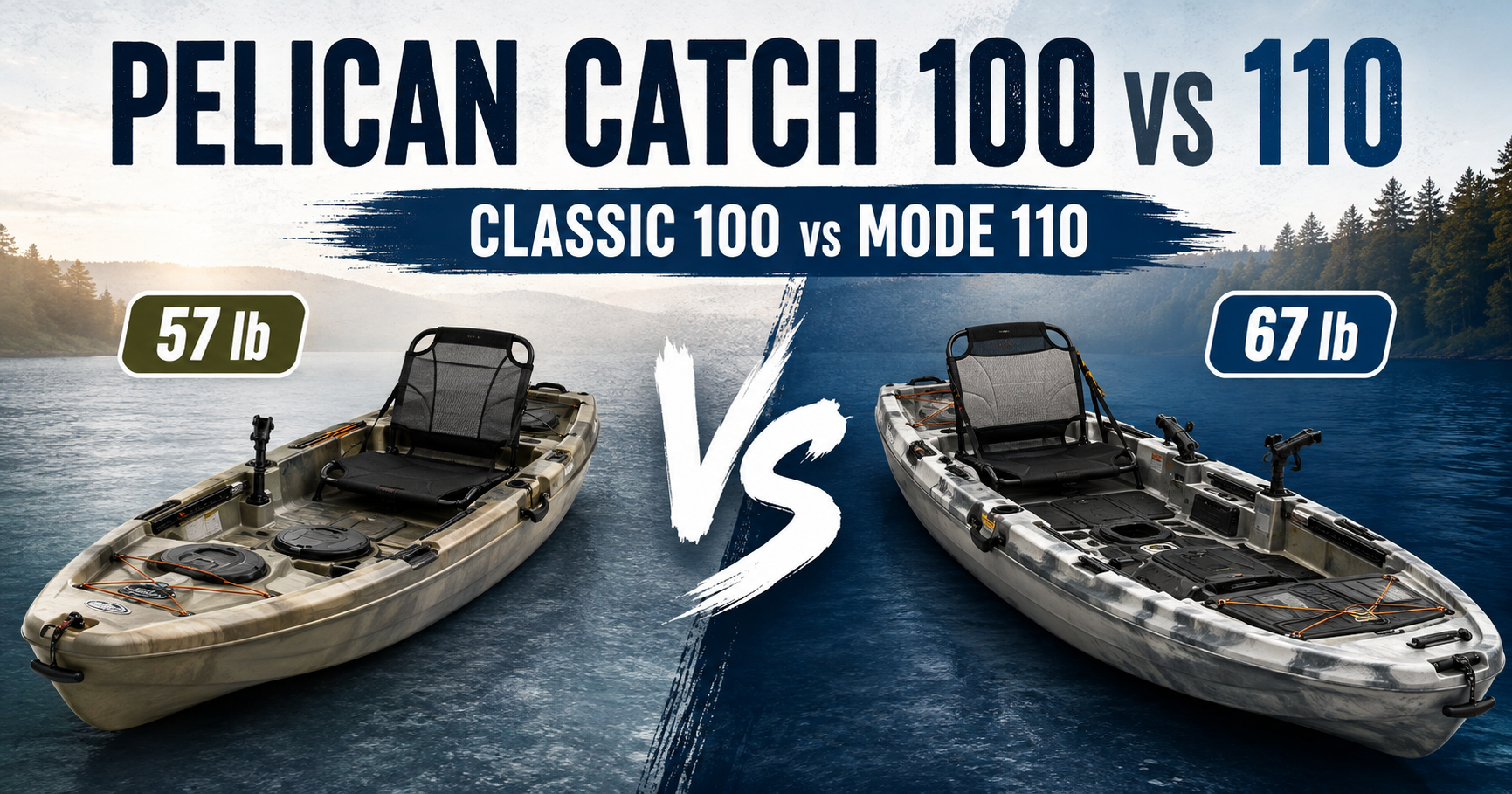
Comparing the Pelican Catch 100 vs 110 usually means choosing between the Catch Classic 100 and Catch Mode 110. Both are compact paddle fishing kayaks, but they solve different problems: the Classic 100 is lighter and easier to transport, while the Mode 110 provides a more developed fishing layout, an adjustable Ergoboost seat, additional capacity, a tracking skeg, and factory-supported stern-motor compatibility.
Choose the Catch Classic 100 if lower weight, compact storage, and easier solo handling matter most. Choose the Catch Mode 110 if you want the more capable fishing platform and can comfortably transport the extra 10 pounds.
If you’re still comparing the broader lineup, our Pelican Catch model guide covers the other paddle, pedal, and motor-compatible options.
Disclosure: This article contains affiliate links. If you buy through these links, Kayak-Fishing.com may earn a commission at no extra cost to you.
Comparison basis: Core specifications and features were checked against current Pelican/Confluence Outdoor documentation. Independent testing is used where it adds useful on-water evidence. Kayak-Fishing.com has not personally tested these two kayaks, so no firsthand use is implied.
Pelican Catch 100 vs 110: Key Differences
| Feature | Catch Classic 100 | Catch Mode 110 |
|---|---|---|
| Length | 10 ft / 120 in | 10 ft 8 in / 128 in |
| Width | 34 in | 34.5 in |
| Weight | 57 lb | 67 lb |
| Maximum capacity | 350 lb | 375 lb |
| Propulsion | Paddle | Paddle |
| Seat | Ergocast Classic dual-position | Ergoboost |
| Rigging tracks | Two 4-inch tracks | Two 4-inch tracks |
| Rear tankwell | Yes | Yes |
| Standing-oriented deck | Yes | Yes |
| Retractable skeg | Not listed | Yes |
| Pelican stern transom compatibility | Not listed | Yes; optional transom |
| Maximum motor rating with Pelican transom | — | 2.5 hp / 1.8 kW |
The biggest differences are not the half-inch of width or 25 pounds of additional rated capacity. For most buyers, the decision comes down to transport versus fishing capability. The Classic 100 saves 10 pounds and eight inches of hull length. The Mode 110 uses that extra size and weight to provide a more developed fishing platform.
Quick Verdict: Catch 100 or Catch 110?
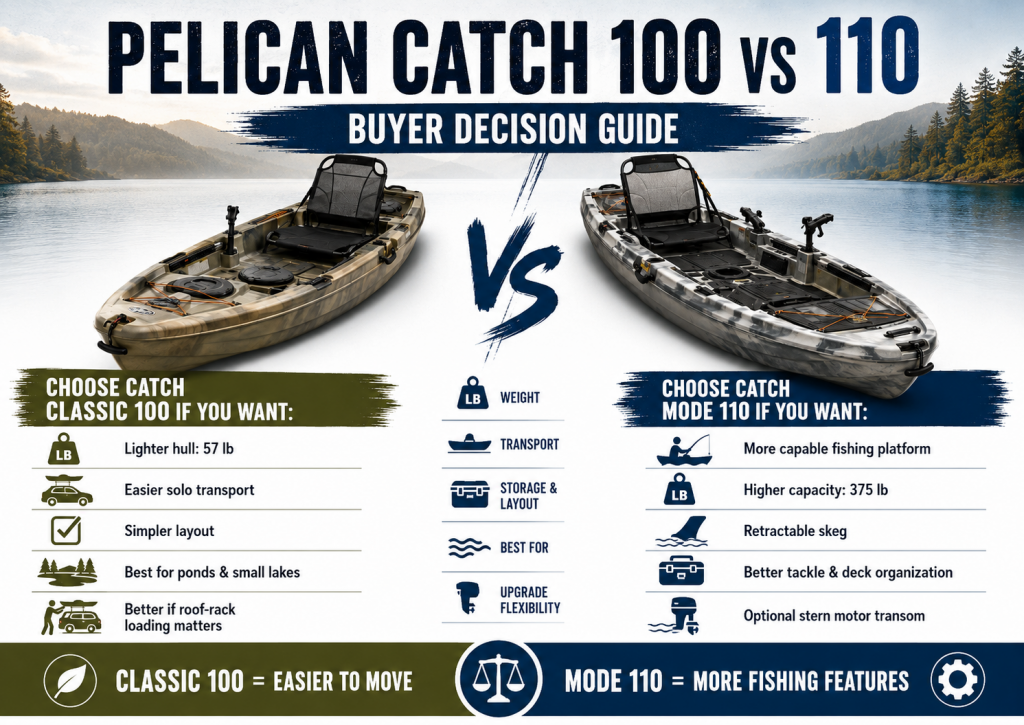
Choose the Catch Classic 100 if:
- You usually load and unload the kayak by yourself.
- Roof-rack loading is part of most fishing trips.
- Storage space at home is limited.
- You fish mostly ponds, smaller lakes, and protected slow water.
- You want a simple paddle fishing kayak without paying for features you may not use.
- Keeping hull weight down matters more than maximizing fishing space.
Choose the Catch Mode 110 if:
- Standing and casting are important to you.
- You want a more developed fishing deck and tackle layout.
- You carry more tackle and accessories.
- You want a retractable skeg to help with tracking.
- You may eventually add Pelican’s optional stern transom and a small motor.
- The extra 10 pounds will not make transporting the kayak significantly harder.
Overall winner for fishing capability: Catch Mode 110.
Better choice for lower weight and easier transport: Catch Classic 100.
That does not make the Mode 110 the automatic better buy. If the kayak has to be lifted onto a roof rack alone after every trip, the Classic 100’s 10-pound weight advantage may matter more than the Mode 110’s additional features.
Catch Classic 100
Best fit if lower weight, compact storage, and easier solo transport are the priorities.
Catch Mode 110
Best fit if fishing layout, tracking, capacity, and future rigging flexibility matter more.
Retailer configurations can vary. Confirm the exact model, included hardware, color, and SKU before ordering.
Transport and Weight: Classic 100 Is Easier to Handle
Transport is one of the strongest reasons not to automatically choose the larger kayak.
The Catch Classic 100 weighs 57 pounds, while the Catch Mode 110 weighs 67 pounds. The Classic is also eight inches shorter.
A 10-pound difference may not seem dramatic when comparing specifications on a screen. It becomes more meaningful when the kayak has to be lifted to shoulder height, pushed onto a roof rack, carried down an uneven bank, or moved around a garage after every trip.
The Classic 100 therefore makes more sense for anglers whose biggest limitation is getting the kayak to the water. That advantage can matter especially for a first fishing kayak: a slightly simpler boat that is noticeably easier to move can get used more often.
The Mode 110 is still relatively compact for a fishing kayak. Independent testing has also highlighted its sub-11-foot length and large side handles as useful portability features. But between these two Pelicans, the Classic 100 wins on transport.
Winner: Catch Classic 100
Stability and Standing: Mode 110 Has Stronger Evidence
Both kayaks are designed around stability and standing-friendly fishing layouts.
Pelican describes the Classic 100 as having a flatter hull intended to provide stability and specifically promotes standing while fishing. The Mode 110 uses a tunnel hull with a wide, flat deck and anti-slip traction pads.
The difference is the amount of independent evidence available. In an on-water test of the Mode 110, paddlesports reviewer Ken Whiting reported that it felt solid in the normal seat position, elevated position, and while standing.
There is no controlled head-to-head test proving the Mode 110 is universally more stable than the Classic 100, so we would not treat stability as an absolute win based on width alone. Angler weight, height, balance, gear placement, wind, and boat wake all affect how stable a kayak feels.
If standing is a major reason for buying, however, the Mode 110 has the stronger documented case because its broad tunnel-hull deck and traction-pad layout are clearly built around standing and casting.
Advantage: Catch Mode 110
Paddling and Tracking: Mode 110 Gets the Skeg
Neither kayak should be bought primarily for speed. These are short, wide fishing kayaks that prioritize stability and deck usefulness over efficient long-distance paddling.
The Catch Mode 110 includes a retractable stern skeg, which Pelican says is intended to improve tracking in windy conditions. Independent testing also found that deploying the skeg noticeably improved its ability to hold a straighter course.
That test identified an important limitation: once the skeg was lowered, the tester could not retract it again from the cockpit and had to return to shore to move it manually.
The Classic 100 does not list a comparable retractable skeg in Pelican’s current specifications.
If your fishing involves only short moves around a small pond, the difference may not matter much. If you routinely paddle across an open lake or deal with wind pushing a short, wide kayak off course, the Mode 110’s tracking aid becomes more useful.
Tracking aids help, but wind still changes how these wide fishing platforms handle. Our kayak fishing in wind guide covers route planning and boat control in more detail.
Winner: Catch Mode 110
Seat and Comfort
The Catch Classic 100 uses Pelican’s Ergocast Classic dual-position seat, which the manufacturer lists as adjustable between high and low positions.
The Mode 110 uses the Ergoboost seating system. Pelican says it can be adjusted to provide an elevated seating position and better field of vision, and it includes an EVA seat pad and under-seat storage.
That elevated configuration has practical fishing benefits. Starting from a higher position can improve visibility and can make the transition to standing easier than starting close to deck level.
Independent testing of the Mode 110 praised the suspension-style seat and range of seating positions but also identified some side-to-side seat movement and less lumbar support than the tester preferred.
Tall anglers should also pay attention to cockpit fit. The same tester, at 6-foot-2 with long legs, reported using the footpegs at their maximum extension. That is one person’s fit experience rather than a universal height limit, but it makes trying the seating position worthwhile for substantially taller buyers.
Advantage: Catch Mode 110 for fishing-position flexibility
Fishing Deck and Storage
The Catch Classic 100 keeps its fishing layout relatively simple. Pelican equips it with two 4-inch rigging tracks, a locking front hatch, anti-slip deck material, paddle/rod tie-downs, adjustable footrests, and a rear tankwell with bungee storage.
That is enough for a straightforward fishing setup. A crate in the rear tankwell, a few tackle trays, and track-mounted accessories can cover a lot of freshwater fishing without turning the kayak into a complicated rigging project.
The Mode 110 provides a more developed workspace. Its current manufacturer feature list includes a bow tankwell with mesh cover and paddle sleeve, rod-tip protectors, two 4-inch rigging tracks, traction padding, two side tackle-box storage areas, paddle/rod tie-downs, three flush-mount rod holders, under-seat storage, and a rear tankwell.
Those features become useful if you carry several rods, want tackle accessible without constantly reaching into a rear crate, or expect the kayak setup to become more elaborate over time.
The Mode 110 is only eight inches longer, but more of its layout is organized around keeping fishing gear immediately accessible.
Winner: Catch Mode 110
Capacity: 350 vs 375 Pounds
Pelican rates the Classic 100 for a 350-pound maximum weight capacity and the Mode 110 for 375 pounds.
The 25-pound difference is useful, but neither number should be treated as a target operating load. Everything carried in or on the kayak contributes to the total load.
- Angler
- PFD and clothing
- Rods and tackle
- Crate
- Anchor
- Cooler
- Electronics
- Battery, motor, and mounting hardware when applicable
A 300-pound angler, for example, has only 50 pounds of published capacity remaining in the Classic 100 before reaching the manufacturer maximum. The Mode 110 increases that theoretical margin to 75 pounds.
That does not mean either kayak should automatically be loaded to its maximum rating. Handling and freeboard can change as total load increases. Buyers approaching either rating should consider whether a higher-capacity kayak is a better fit.
Winner: Catch Mode 110
Trolling Motor Compatibility
This may be the deciding factor for buyers who think they could add a motor later.
Pelican lists the standard Catch Mode 110 as compatible with its optional stern transom. The manufacturer rates the transom configuration for motors up to 2.5 horsepower / 1.8 kW. The optional transom is not included with the standard manufacturer configuration.
Pelican’s current Catch Classic 100 specifications do not list the same stern-transom provision.
That makes the Mode 110 the better starting point if future motor use is part of the buying plan. Remember that adding a motor also means adding a mount, battery, wiring, and additional weight.
Motorizing a kayak can also change registration and equipment requirements depending on where it is operated. Verify the applicable state rules before building a motorized setup.
Winner: Catch Mode 110
Which Is Better for Small Lakes and Ponds?
The Catch Classic 100 makes a strong case on small water.
On a pond or neighborhood lake, the advantages of a more developed fishing platform can matter less because you may only paddle short distances between spots. The Classic’s 10-foot hull is easier to store and transport, while its fishing layout is still sufficient for a basic crate-and-tackle setup.
Choose the Mode 110 instead if standing, extra tackle organization, or its seat and skeg features matter more than minimizing size and weight.
Winner for simple pond fishing: Catch Classic 100
Which Is Better for Bass Fishing?
For anglers who regularly use multiple rods, tackle trays, electronics, or a crate, the Catch Mode 110 is the more developed fishing platform.
Its broad deck, side tackle storage, rigging tracks, adjustable Ergoboost seat, and standing-oriented layout give the angler more ways to organize gear around the cockpit.
The Classic 100 still works for a simpler setup. If you carry a couple of rods, a small crate, and a few tackle boxes, there is no requirement to choose the larger kayak.
Winner for a more developed bass-fishing setup: Catch Mode 110
Which Is Better for Beginners?
This depends on what the beginner is most concerned about.
Choose the Classic 100 if carrying the kayak, loading it alone, storing it at home, and keeping the setup simple are the biggest concerns.
Choose the Mode 110 if a broad fishing platform, adjustable elevated seating, standing space, accessory organization, and room to grow into a more developed fishing setup matter more.
For many beginners, transport deserves more weight in the decision than it gets. A 57-pound kayak that is easy to move can be a better first kayak than a 67-pound model with more features that becomes annoying to load.
If neither Pelican clearly fits your transport, capacity, or budget requirements, our best fishing kayaks for beginners guide compares several alternatives.
Who Should Buy the Catch Classic 100?
The Catch Classic 100 makes the most sense for an angler who wants a genuine fishing layout without turning every trip into a transportation project.
- You fish smaller lakes, ponds, and protected slow water.
- You have limited garage or shed space.
- You lift the kayak onto a vehicle alone.
- You want to keep your fishing setup relatively simple.
- You do not expect to build the kayak around a stern motor.
Its biggest advantages are practical rather than flashy: it is shorter, 10 pounds lighter, and simpler to live with.
If that sounds like the way you will actually transport and fish, check the Catch Classic 100 on Amazon.
Who Should Skip the Catch Classic 100?
Compare other options if standing is one of your highest priorities, you carry substantial fishing gear, you are already close to the Classic 100’s 350-pound maximum capacity, or you know you want manufacturer-supported stern motor compatibility.
Also look elsewhere if your normal fishing day involves long open-water paddles, strong current, or exposed conditions where paddling efficiency matters more than a compact fishing platform.
Who Should Buy the Catch Mode 110?
The Catch Mode 110 is the better choice for anglers who want more fishing capability without moving into a much larger kayak.
- You want an adjustable elevated fishing-seat configuration.
- You value a broad standing-oriented deck.
- You want tackle storage close to the cockpit.
- You want a retractable skeg for additional tracking help.
- You need a little more published capacity.
- You may add Pelican’s optional stern transom later.
It is the more complete fishing platform of the two, provided the additional hull weight does not create a transport problem.
If that tradeoff fits your setup, check the Catch Mode 110 on Amazon.
Who Should Skip the Catch Mode 110?
Skip it if the 67-pound hull will create problems every time you fish. Someone routinely lifting a fishing kayak onto a tall SUV may value the Classic 100’s lower weight more than the Mode 110’s additional features.
It is also not designed as a fast touring kayak. Independent testing reinforces what its dimensions suggest: the short, wide hull prioritizes fishing stability rather than effortless long-distance glide.
Very tall buyers should test the seating position if possible because one 6-foot-2 independent tester with long legs reached the maximum footpeg extension.
If you like the Mode 110’s compact size but want more factory support for electronics and fishing rigging, see our Old Town Sportsman 106 vs Catch Mode 110 comparison.
Pelican Catch 100 vs 110: Final Verdict
The Pelican Catch Classic 100 and Catch Mode 110 solve slightly different problems.
The Classic 100 is the better choice when getting the kayak to and from the water is a major part of the buying decision. At 57 pounds and 10 feet long, it is easier to store, move, and load than the Mode 110 while still providing a framed dual-position seat, rigging tracks, storage, and a fishing-oriented deck.
The Mode 110 is the stronger overall fishing platform. Its 375-pound maximum capacity, wide tunnel-hull deck, Ergoboost seating system, side tackle storage, traction pads, retractable skeg, and optional stern-transom compatibility give it more room to grow with the angler.
Buy the Catch Classic 100 if lower weight, compact size, and simplicity matter most.
Buy the Catch Mode 110 if fishing layout, standing-oriented deck space, tracking, capacity, and future motor flexibility matter more.
For buyers who can comfortably transport the extra 10 pounds, the Mode 110 provides the more developed long-term fishing platform. For the angler who has to wrestle a kayak onto a roof rack alone every weekend, the Classic 100 may be the smarter purchase precisely because it gives up some capability to remain easier to live with.
Check Current Options
Pelican Catch Classic 100
Better for lower weight, compact storage, and easier solo handling.
Pelican Catch Mode 110
Better for fishing layout, tracking, capacity, and future rigging flexibility.
Pelican Catch 100 vs 110 FAQs
What is the difference between the Pelican Catch 100 and 110?
When comparing the current Catch Classic 100 with the Catch Mode 110, the Classic is 10 feet long, 57 pounds, and rated to 350 pounds. The Mode 110 is 10 feet 8 inches long, 67 pounds, and rated to 375 pounds. The Mode also adds a more developed fishing deck, Ergoboost seating, side tackle storage, a retractable skeg, and compatibility with Pelican’s optional stern transom.
Is the Pelican Catch 100 or 110 more stable?
There is no controlled head-to-head stability test establishing a universal winner. Both are designed as stable fishing platforms. The Mode 110 has stronger independent evidence for standing use, with published on-water testing finding it solid while normally seated, elevated, and standing. Individual stability will still depend on paddler size, balance, gear load, and water conditions.
Which is easier to transport, the Pelican Catch 100 or 110?
The Catch Classic 100. It weighs 57 pounds compared with 67 pounds for the Mode 110 and is eight inches shorter. That 10-pound difference can be significant for frequent solo roof loading or carrying the kayak to the launch.
Can you put a trolling motor on the Pelican Catch Mode 110?
Pelican lists the standard Catch Mode 110 as compatible with its optional stern transom, with a maximum motor rating of 2.5 horsepower / 1.8 kW. The optional transom is not included with the standard manufacturer configuration. Check the exact retailer package and applicable registration requirements before adding a motor.
Is the Pelican Catch Mode 110 worth the extra weight?
It can be if you value its additional fishing features. The Mode 110 adds 25 pounds of maximum rated capacity, a more developed tackle and deck layout, Ergoboost seating, a tracking skeg, and optional stern-transom compatibility while weighing 10 pounds more than the Classic 100. If transport is already difficult, the lighter Classic 100 may still be the better buy.
Sources and verification
Core specifications and features were checked against current Pelican/Confluence Outdoor documentation for the Catch Classic 100 and Catch Mode 110. On-water Mode 110 observations referenced in this comparison come from Ken Whiting’s independent test. Retailer listings can vary by model year and configuration, so confirm the exact SKU and included hardware before purchase.