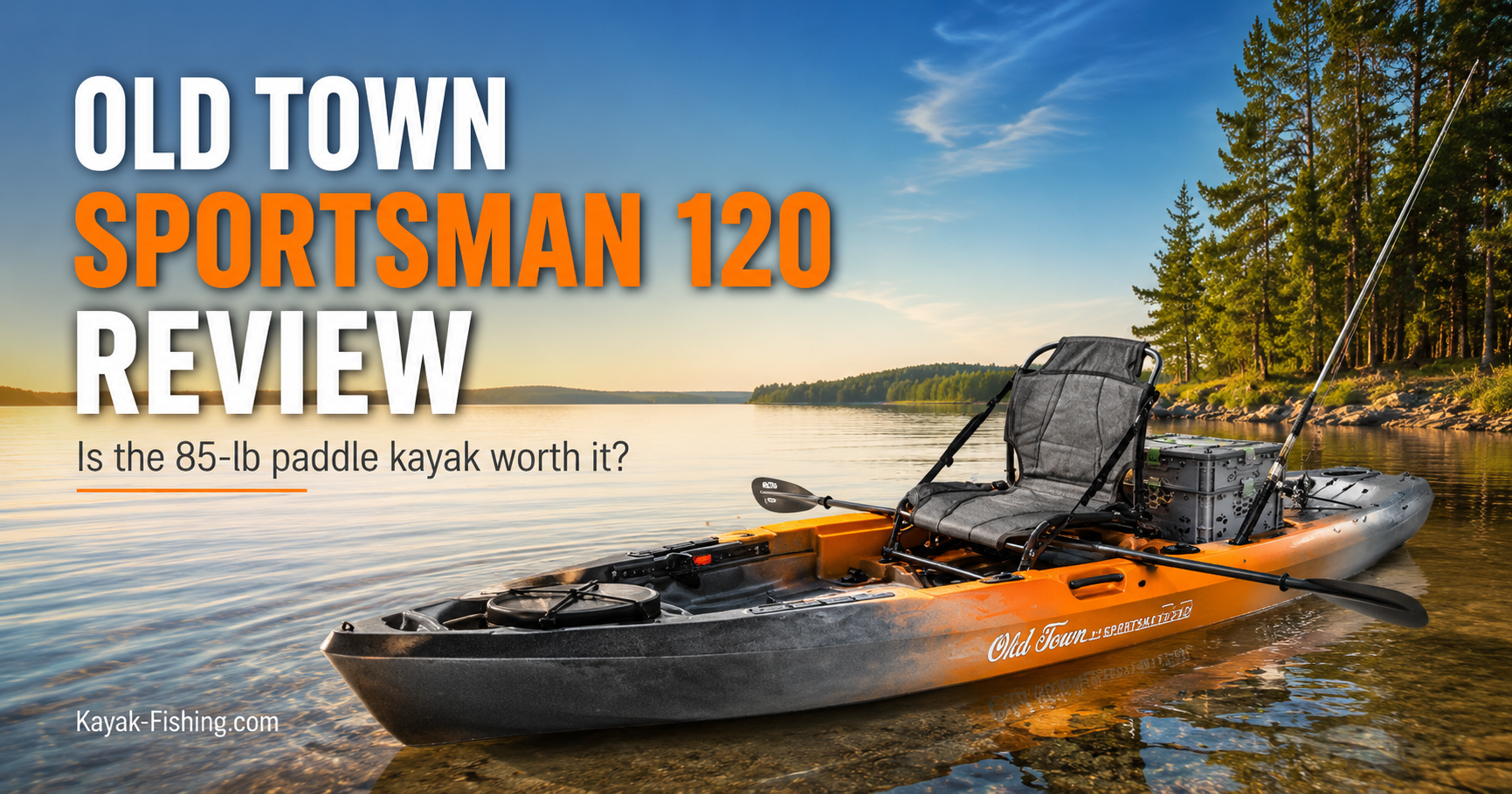
Old Town Sportsman 120 Review: Is the 85-Lb Paddle Kayak Worth It?
The Old Town Sportsman 120 asks a more important question than whether it is stable or well equipped: are you willing to own and transport an 85-pound, 12-foot paddle kayak to get its extra space, capacity, and fishing platform?
That tradeoff defines this Old Town Sportsman 120 review. The standard paddle model gives you a 415-pound usable capacity, Old Town’s stability-focused DoubleU hull, a large open cockpit, an elevated high/low seat, substantial storage, and a fishing-specific layout without moving into pedal-drive pricing or complexity. But none of those advantages make the kayak easier to lift onto a vehicle or move from the parking lot to the water.
Research note: Kayak-Fishing.com has not personally tested the Sportsman 120. This review is based on manufacturer documentation, independent coverage, owner feedback, and our analysis.
Affiliate disclosure: Kayak-Fishing.com may earn a commission from qualifying purchases through some links on this page at no extra cost to you.
Quick Verdict: Is the Old Town Sportsman 120 Worth It?
Best for: Anglers who want a roomy, stability-first paddle fishing kayak and have a realistic way to transport an 85-pound hull.
Think twice if: Easy solo roof loading, compact storage, or long-distance paddling efficiency are higher priorities than fishing space and capacity.
Biggest advantage: The combination of stand-up stability, a large fishing platform, and 415 pounds of usable capacity.
Biggest drawback: An 85-pound assembled weight that can turn loading and launch access into a bigger part of every fishing trip.
Buyer verdict: The Sportsman 120 makes the most sense when you actually need what the 12-foot hull gives you. If you regularly carry more gear, want more room to fish, or prefer the dimensions of the longer boat, accepting the additional transport burden can be worthwhile. If your fishing happens close to the launch and storage or vehicle loading is already a concern, the lighter, shorter Sportsman 106 deserves a hard look first.
Standard paddle Sportsman 120 — ASIN B085JKD4QD
Jump to:
Make Sure You Are Looking at the Standard Sportsman 120
The name Sportsman 120 now covers several very different Old Town kayaks, and search results can easily mix them together.
This review covers the standard paddle-powered Sportsman 120: the 12-foot, 33.5-inch-wide model with an 85-pound assembled weight and 415-pound usable capacity.
It is not the Sportsman PDL 120, AutoPilot 120, or Sportsman 120 Pro. The current 120 Pro is a separate 36-inch-wide, roughly 102-pound paddle platform built around substantially more accessory mounting, storage, and bow- and stern-motor customization. This review covers the standard 33.5-inch-wide, 85-pound Sportsman 120.
Can You Live With an 85-Pound Kayak?
Before comparing rod holders or accessory tracks, figure out how you are going to get the Sportsman 120 from storage to the water.
Old Town lists the assembled boat at 85 pounds. The removable seat itself weighs 6 pounds, so taking the seat out can make loading a little easier, but it does not transform the Sportsman 120 into a lightweight kayak.
The practical difficulty depends heavily on your vehicle and launch routine. Sliding a 12-foot hull into a pickup bed is a very different job from lifting it above shoulder height onto a tall SUV. Likewise, carrying it 20 feet from a paved parking space is different from moving it several hundred yards down a rough trail.
Owner discussions reflect both sides. Some Sportsman 120 owners successfully roof-load the paddle model by using a rear-loading technique. Others describe transportation as the biggest deterrent to getting on the water and use carts, truck-bed extenders, rollers, or trailers to make the process easier.
Buyer implication: do not buy the Sportsman 120 because an 85-pound number looks manageable while you are sitting at a computer. Picture your actual vehicle, storage area, launch ramp, and the final hour of a long fishing day. If the loading process already sounds irritating, that matters more than another accessory track.
What You Get for Accepting the Extra Size
The reason to tolerate the Sportsman 120’s weight is that the boat gives you a substantial fishing platform without moving to pedal or electric propulsion.
| Specification | Old Town Sportsman 120 |
|---|---|
| Length | 12 ft |
| Width | 33.5 in |
| Assembled boat weight | 85 lb |
| Removable seat weight | 6 lb |
| Usable capacity | 415 lb for paddler, gear and pets |
| Total capacity | 500 lb including the assembled kayak |
| Propulsion | Paddle |
| Construction | Single-layer polyethylene |
| Seat | Element Seating System, high/low positions |
| Accessory tracks | Two 18-in tracks |
| Rod holders | 3 flush-mounted: 1 forward-facing, 2 rear-facing |
| Hatch | Sealed bow hatch |
| Rear storage | Oversized tankwell |
| Fish finder setup | Universal transducer mount |
| Rudder | Compatible, not included |
| Paddle | Sold separately on the current Amazon listing |
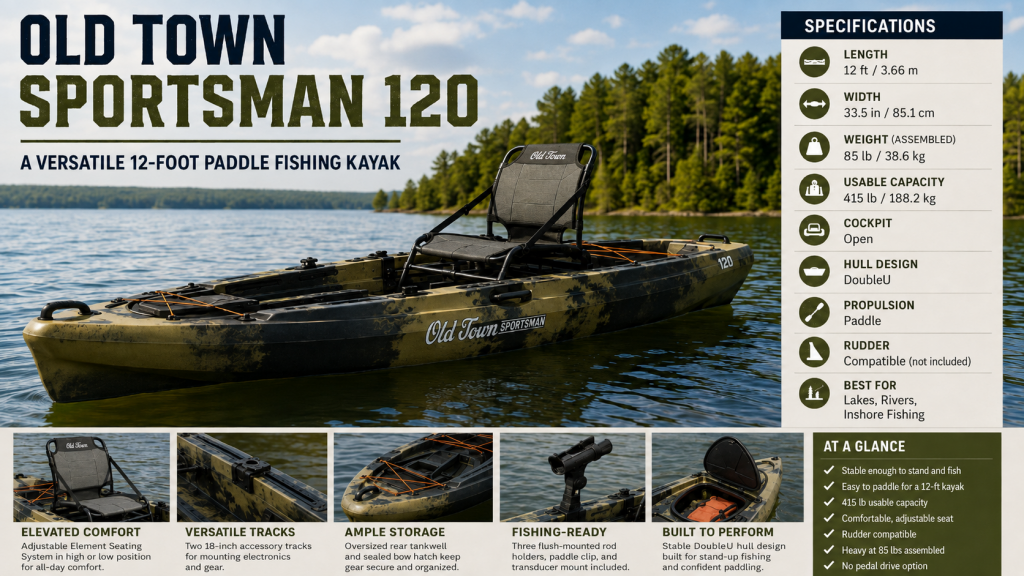
The useful number for most buyers is 415 pounds, not the 500-pound headline capacity. Old Town defines usable capacity as the weight available for the paddler, gear, and pets after the assembled kayak itself is accounted for.
The fishing-specific hardware is also meaningful. You start with an open standing area, EVA deck pads, three built-in rod holders, accessory tracks, bow storage, a large stern tankwell, adjustable foot braces, a paddle clip, and a transducer-mounting provision instead of having to turn a recreational hull into a fishing platform after purchase.
Does the 12-Foot Hull Actually Paddle Better?
Moving from a short fishing kayak to a 12-foot hull generally gives the designer more waterline to work with, but the Sportsman 120 is still fundamentally a stability-oriented fishing kayak rather than a narrow touring boat.
Old Town describes the 120 as easy to paddle and says it tracks well. Independent exact-model coverage has also been positive about tracking. That is encouraging, especially compared with very short, wide fishing platforms.
Owner feedback prevents us from turning that into an absolute claim. At least one paddle-model owner reported substantial difficulty keeping the boat tracking straight and began looking into a rudder. Paddling technique, load distribution, wind, current, and paddle choice can all affect the experience, so one report does not prove the hull tracks poorly—but it does show that buyers should not expect touring-kayak behavior simply because the boat is 12 feet long.
Old Town lists the standard Sportsman 120 as rudder compatible, which gives buyers an upgrade path if directional control becomes an issue. A rudder can help with holding a course and making corrections, but it does not remove the basic effects of wind or turn a wide fishing hull into a fast sea kayak.
For open reservoirs and larger lakes, the 120’s dimensions make more sense than a very short fishing kayak when you have to cover distance between spots. But if your normal trip includes long crossings, persistent current, or regular paddling into strong wind, consider whether a more performance-oriented paddle hull—or pedal propulsion—would better fit the job.
Our kayak fishing in wind guide explains why stability and wind-handling are separate issues. A kayak can feel very stable under you and still become exhausting to paddle home in the wrong conditions.
Is It Stable Enough to Stand and Fish?
Stand-up stability is one of the strongest reasons to consider the Sportsman 120.
Old Town uses its DoubleU hull design to push stability toward the outside of the boat and explicitly markets the 120 as a stand-up fishing platform. The open cockpit and EVA-covered deck are designed around the same use case.
Independent and owner evidence largely supports that design goal. Exact-model coverage describes the paddle 120 as a platform built around stand-up fishing, while multiple Sportsman 120 owners describe being comfortable standing and casting. Stability and confidence also show up repeatedly when owners explain why they chose the boat over lighter or narrower alternatives.
That does not mean every buyer will feel equally comfortable standing. A paddler’s height, body weight, balance, seat position, gear placement, waves, wind, and experience all change the result. Capacity and stability are related, but they are not the same measurement.
Buyer implication: if standing to cast, reach into the tankwell, or change positions is central to how you want to fish, the Sportsman 120’s evidence is strong. If you rarely stand, you may be accepting some of the weight and width of a stability-first design without using one of its main advantages.
Do You Actually Need 415 Pounds of Usable Capacity?
The Sportsman 120’s capacity is more useful when treated as a loading budget rather than a marketing number.
| Typical Situation | What the 415-lb Usable Capacity Means |
|---|---|
| Light paddler + minimal tackle | You may be paying a weight and size penalty for capacity you rarely use. |
| Average paddler + crate + several rods + electronics | The additional capacity leaves useful room for a complete fishing setup. |
| Larger paddler + normal fishing gear | The 415-lb rating can be a major reason to choose the 120 over lower-capacity compact kayaks. |
| Heavy paddler + substantial electronics, battery, cooler or extra gear | Add the entire load rather than looking only at body weight. |
For example, a 300-pound paddler does not have “200 pounds left” because the total capacity says 500. Using Old Town’s usable-capacity figure, that paddler has about 115 pounds remaining for clothing, PFD, rods, tackle, electronics, battery, food, water, and anything else carried on the boat.
The important point is not to fill the kayak to its published limit. It is to compare your realistic fishing load with the usable-capacity figure and decide whether the Sportsman 120’s extra carrying room solves an actual problem for you.
Where the Extra Fishing Space Helps
The Sportsman 120’s fishing layout is relatively straightforward, which is a strength if you want a capable paddle kayak without turning the cockpit into a maze of proprietary components.
Open cockpit: The uncluttered center area leaves room for your feet while seated and gives you a defined standing platform when conditions allow.
Accessory tracks: Two 18-inch tracks provide mounting space for compatible electronics, rod holders, cameras, lights, or other accessories without immediately drilling into the hull.
Rod management: Old Town includes one forward-facing and two rear-facing flush rod holders. There is also horizontal rod-storage provision along the sides, helping keep rods within reach without requiring a large crate full of extra holders.
Rear tankwell: The oversized stern storage area is where the 12-foot platform becomes particularly useful. A crate, dry bag, cooler, or other fishing gear can sit behind the seat without consuming the standing area.
Bow hatch: The sealed bow hatch provides internal storage and hull access. It is better suited to gear you do not need every few minutes than frequently changed tackle.
Electronics: The universal transducer mounting system gives fish-finder buyers a cleaner starting point than improvising an external transducer installation.
The practical advantage is not that any one feature is unusual. It is that the Sportsman 120 arrives with most of the basic fishing infrastructure already in place while leaving enough open space for you to decide how much additional rigging you actually need.
Seat and Long-Session Comfort
Old Town’s Element Seating System can be positioned high or low and removed for transport. The seat uses breathable mesh materials rather than a simple molded seat pan, and the adjustable foot braces let different paddlers set their leg position.
Seat comfort also receives positive owner feedback. Paddle-model owners have specifically described the seat as comfortable, and comfort is commonly part of the Sportsman family’s appeal compared with inexpensive recreational kayaks.
The high position is especially useful when you want a better fishing vantage point or an easier transition to standing. The lower position lowers your center of gravity. Which one feels better depends on your body dimensions, paddling stroke, balance, and water conditions.
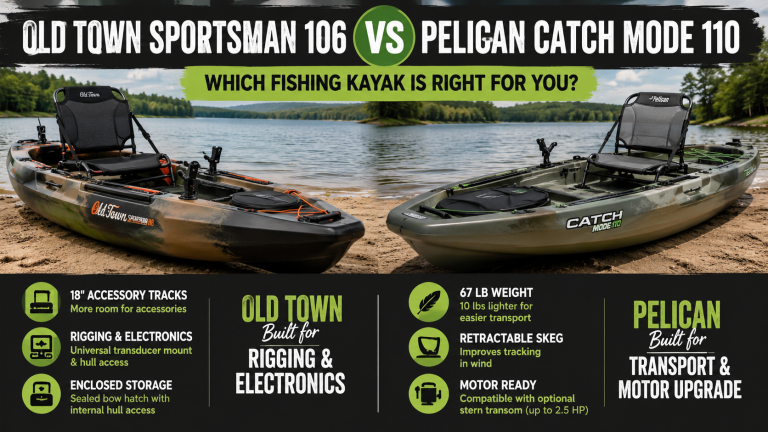
Old Town Sportsman 120 vs 106: Is the Extra Size Worth It?
For many buyers, this is the comparison that matters more than comparing the Sportsman 120 with an entirely different brand.
| Sportsman 106 | Sportsman 120 | |
|---|---|---|
| Length | 10’6″ | 12′ |
| Width | 34.5″ | 33.5″ |
| Assembled weight | 77 lb | 85 lb |
| Usable capacity | 363 lb | 415 lb |
| Total capacity | 440 lb | 500 lb |
| Rudder | None | Compatible |
| Primary advantage | Shorter, lighter footprint | More capacity and longer waterline |
The 120 adds 18 inches of length, 8 pounds of assembled weight, and 52 pounds of usable capacity while being one inch narrower.
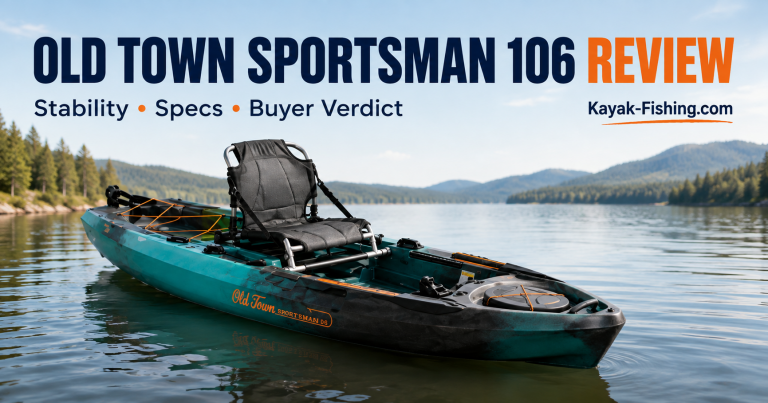
Choose the Sportsman 106 if garage space, shorter truck-bed fit, easier handling, tighter maneuvering, or keeping total size down matters most. For fishing relatively close to the launch, the smaller boat may give you most of the fishing functionality with less ownership hassle.
Choose the Sportsman 120 if the additional usable capacity matters, you carry more gear, or you want the dimensions of the longer hull for trips where you cover more water between fishing spots.
Read our full Old Town Sportsman 106 review if the smaller model sounds closer to your needs.
Where Owner Feedback Changes the Picture
Manufacturer specifications explain what the Sportsman 120 is designed to do. Owner reports are more helpful for showing where those design choices become noticeable after purchase.
The design appears to translate especially well in three areas:
- Stability: This is the clearest positive. Owners regularly discuss the Sportsman 120 as a confidence-inspiring platform, including larger paddlers and anglers who want to stand.
- Fishing room: The large cockpit and storage capacity are major reasons people move up from smaller entry-level kayaks.
- Seat comfort: The elevated frame-style seat is repeatedly viewed as a substantial step up from basic recreational seating.
The evidence becomes less uniform in two areas:
- Tracking: Old Town and independent coverage are positive, but some owner experiences are less enthusiastic. Treat “tracks well” as a design goal rather than a guarantee under every load and condition.
- Transport: Owners vary widely in how manageable the kayak feels off the water. Some rooftop it alone; others move to carts, bed extenders or trailers because the transport routine becomes inconvenient.
That split is useful because it reinforces the central buying decision: the Sportsman 120’s biggest advantages are experienced on the water, while its biggest drawback is often experienced before and after the fishing.
Closest Alternatives
Old Town Sportsman 106: If Transport Is the Problem
The Sportsman 106 is the first alternative to consider if you like Old Town’s stability-first fishing layout but do not actually need the 120’s additional capacity and length. It is still not lightweight at 77 pounds, but it saves 8 pounds and 18 inches of hull.
Perception Outlaw 11.5: If a High Fishing Platform Matters More
The Perception Outlaw 11.5 is another stability-oriented paddle kayak with an especially elevated fishing seat and wide-open standing platform. Perception currently lists it at 11 feet 6 inches long, 35 inches wide and 77 pounds, with a 425-pound maximum capacity. That 425-pound figure is not directly comparable with Old Town’s 415-pound usable capacity because the manufacturers report capacity differently. The Outlaw is worth comparing if an elevated seat, wide standing deck, and somewhat lower hull weight matter more than the Sportsman 120’s capacity advantage.
Sportsman BigWater 132: If Open-Water Paddling Matters More
If you like Old Town but expect to cover more distance on larger lakes or open water, the Sportsman BigWater 132 is the more performance-oriented paddle alternative. Old Town uses a longer 13’2″ performance tri-hull designed to improve paddling efficiency while retaining stand-up fishing stability. At 86 pounds it is only one pound heavier than the Sportsman 120, but its 339-pound usable capacity is substantially lower. Choose it for paddling performance and bigger-water versatility rather than maximum carrying room.
Sportsman PDL 120: If You Already Want Hands-Free Fishing
If your real goal is to cast, troll, and control the kayak without putting down the rod to paddle, the Sportsman PDL 120 solves a different problem. It adds Old Town’s pedal drive and rudder but also adds substantial weight, cost, and mechanical complexity.
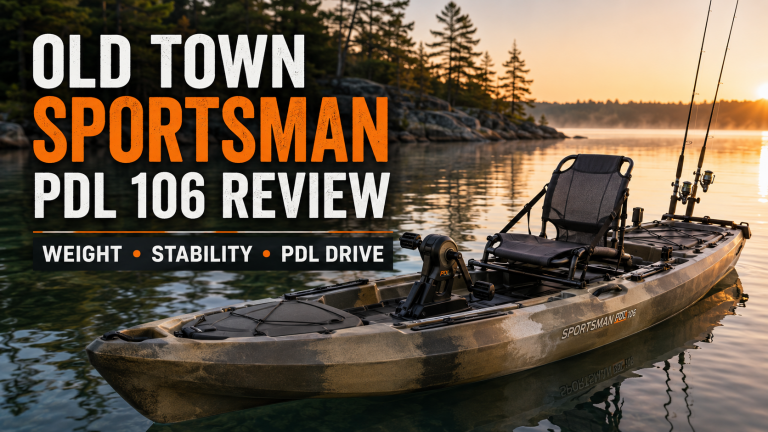
If you are still deciding whether paddle or pedal propulsion fits your fishing, our Old Town Sportsman PDL 106 review shows what that change in propulsion does to both on-water control and off-water ownership.
Who Should Buy the Sportsman 120?
The Sportsman 120 is a strong fit if:
- You prioritize stand-up stability over outright speed.
- You need more usable capacity than many compact fishing kayaks provide.
- You want enough cockpit and tankwell room for a complete fishing setup.
- You prefer the simplicity of paddle propulsion.
- You regularly fish lakes, reservoirs, slow rivers, or protected water where the stability-focused hull makes sense.
- You have a truck-bed, trailer, roof-loading system, cart, or other realistic plan for an 85-pound kayak.
Skip it or compare something else if:
- You need a kayak you can casually shoulder-carry from the vehicle to the water.
- Your storage area cannot comfortably handle a 12-foot hull.
- Your fishing regularly involves long open-water crossings where paddling efficiency matters more than stand-up stability.
- You already know you want hands-free pedal propulsion.
- You want extensive built-in motor mounting and future power customization—in that case, compare the newer Sportsman 120 Pro.
If this would be your first fishing kayak, our best fishing kayaks for beginners guide includes lighter and less expensive options worth comparing before committing to a large 12-foot fishing platform.
Old Town Sportsman 120 FAQs
How much does the Old Town Sportsman 120 weigh?
Old Town currently lists the standard paddle-powered Sportsman 120 at 85 pounds assembled. The removable seat weighs 6 pounds. The PDL, AutoPilot and Sportsman 120 Pro are different models with different weights.
What is the Old Town Sportsman 120 weight capacity?
The current total capacity is 500 pounds, but the more useful number for buyers is the 415-pound usable capacity. Old Town defines usable capacity as the weight available for people, gear and pets after accounting for the assembled kayak.
Is the Sportsman 120 stable enough to stand in?
Stand-up stability is one of the Sportsman 120’s main design priorities. Old Town uses its DoubleU hull specifically to create a stable fishing platform, and independent and owner feedback is generally positive about standing stability. Individual comfort still depends on paddler size, balance, loading and water conditions.
Does the Old Town Sportsman 120 track well?
Old Town says the 12-foot Sportsman 120 tracks well, and independent coverage has been positive. Owner reports are not completely uniform, however. The standard Sportsman 120 is rudder-compatible, which gives buyers an option if they want additional directional control.
Should I buy the Sportsman 106 or 120?
Choose the Sportsman 106 if shorter storage length and easier handling matter more. Choose the Sportsman 120 if you need its additional 52 pounds of usable capacity, want more hull length, and can comfortably manage the larger kayak off the water.
Final Buyer Verdict
The Old Town Sportsman 120 is not difficult to understand once you stop treating its specifications as separate features.
The same design choices that make it appealing on the water—12 feet of hull, substantial usable capacity, a roomy cockpit, an elevated seat and a stability-focused DoubleU platform—also create the main ownership compromise. It is an 85-pound fishing kayak that needs a deliberate transport and storage plan.
If you can solve that problem, the standard Sportsman 120 makes a strong case for anglers who want a serious paddle fishing platform without moving to a heavier pedal drive or motorized kayak. Its stability, usable capacity, storage and fishing layout give the extra size a clear purpose.
If you do not need the extra capacity or regularly dread loading heavy gear, buying the smaller Sportsman 106 may result in more actual fishing simply because the kayak is easier to live with.