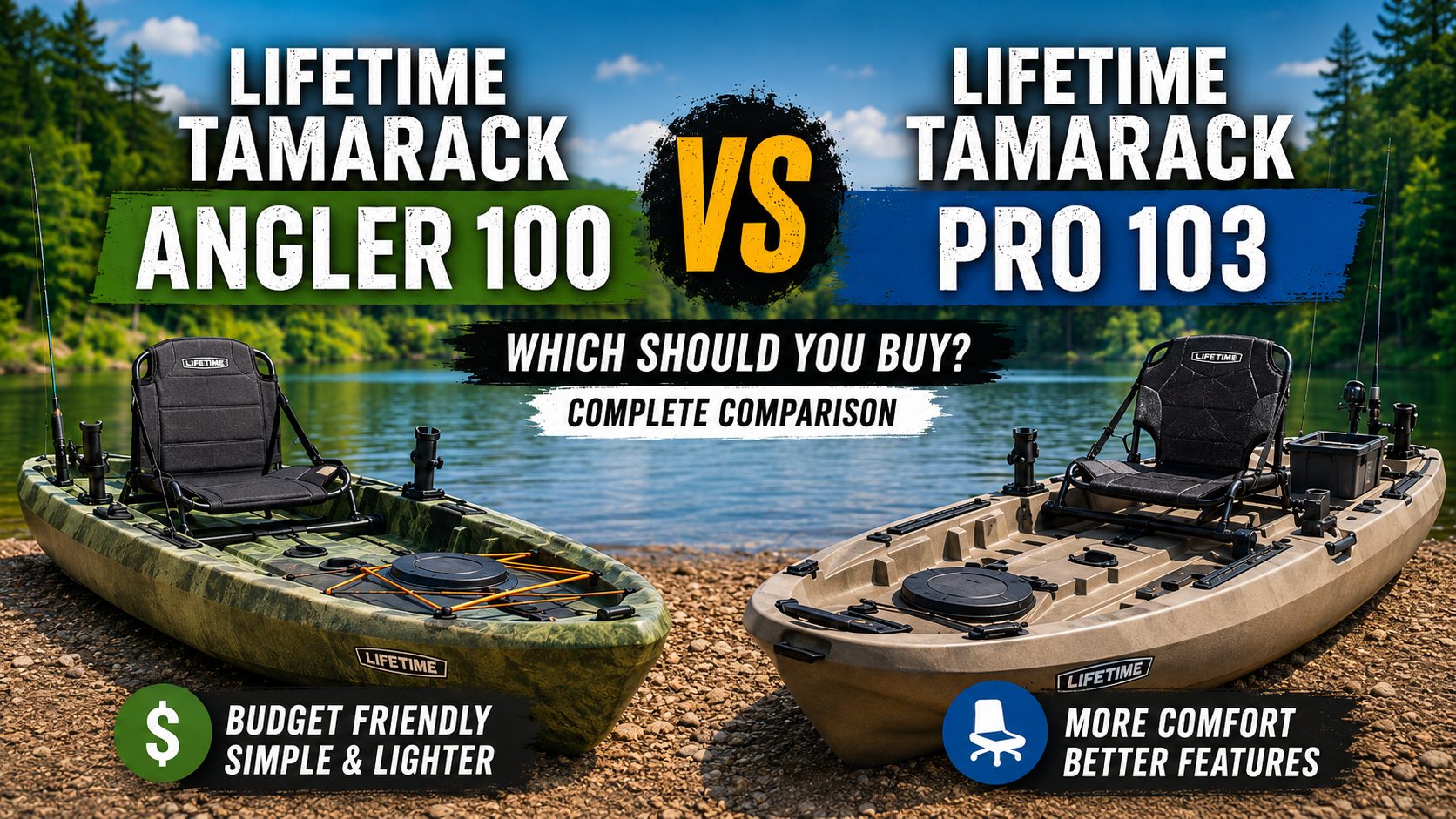
Lifetime Tamarack Angler 100 vs Tamarack Pro 103: Which Budget Fishing Kayak Should You Buy?
The Lifetime Tamarack Angler 100 vs Tamarack Pro 103 decision looks simple at first. One costs less. One has the better seat and fishing layout. But the more useful comparison is what those differences mean for comfort, transport, storage, and how much gear you want to carry.
Both are compact 31-inch-wide sit-on-top fishing kayaks with simple paddle-driven layouts. Neither is a pedal-drive boat or a dedicated stand-up platform, so the comparison is really about which budget-friendly Tamarack gives you the better mix of portability, comfort, storage, and fishing features.
The useful question is this: do you want the lower-cost, lighter option, or is it worth carrying a little more weight for the Pro 103’s framed seat, extra storage, and accessory tracks?
Our pick for most buyers is the Tamarack Pro 103. The Angler 100 still makes sense when price, lower weight, and simplicity matter most. The Pro 103 earns the overall edge because its framed seat, deeper tank well, under-seat tackle storage, and accessory tracks make it easier to configure for regular fishing.
Disclosure: As an Amazon Associate, Kayak-Fishing.com earns from qualifying purchases at no additional cost to you.
Comparison basis: specifications and features were checked against current Lifetime product documentation and current retailer listings. This comparison is buyer-focused analysis, not a claim of hands-on testing.
Table of Contents
Quick Verdict
Buy the Tamarack Angler 100 if: it is meaningfully cheaper where you shop and lower weight, simplicity, and short calm-water trips are the priorities.
Buy the Tamarack Pro 103 if: you want a framed seat, deeper storage, accessory tracks, and a layout with more room to organize fishing gear.
Biggest difference: seat design. The Pro 103’s framed seat is the most meaningful upgrade between the two models.
Stability winner: close for seated fishing. Neither kayak is ideal if standing is a major priority.
Transport winner: Angler 100, which Lifetime lists 7.7 pounds lighter.
Best long-term pick for most buyers: Tamarack Pro 103.
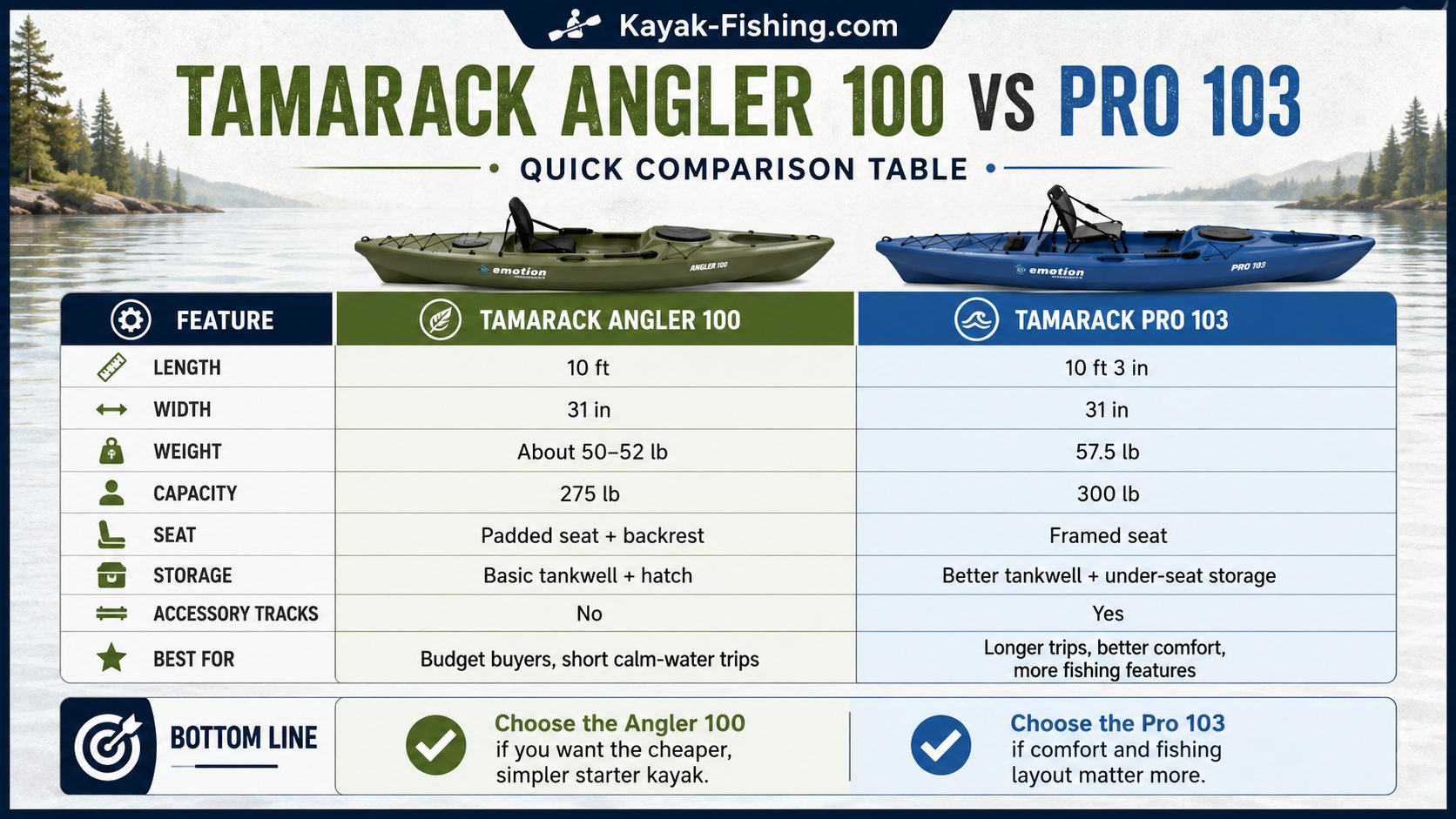
Lifetime Tamarack Angler 100 vs Tamarack Pro 103 Comparison Table
| Feature | Lifetime Tamarack Angler 100 | Lifetime Tamarack Pro 103 |
|---|---|---|
| Length | 10 ft. / 120 in. | 10 ft. 3 in. / 123 in. |
| Width | 31 in. | 31 in. |
| Weight | 49.8 lb | 57.5 lb |
| Weight capacity | 275 lb | 300 lb |
| Material | UV-protected high-density polyethylene | UV-protected high-density polyethylene |
| Seat style | Padded seat pad with adjustable padded backrest | Adjustable framed seat |
| Rod holders | Two flush-mounted rod holders plus one adjustable/top-mount rod holder | Two flush-mounted rod holders plus one adjustable/top-mount rod holder |
| Storage | Front and rear shock cords, one 6-inch center storage compartment, paddle keeper | Deeper rear tank well, center hatch with bucket, under-seat tackle storage, bungees, paddle keeper |
| Accessory mounting | No built-in accessory tracks listed by Lifetime | Two 12-inch universal accessory tracks |
| Paddle included? | Model/package dependent; Lifetime model 90508 includes a paddle | Model/package dependent; some Pro 103 SKUs include a paddle |
| Warranty | 5-year limited warranty | 5-year limited warranty |
| Best use | Short beginner trips, ponds, calm lakes, simple fishing | Longer seated fishing sessions, better tackle access, more serious beginner use |
| Main weakness | Simpler seat and fewer built-in mounting options | 7.7 lb heavier; retailer pricing varies |
Buyer note: Specs and included accessories can vary by model number, color, and retailer package. The Tamarack Angler 100 is especially common in different retailer bundles, so check the exact listing for paddle inclusion, hatch layout, color, hatch configuration, and shipping or pickup details before buying.
Buying note: Length and capacity do not tell the whole story here. The more meaningful differences are seat design, storage access, accessory mounting, transport weight, and how much gear you expect to carry. The Angler 100 keeps the setup simple; the Pro 103 gives you more room to organize and customize.
The Decision Comes Down to Your Second Month, Not Your First Trip
For very simple trips, both kayaks cover the basics: a compact sit-on-top hull, built-in rod holders, storage, and a paddle-friendly layout. The differences become more important as trips get longer and the amount of fishing gear increases.
That is where the Pro 103’s upgrades start to matter more.
For short calm-water trips with a light tackle load, the Angler 100 keeps making sense. It is about 8 pounds lighter, has a simpler deck layout, and avoids paying for features you may not need.
If your trips start getting longer, the Pro 103 begins to pull away. The framed seat matters more. The deeper rear tank well becomes more useful. The gear tracks let you experiment before drilling holes. The extra capacity gives you a little more room once you add a crate, anchor, water bottle, safety gear, and a second rod.
That is why the Pro 103 is the better long-term buy for most anglers who can afford it. The Angler 100 is the better “get me fishing now” kayak.
Where the Angler 100 Makes More Sense
The Tamarack Angler 100 makes more sense when the budget is tight and the fishing plan is simple. Think ponds, small lakes, calm coves, and short trips where easy transport matters more than extra storage or accessory mounting.
Its biggest practical advantage is portability. Lifetime lists the Angler 100 at 49.8 pounds, compared with 57.5 pounds for the Pro 103. That difference can matter if you car-top, load alone, or move the kayak any distance between the vehicle and the water.
The layout is basic, but that can be a good thing. Two rods, a small crate, a dry bag, pliers, and a couple tackle trays are enough. You do not need a fish finder, anchor trolley, camera arm, five rod holders, and a deck full of loose line on your first few trips.
The main compromise is the seat. The Angler 100 uses a padded seat pad with an adjustable backrest, while the Pro 103 uses an adjustable framed seat. The simpler Angler seat helps keep cost and weight down, but the framed Pro seat is the more appealing design if longer seated sessions are part of the plan.
For a deeper look at the cheaper model, read our full Tamarack Angler 100 review.
Where the Pro 103 Pulls Ahead
The Tamarack Pro 103 makes more sense if you expect to fish regularly and want more flexibility to organize and refine the setup over time.
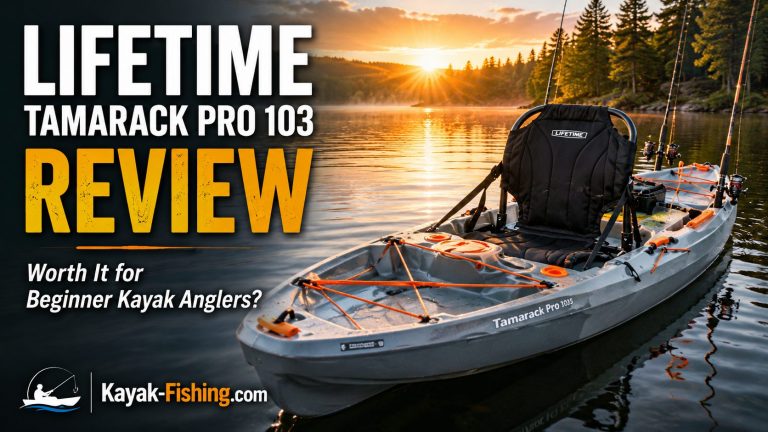
The framed seat is the main reason. Compared with the Angler 100’s padded seat pad and backrest, the Pro 103’s elevated framed seat gives the kayak a more conventional fishing-kayak seating position and makes the comfort upgrade easy to understand before you buy.
The fishing layout is also more flexible. The deeper rear tank well is better suited to a crate, the under-seat tackle storage creates another place for small boxes, and the accessory tracks let you position add-ons without immediately committing to permanent holes.
The Pro 103 is still a compact 31-inch-wide paddle kayak. Its advantage over the Angler 100 is comfort and organization—not pedal propulsion, stand-up capability, or a major jump in rough-water performance.
For the standalone buyer breakdown, see our Tamarack Pro 103 review.
Comfort and Seat Comparison
Seat design is the most important day-to-day difference between these two kayaks.
Rod holders and storage are easy to compare on a spec sheet, but the seat affects every minute spent in the kayak. The Angler 100 uses a padded seat pad and adjustable backrest; the Pro 103 moves to an adjustable framed seat.
The Angler 100 uses a padded seat pad and adjustable backrest mounted low in the kayak. That simpler arrangement helps keep the boat lighter and leaves the Pro 103’s framed seat as one of the clearest reasons to upgrade.
The trade-off is a lower, simpler seating position with less structure than a framed seat. That may be perfectly acceptable for short outings, but buyers planning longer sessions have a stronger reason to pay for the Pro 103.
The Pro 103’s framed seat is the clearest upgrade in the comparison. It raises the seating surface off the deck and provides a more structured seat than the Angler 100’s pad-and-backrest setup. For buyers prioritizing longer seated fishing sessions, that difference carries more weight than the three-inch difference in hull length.
For short, simple outings, the Angler 100 seat may be enough. For buyers expecting longer sessions, the Pro 103 is the stronger choice.
Stability Comparison
Both kayaks are stable enough for normal seated fishing in calm water. That is the key phrase: seated fishing.
The 31-inch width gives both boats a beginner-friendly feel when you are casting, reaching for a tackle tray, or landing a fish beside the kayak. The sit-on-top design also makes them easier to use around shallow launches because you can swing your legs over the side and step out carefully.
Neither one should be treated as a true stand-up fishing platform. Lifetime specifically says it does not recommend standing in the Tamarack Angler 100, and the Pro 103 is marketed around seated fishing rather than stand-up use. If standing and casting is a priority, a wider kayak designed for that purpose is the better category to shop.
Both use a 31-inch-wide hull, and Lifetime describes their flat-bottom/chine-rail designs as stability-focused. The Pro 103’s higher framed seat changes the seating position, but there is not enough verified evidence here to declare a meaningful stability winner between the two for seated fishing.
For practical purposes, stability is close. For seated fishing comfort, the Pro 103 gets the edge.
Fishing Layout and Storage
The Angler 100 gives you enough to start. You get rod holders, bungees, a hatch, a paddle keeper, and room behind the seat for a small crate or soft tackle bag. Keep the setup lean and it works.
The Angler 100 works best with a deliberately simple loadout. Its 275-pound capacity has to account for the paddler and everything carried aboard, so extra rods, tackle, an anchor, water, and other gear should be counted as part of the total load rather than treated as free capacity.
The Pro 103 gives you more room to organize. The deeper rear tank well is better for a crate. The under-seat tackle storage is useful for small boxes. The gear tracks are helpful because you can move accessories around as you learn where your paddle stroke, cast, and reach actually happen.
The tracks also reduce commitment: accessories can be repositioned as your setup changes instead of requiring a permanent mounting location from the start.
If you are building your first crate, keep it simple and low. In either kayak, clean organization beats carrying every lure you own.
Paddling, Tracking, and Wind
Neither kayak is positioned as a speed-focused design. Lifetime emphasizes stable flat bottoms, chine rails, and deep tracking channels on both models.
Both are short, 31-inch-wide sit-on-top fishing kayaks. Their dimensions and layouts make the most sense for shorter routes, protected banks, ponds, coves, and other situations where range and speed are not the main priorities.
For short calm-water routes, both fit the compact recreational-fishing role well. Wind is where route planning becomes more important: short kayaks with fishing gear above the deck can be pushed off line, so neither is a strong choice for long exposed crossings when the forecast is marginal.
The Angler 100’s lower weight is a clear advantage off the water. On the water, the more useful distinction is that both are compact paddle kayaks, so wind exposure and distance from shelter matter more than small differences between the two models.
With either kayak, plan your route around the forecast. On breezy days, paddle into the wind early so the return trip is easier. Stay near protected banks. Avoid long open-water crossings unless conditions are clearly within your ability.
Transport and Storage
The Angler 100 wins this category. Its lower weight makes it easier to load, unload, drag short distances, and store. That matters more than some buyers expect.
The official weight difference is 7.7 pounds: 49.8 pounds for the Angler 100 versus 57.5 pounds for the Pro 103. That is not enormous, but it is meaningful if every trip requires solo lifting onto a roof rack or carrying the kayak from parking to the launch.
The Pro 103 remains compact at 10 feet 3 inches, but buyers who car-top alone should weigh the extra 7.7 pounds against the framed-seat and storage benefits. A truck bed, trailer, or kayak cart reduces that disadvantage.
Transport convenience is one of the few categories with a clear winner: the Angler 100.
Best Water for Each Kayak
Small ponds
Both kayaks work well on ponds. The Angler 100 is especially appealing here because you do not need much speed, storage, or range. Launch, fish the edges, and keep it simple.
Small lakes and calm coves
Both can work, but the Pro 103 is better if you plan to stay out longer or bring a crate and extra rod. The better seat starts to matter once the trip becomes more than a quick loop.
Slow creeks and gentle rivers
Either kayak can work in mild moving water with a cautious paddler. Avoid fast current, strainers, low-head dams, and places where you cannot easily get to shore. Anchoring in current deserves extra caution.
Windy reservoirs
Neither is ideal. If your normal water is wide, windy, and full of boat traffic, look for a longer, more capable fishing kayak with better speed, capacity, and rough-water confidence.
Protected inshore water
Lifetime says the Angler 100 can be used in fresh or salt water, but neither model is a strong first choice for exposed tidal water, chop, open bays, or heavy boat wakes. Their compact size makes more sense in protected conditions where shore and shelter stay close.
Whatever kayak you choose, wear a comfortable PFD and dress for the conditions. If you are still sorting that out, start with a fishing PFD you will actually keep on all day and review basic kayak fishing safety habits before your first trip.
Which One Is Better for Beginners?
The Angler 100 is better for the beginner who wants the lowest-cost, simplest way to get on the water. It is the practical choice if the alternative is waiting another season to buy anything.
The Pro 103 is better for the beginner who already knows kayak fishing is going to stick. If you fish regularly, comfort and layout become more important than saving a little money upfront.
The split is simple:
- Choose the Angler 100 if budget and easy transport matter most.
- Choose the Pro 103 if longer trips and comfort matter most.
Not sure either Lifetime is the right fit? Compare them with wider, higher-capacity, and premium alternatives in our Best Fishing Kayaks for Beginners guide.
If this is your first fishing kayak, it is also worth reading our kayak fishing for beginners guide before buying more gear than you need. Start with comfort, capacity, transport, and where you will actually fish most often.
Which One Is Better for Serious Fishing?
The Tamarack Pro 103 is the better choice for more frequent fishing, as long as the expectations stay realistic.
It is not a tournament-grade pedal kayak or a wide stand-up platform, and it is not a strong fit for big reservoirs when steady wind and long exposed crossings are normal parts of the trip.
But for budget freshwater fishing, it has the better bones. The framed seat helps you stay comfortable. The tank well is easier to use with a crate. The tracks make accessories easier to place. The 300-pound capacity gives you slightly more room for the real load: paddler, paddle, PFD, crate, rods, tackle, anchor, water, dry bag, and safety gear.
If you fish often enough to care about lure changes, rod management, and boat position, the Pro 103 is the better choice.
Who Should Skip Both?
Skip both kayaks if you already know you want pedal drive. Hands-free boat control is a major advantage when you are fishing windblown banks, offshore grass, docks, or current seams.
Skip both if standing is a major part of how you want to fish. These are seated fishing kayaks first.
Skip both if you are a bigger angler near the top of the capacity range or you carry a lot of gear. Listed capacity includes everything in the kayak, not just your body weight.
Also skip both if your normal water is big, rough, strongly tidal, or exposed to heavy boat traffic. In those conditions, shop for a kayak designed around greater range, rough-water capability, and the load you expect to carry.
Is the Pro 103 Worth the Upgrade?
Yes, if the price gap is manageable and you plan to fish more than quick, casual trips.
The Pro 103 upgrade is not about three extra inches of length. It is about the framed seat, better storage, cleaner rigging options, and a layout that feels less cramped once you add normal fishing gear.
The Angler 100 can absolutely get you fishing. But if you already suspect you will want a better seat, a crate, a forward rod holder, and a cleaner tackle setup, the Pro 103 may save you from trying to turn the cheaper kayak into something it was never meant to be.
Final Verdict: Lifetime Tamarack Angler 100 vs Tamarack Pro 103
In the Lifetime Tamarack Angler 100 vs Tamarack Pro 103 matchup, the Angler 100 wins on lower weight and simplicity, and it often has the lower purchase price. It is the better fit for short calm-water trips and buyers who want the least complicated setup.
The Tamarack Pro 103 is the better overall fishing kayak. The framed seat is the biggest reason, but the improved layout matters too. The deeper tank well, accessory tracks, under-seat storage, and extra capacity make it easier to fish longer and stay organized.
- Best budget pick: Lifetime Tamarack Angler 100
- Best comfort pick: Lifetime Tamarack Pro 103
- Best long-term buy: Lifetime Tamarack Pro 103
If the price gap still leaves room in the budget for a good PFD and the other essentials, the Pro 103 is the stronger overall buy. If the Angler 100 is substantially cheaper and your trips will stay short and simple, its lower weight and simpler layout can make it the better value.
Final buying shortcut: Choose the Angler 100 if price and easy transport matter most. Choose the Pro 103 if comfort, storage, and long-term use matter more.
FAQs
Is the Tamarack Pro 103 better than the Tamarack Angler 100?
For most anglers, yes. The Tamarack Pro 103 has a more comfortable framed seat, better storage layout, accessory tracks, and a slightly higher capacity. The Angler 100 is still a good choice if you want the cheaper and lighter kayak.
Is the Tamarack Angler 100 good enough for beginners?
Yes, especially for short trips on calm ponds, small lakes, and protected coves. It is simple, stable for seated fishing, and easy to understand. Its biggest limitation is seat comfort on longer outings.
Can you stand in either kayak?
Neither kayak should be treated as a true stand-up fishing platform. Lifetime specifically says it does not recommend standing in the Tamarack Angler 100, while the Pro 103 is sold as a seated fishing kayak rather than a stand-up model. If standing is important, look for a wider kayak designed around that use.
Which kayak is easier to transport?
The Tamarack Angler 100 is easier to transport because it is lighter. The Pro 103 is still manageable for many anglers, but the extra weight is noticeable when loading onto a roof rack or moving the kayak alone.
Which one is better for longer fishing trips?
The Tamarack Pro 103 is better suited to longer trips because of its framed seat and more useful fishing layout. The value of the seat upgrade increases as seated sessions get longer.
Are these kayaks good for rivers?
They can work on slow, gentle rivers with easy access and mild current. Avoid fast current, strainers, low-head dams, and unnecessary anchoring in moving water; current increases the consequences of a snagged anchor line or poor boat angle.
Which kayak should I buy if prices are close?
If prices are close, buy the Tamarack Pro 103. The seat and fishing layout are worth the upgrade for most anglers. If the Angler 100 is much cheaper and your trips will be short and simple, it can still be the better value.