Kayak Fishing Cape Cod: Areas, Seasons & Safety Guide
Kayak fishing Cape Cod gives anglers access to tidal flats, protected harbors, estuaries, channels, sandy shorelines, and more exposed coastal water that can hold striped bass, bluefish, bonito, false albacore, fluke, and other Northeast saltwater species.
That variety creates opportunity, but it also means one Cape Cod kayak plan does not fit every shoreline or weather pattern.
Tide, wind, surf, fog, cold water, boat traffic, and launch access can change the risk of a trip quickly. A protected harbor at one tide stage is a very different proposition from an exposed beach launch with building swell or a long return against current.
This guide breaks down useful Cape Cod kayak-fishing areas, launch-planning factors, seasonal patterns, common target species, practical lure choices, and the safety issues that matter most in cold water, fog, tides, boat traffic, surf, and coastal wind.
Before You Go: Check the current Massachusetts recreational saltwater fishing regulations and saltwater fishing permit requirements. Species limits, seasons, measurement rules, and gear requirements can change.
Table of Contents
What Makes Cape Cod Different for Kayak Anglers
A useful planning mistake to avoid is treating Cape Cod like one single fishery. Cape Cod Bay, Buzzards Bay, Vineyard Sound, Nantucket Sound, Pleasant Bay, south-side estuaries, and the Outer Cape differ in exposure, current, access, bottom type, and seasonal fish movement.
A southwest wind may make one side of the Cape sloppy while another side stays fishable. An outgoing tide may set up perfectly in one harbor but turn another area into a long paddle home. Fog may be light at the launch and thick enough offshore to erase the shoreline ten minutes later.
Plan the zone around wind direction, tide stage, current, parking and hand-launch access, boat traffic, water temperature, and a realistic paddle or pedal range. Then fit the fishing plan to the conditions rather than stretching the route to reach a distant bite.
On a perfect day, you might chase birds, cast to breaking stripers, or work open-water edges. On a marginal day, the smarter move may be staying inside a protected bay, fishing creek mouths, or drifting channel edges close to your launch.
Cape Cod Kayak Fishing Areas to Research
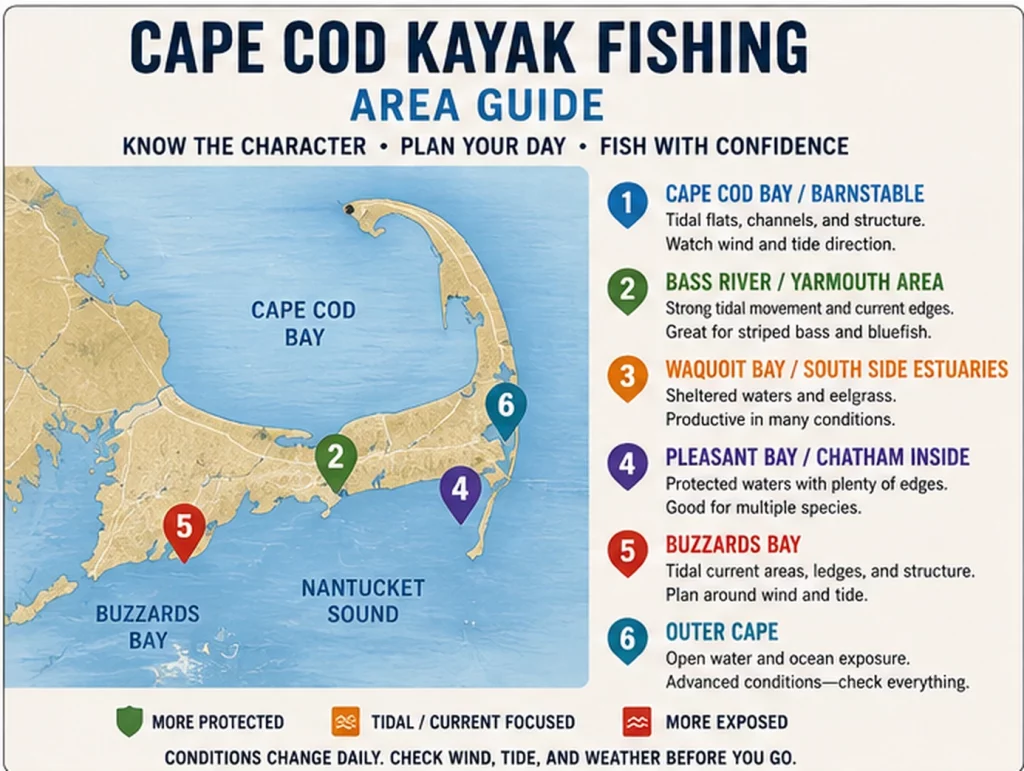
Cape Cod has too many possible kayak fishing spots to cover every launch and shoreline. The better way to plan a trip is to understand the main types of water and match them to your skill level.
Barnstable Harbor and Cape Cod Bay Flats
Barnstable Harbor and the Cape Cod Bay flats are excellent places to think about when targeting striped bass from a kayak. You get sand flats, channels, marsh edges, bait movement, and tide-driven feeding lanes without immediately committing to exposed ocean water.
Water depth and tide timing matter here. A flat that is easily navigable at higher water can become a long carry or drag as the tide falls. Soft plastics, smaller topwater plugs, and controlled drifts along current seams are practical options when they match the depth and fish position.
Potential fit: spring and fall stripers, low-light topwater, flats fishing, and tide-based kayak drifts.
Bass River and the Yarmouth Area
Bass River gives kayak anglers a more protected option when open beaches or sound-side water are too exposed. It has current, docks, bends, creek mouths, and deeper edges that can hold stripers and bluefish at different parts of the tide.
This is the kind of place where you do not need to overcomplicate your tackle. A paddle tail, a small topwater plug, a bucktail, and a few metals can cover a lot of water. Work visible current, ambush points, and shaded structure early and late in the day.
Potential fit: protected-water sessions, mixed striper and bluefish action, windy-day backup plans, and easier scouting from a kayak.
Waquoit Bay and South-Side Estuary Water
Waquoit Bay and nearby south-side estuaries are good examples of why Cape Cod kayak fishing is so interesting. These areas can offer shelter, grass edges, creek mouths, baitfish, and tidal outflows that set up nicely for kayaks.
They are also useful when bigger water is not a good idea. If the forecast makes rips, beaches, or open sound water feel questionable, a protected bay or estuary can still give you a productive and safer trip.
Potential fit: light tackle stripers, creek-mouth fishing, sheltered water, and trips where safety matters more than chasing a distant bite.
Pleasant Bay and Chatham-Area Inside Water
Pleasant Bay and Chatham-area inside water can be very productive, but do not confuse “inside water” with “easy water.” Wind, tide, boat traffic, seals, fog, and current can all matter here. This is an area where you should launch with a clear plan and avoid getting pulled farther from safety just because birds or breaking fish appear outside your comfort zone.
Fish channel edges, current seams, bars, and bait-holding structure. If you are new to the area, start conservative. Learn how the tide moves before you commit to a long run.
Potential fit: experienced kayak anglers, moving-water striper fishing, bluefish encounters, and careful scouting around channels and bars.
Buzzards Bay Edges and Protected Harbors
The Buzzards Bay side can be productive, especially around protected harbors, rocky edges, eelgrass, and current. It can also get ugly fast when wind and tide stack up. A short, choppy paddle in Buzzards Bay can feel much harder than it looks from shore.
Look for places where you can stay near protected water and still reach fishable structure. Rocky points, harbor mouths, and bait-holding edges can all produce stripers and bluefish without forcing you into a long exposed crossing.
Potential fit: experienced paddlers, structure fishing, early mornings, and days when the wind direction gives you a manageable shoreline.
Outer Cape Beaches and Surf Zones
The Outer Cape adds surf, swell, fog, cold water, wildlife, and greater exposure. Cape Cod National Seashore specifically warns visitors about shore break, strong undertows and rip currents, and recommends kayaking and paddling in groups.
Surf launching should be reserved for anglers who already have the skills to time waves, secure gear, perform a surf landing, and abandon the plan when shore break or swell exceeds their ability. The National Park Service also advises staying away from schools of fish and seals because they can attract sharks.
Potential fit: advanced anglers only, perfect-condition windows, and anglers with real surf-launch experience.
Cape Cod Kayak Launches: What to Check First
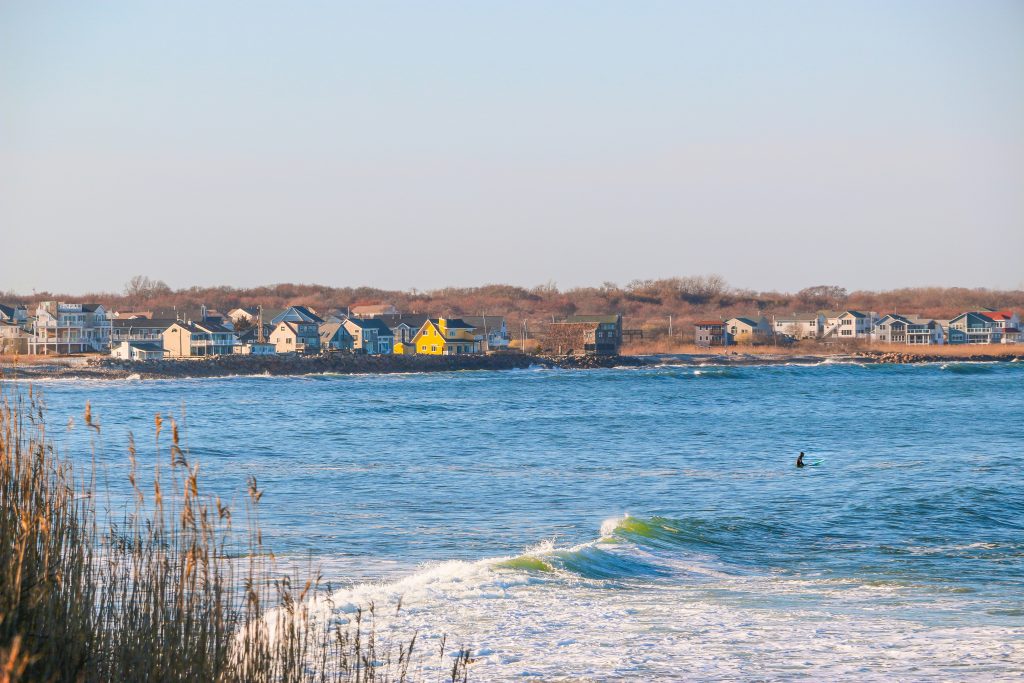
Cape Cod kayak launches can be tricky because rules change by town, beach, season, parking area, and time of day. A place that looks easy on a map may have resident-only parking, seasonal beach restrictions, limited roadside access, or a long carry at low tide.
Before driving across the Cape with your kayak loaded, check four things:
- Parking rules: Some areas are limited, seasonal, or town-controlled.
- Hand-launch access: Not every beach or ramp is friendly to kayaks.
- Tide height: Low tide can expose mud, flats, rocks, or long carries.
- Return conditions: A launch that feels easy with the wind at your back may be miserable on the paddle home.
Identify a backup launch or protected-water option before leaving home. Because access and parking can be town-controlled or seasonal, verify both the primary and backup plan with the current local authority rather than relying only on a map pin.
Seasonal Patterns for Kayak Fishing Cape Cod
Spring: First Strong Striper Push
Massachusetts Division of Marine Fisheries describes striped bass as migrating northward during spring and summer before returning south in fall. On Cape Cod, that makes spring an important striped-bass period, but exact timing varies with water temperature and annual conditions. Flats, estuaries, marsh edges, and tidal current are all areas worth evaluating as fish move through.
The catch is cold water. Spring air can feel comfortable while the water is still dangerous. Dress for immersion, not for the parking lot.
Summer: Early, Late, and Moving Water
Summer generally brings more recreational boat traffic and beach activity. Low-light periods and moving water can be useful fishing windows, but striped bass depth and feeding behavior vary with water temperature, forage, current, and location. Bluefish may also be present around concentrated bait.
If you are fishing summer weekends, launch early and avoid paddling through busy boat channels longer than necessary. A visible flag, bright clothing, and a light are not just nice extras. They help other boaters see you.
Late Summer and Fall: Bluefish, Albies, Bonito, and Bigger Moves
Late summer and fall can add bluefish, Atlantic bonito, and false albacore opportunities in some Cape waters, while striped bass begin their broader southward fall migration. Exact timing and location vary from year to year.
The key is discipline. Breaking fish can make kayak anglers do dumb things. Keep one rod ready with a metal, epoxy jig, or small fast-moving lure, but do not chase schools too far offshore or across unsafe water. A fish that is just out of range is not worth a bad paddle home.
Tides, Wind, and Fog: The Three Big Trip-Deciders
On Cape Cod, tides do more than move water up and down. They position bait, expose flats, create current seams, open and close access, and decide how hard your return paddle will be.
For flats and estuaries, pay close attention to when fish can move onto shallow water and when they are forced back toward channels. For harbor mouths and creek outflows, moving tide can create feeding windows that are much better than slack water.
Wind is just as important. A forecast that looks mild on land can feel very different once wind has room to build across open water. Before launching, check the NOAA Cape Cod Bay marine forecast or the correct marine zone for the side of the Cape you plan to fish. Pay attention to wind direction, gusts, sea height, wave period, and whether wind will be pushing against the tide.
If wind is one of your weaker skills, read this guide on kayak fishing in wind before planning an exposed Cape Cod trip.
Fog deserves its own warning. If visibility starts dropping, a shoreline that felt obvious on the paddle out can disappear fast. In a kayak, that creates two problems at once: you may lose your visual reference for getting home, and powerboats may have a harder time seeing you.
For bigger water, carry more than a phone. A compass or GPS, whistle, light, visible flag, and VHF radio are all worth considering. Fog can make Cape Cod feel much bigger than it looked from the beach.
Common Cape Cod Kayak Fishing Targets
Striped Bass
Striped bass are the main draw for many Cape Cod kayak anglers. They can be caught around flats, marsh edges, boulder fields, harbor mouths, beaches, channels, and current seams. A kayak is especially useful because it lets you fish shallow water quietly and position yourself along edges that are hard to work from shore.
Topwater plugs are fun when fish are looking up. Paddle tails and jerk shads are more versatile when the bite is subtle. Bucktails and swimbaits are good choices when you need to stay near the bottom or work current.
Bluefish
Cape Cod bluefish can turn a quiet morning into chaos. They hit hard, fight dirty, and can destroy soft plastics if you are not prepared. When bluefish are around, carry extra lures and consider single hooks or stronger hardware where appropriate.
Metals, topwater plugs, swimming plugs, and durable soft plastics all work. Watch your fingers around the kayak. A thrashing bluefish next to the boat deserves respect.
Bonito and False Albacore
Bonito and false albacore are not the easiest kayak targets, but they are part of the late-summer and fall excitement around the Cape. They move fast, feed quickly, and often punish anglers who are not ready.
A small metal, epoxy jig, or slim baitfish imitation can stay rigged when these species are expected. Massachusetts now regulates Atlantic bonito and false albacore, so verify the current size and possession rules before retaining either species.
Fluke, Sea Bass, and Tautog
Depending on the area and season, bottom fishing can also be part of a Cape Cod kayak plan. Fluke, black sea bass, and tautog may be available around the right structure, bottom type, and depth. These fisheries can be very regulation-sensitive, so check current rules before keeping anything.
From a kayak, bottom fishing is easier to control when wind and current are manageable. If you cannot control your drift or safely hold position, move to a more protected zone.
Recommended Lures and Setups
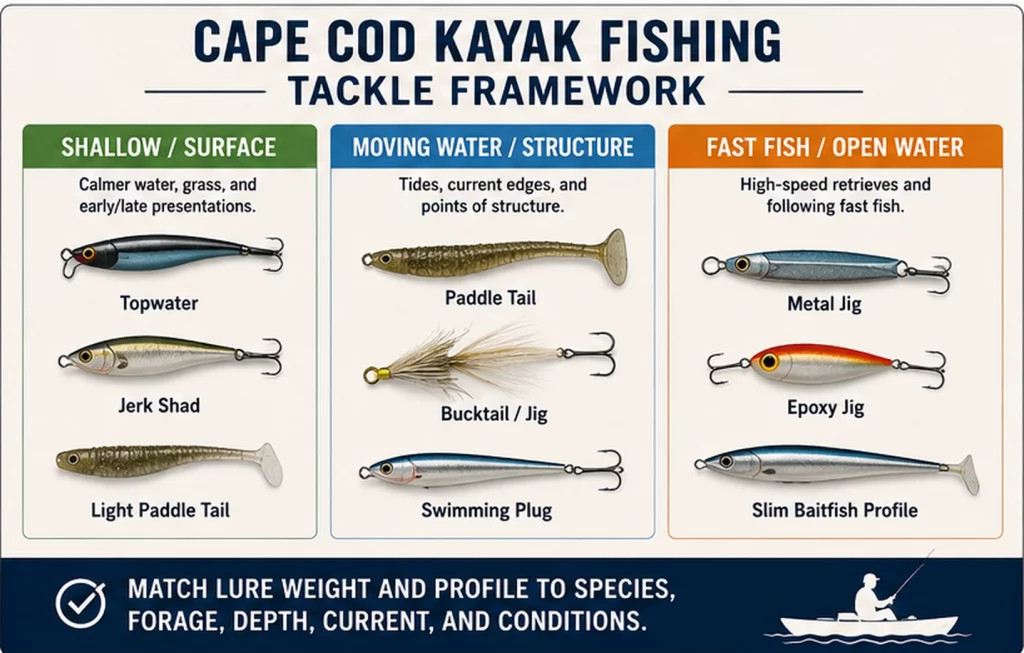
You do not need a giant crate full of tackle to fish Cape Cod from a kayak. In fact, simple is usually better. Bring enough to adjust to depth, bait size, and water movement, but avoid loading the kayak like a tackle shop.
| Situation | Useful Lure Types | Kayak Consideration |
|---|---|---|
| Shallow flats and low light | Topwater walkers, small poppers, weightless soft plastics | Keep distance and make quiet casts before paddling over fish. |
| Channels and current seams | Paddle tails, bucktails, jig heads with soft plastics | Drift naturally and cast across current instead of fighting it. |
| Bluefish around bait | Metals, plugs, spoons, durable soft plastics | Carry extras because bluefish can wreck soft baits quickly. |
| Bonito or albies nearby | Small metals, epoxy jigs, slim baitfish profiles | Keep one rod ready so you are not digging through the crate during a feed. |
| Deeper bottom structure | Bucktails, bottom jigs, bait rigs where legal | Only fish deeper structure when wind and current allow safe boat control. |
A medium or medium-heavy spinning setup in roughly the 7-foot range with a 3000- to 4000-size reel is one practical starting point for many inshore presentations. Exact rod power, reel size, line, and leader should match the lure weight, target species, current, and structure rather than a single universal Cape Cod combination.
Two well-rigged rods can cover a broad range of situations without adding unnecessary deck clutter. One can handle soft plastics and jigs while the other stays ready with a topwater, metal, or other moving bait.
A Simple Cape Cod Kayak Fishing Trip Plan
If you are new to kayak fishing Cape Cod, do not start with the most exposed water on the map. Start with a protected area that still gives you access to moving water, bait, and structure.
A smart first trip might look like this:
- Pick a protected harbor, bay, or estuary with a clear launch and easy return.
- Plan around a moving tide, not just sunrise.
- Check wind direction and gusts before leaving home.
- Rig one rod with a paddle tail or jerk shad.
- Rig a second rod with a topwater plug, metal, or bucktail.
- Stay close enough to the launch that you can quit early if fog, wind, or boat traffic builds.
- Fish edges, current seams, creek mouths, docks, and bait activity instead of paddling randomly.
That kind of trip may not sound dramatic, but it is how you build confidence. Once you learn how the tide moves and how the wind behaves in a specific area, you can expand your range.
Cape Cod Kayak Fishing Safety
Cape Cod is not a place to be casual about safety. You do not need to be scared of it, but you do need to respect it.
Wear the PFD the Entire Time
Massachusetts requires canoeists and kayakers to wear an appropriate life jacket from September 15 through May 15. Outside that period, wearing a properly fitted U.S. Coast Guard-approved PFD throughout the trip remains the safer default because a capsize can happen without enough time to retrieve one from storage. See our kayak fishing PFD guide for fit and feature considerations.
Dress for the Water, Not the Air
Cold-water immersion can become dangerous even when the air feels comfortable. Choose clothing around water temperature, exposure, distance from a safe landing, and the ability to recover from a capsize—not just the parking-lot temperature.
For clothing systems, read our guide to what to wear kayak fishing. For the broader risk framework, see the kayak fishing safety guide.
Do Not Ignore Boat Traffic
Cape Cod has working boats, recreational boats, ferries in some areas, charter traffic, and crowded summer waterways. Stay out of main channels when possible, cross quickly and directly when you must, and do not assume a boat operator sees you.
A visibility flag, bright clothing, a light, and smart positioning can make a big difference. Avoid stopping in blind spots, channel bends, or narrow choke points where boats have limited room to react.
Have a Real Communication Plan
For more exposed water, a waterproof phone should not be the only communication layer. A marine VHF radio can add useful redundancy in coastal areas. Leave a float plan with someone ashore that includes the launch, general route, and expected return time.
Also make sure your navigation plan still works in fog. A saved map on your phone is useful, but a compass, GPS, or simple bearing back to the launch can matter when the shoreline disappears.
Know When to Stay Inside
Some days are not open-water kayak days. That does not mean the trip is ruined. Cape Cod has protected options, and many of them can still fish well. The safer move may be to fish an estuary, harbor, or lee shoreline instead of forcing the original plan.
Changing to protected water—or choosing a different day—is a sound risk-management decision when wind, waves, visibility, current, surf, or cold-water exposure exceed the planned margin.
Cape Cod Kayak Fishing FAQs
Is Cape Cod good for kayak fishing?
Cape Cod offers a wide range of kayak-accessible saltwater habitat, including flats, harbors, estuaries, channels, and coastal shorelines. Striped bass, bluefish, bonito, false albacore, fluke, black sea bass, and tautog may all be relevant depending on season and area. The key is matching the route to current wind, tide, water temperature, access, and skill level.
What is the best fish to target from a kayak on Cape Cod?
There is no single best species for every season or area, but striped bass are a major Cape Cod target and migrate through Massachusetts waters in spring, summer, and fall. Bluefish are another common target, while Atlantic bonito and false albacore can become options in some areas later in the season.
Where should beginners kayak fish on Cape Cod?
A first trip is better suited to protected bays, rivers, harbors, or estuaries than exposed beaches or rips. Look for manageable current, verified launch access, a short return route, and enough shelter to adapt if wind, fog, or boat traffic builds.
What lures work best for Cape Cod kayak fishing?
There is no universal best lure. Paddle tails, jerk shads, bucktails, topwater plugs, metals, epoxy jigs, and swimming plugs can all fit Cape Cod saltwater fishing. Match lure size, weight, and profile to target species, forage, depth, current, and water conditions.
What are the main Cape Cod kayak fishing hazards?
Cold water, fog, tidal current, wind, boat traffic, surf, and changing marine weather can all affect a Cape Cod trip. Use the appropriate marine forecast, wear the required PFD, dress for possible immersion, and choose a route with a realistic return and safe landing options.
Do I need to check regulations before fishing Cape Cod?
Yes. Check current Massachusetts recreational saltwater fishing regulations and permit requirements before the trip. Size limits, possession limits, seasons, measurement rules, and gear requirements can change.
Sources and Method
This guide does not claim firsthand fishing, launching, or paddling experience on Cape Cod. Location and seasonal guidance is based on Massachusetts fisheries information, National Weather Service marine resources, National Park Service coastal-safety guidance, and Kayak-Fishing.com analysis of how those conditions affect small-craft trip planning. Launch parking, beach access, local restrictions, fishing regulations, and marine conditions should be rechecked before every trip.
- Massachusetts Division of Marine Fisheries — Recreational Saltwater Fishing Regulations
- Massachusetts — Recreational Saltwater Fishing Permit
- Massachusetts Division of Marine Fisheries — Learn About Striped Bass
- Massachusetts — Wear Your Life Jacket
- National Weather Service — Marine Weather Services
- Cape Cod National Seashore — Beach and Water Safety
Final Thoughts
Kayak fishing Cape Cod offers a wide range of saltwater options, but the quality of the plan depends as much on wind, tide, fog, current, water temperature, and launch access as it does on the target species.
For a first trip, protected water, a compact tackle selection, a conservative route, the appropriate PFD and immersion clothing, and a current marine forecast create a more manageable starting point. Keep a verified backup plan if conditions change.
The Cape’s mix of estuaries, flats, harbors, and coastal water can support very different trips across the season. Choose the water first by access and conditions, then match the fishing plan to the species and structure available within a safe return range.