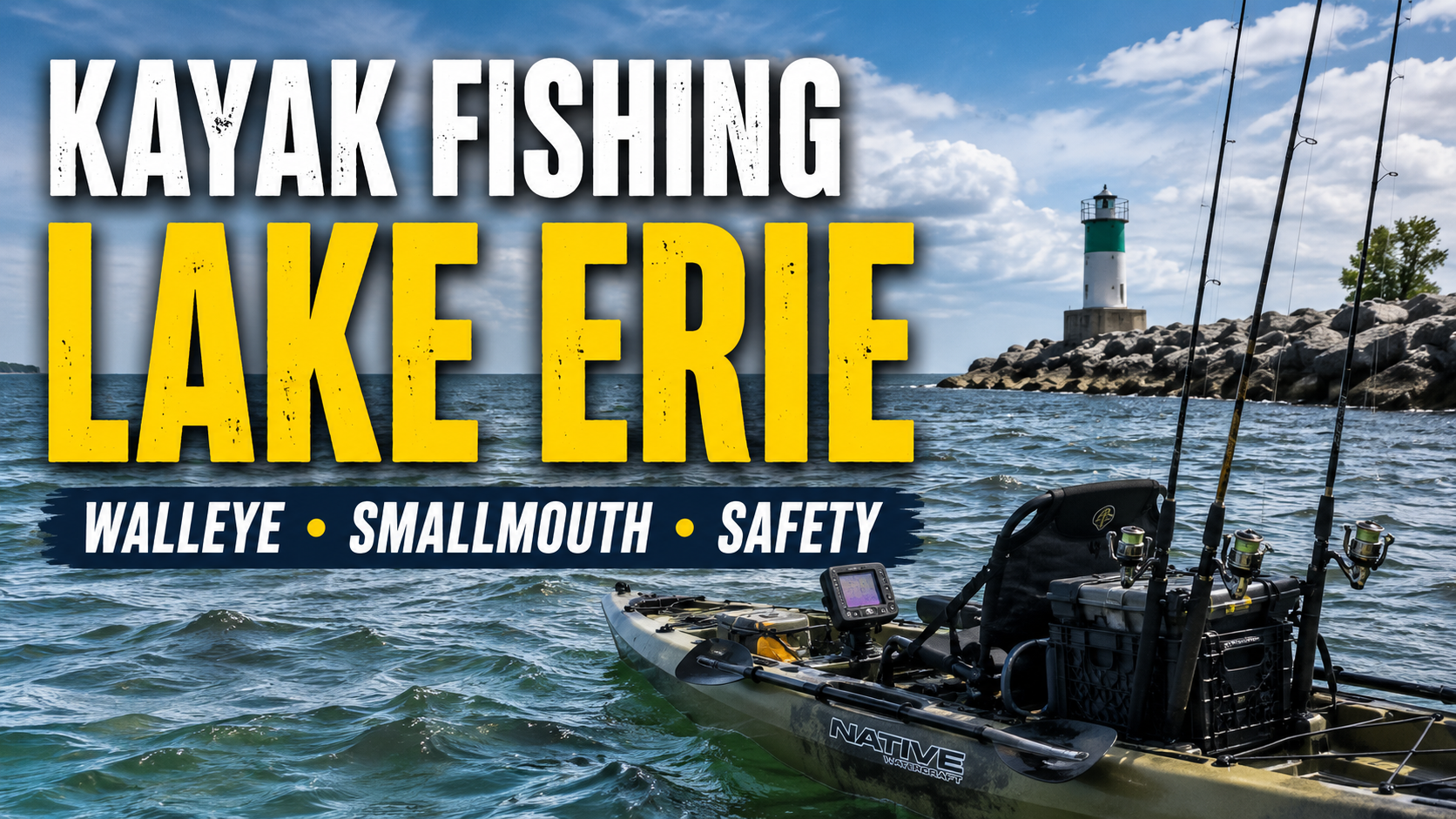
Kayak Fishing Lake Erie: Species, Seasons & Safety Guide
Kayak fishing Lake Erie is less about how far you can travel and more about matching the right section of the lake to a realistic weather window, launch, target species, and return route. Lake Erie supports exceptional walleye, smallmouth bass, yellow perch, and steelhead fisheries, but productive water is not automatically practical kayak water.
A safer and more repeatable approach is to focus on nearshore reefs, rocky structure, harbors, breakwalls, bays, tributary areas, and other water that can be reached without making a long open-lake crossing mandatory. The Western, Central, and Eastern basins also fish differently enough that the same kayak plan should not be copied from one end of the lake to the other.
This guide combines current information from Ohio, Pennsylvania, and New York fisheries agencies with National Weather Service marine guidance and Kayak-Fishing.com analysis of how wind, waves, cold water, boat traffic, and limited small-craft range affect trip planning.
Quick Answer: Is Lake Erie Good for Kayak Fishing?
Yes, when the trip is built around protected access, a conservative weather window, and fishable structure within a realistic return range. Smallmouth bass can be especially kayak-friendly where rocky nearshore structure, harbors, and reefs are accessible. Walleye can also move into reachable water during spring, fall, and low-light periods, while many summer walleye patterns occur farther offshore and are better suited to larger boats.
- Good starting water: harbors, bays, breakwalls, nearshore reefs, rocky shorelines, and protected lee-side structure.
- Higher-risk plans: long crossings, offshore trolling routes, exposed reef runs, or any trip where increasing wind creates a difficult return.
- Weather rule: use the current marine forecast and warnings—not only a general weather app—before deciding whether the main lake is appropriate.
Table of Contents
Lake Erie’s Three Basins From a Kayak
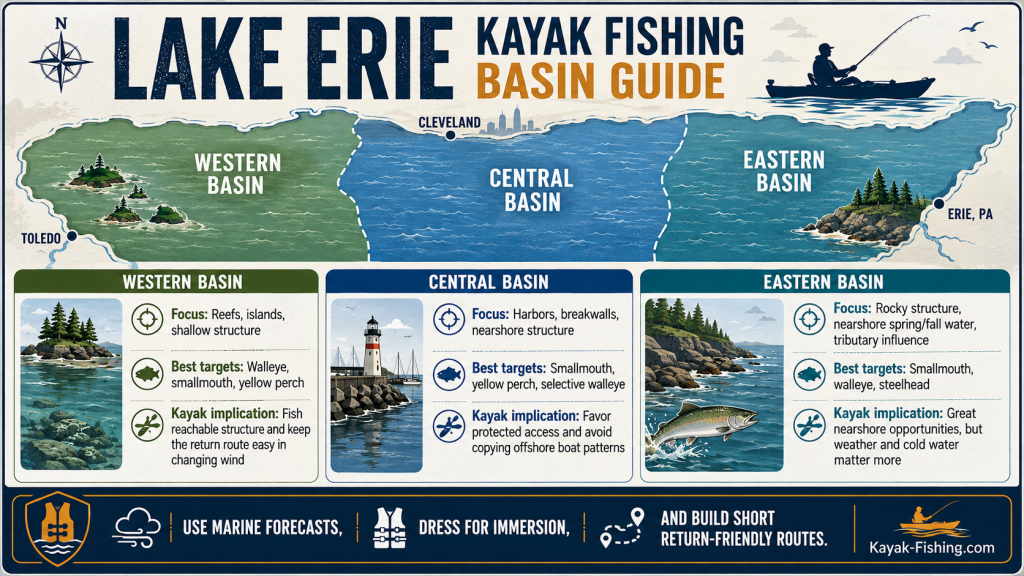
Lake Erie should not be treated as one uniform kayak fishery. The Western Basin is comparatively shallow and is known for reef and island structure. The Central Basin transitions into deeper open water with major harbor systems along the Ohio shoreline. The Eastern Basin includes deeper water, rocky structure, productive New York smallmouth habitat, and Pennsylvania and New York steelhead fisheries associated with Lake Erie tributaries.
The important kayak implication is simple: a productive pattern in one basin may require a completely different amount of open-water exposure in another. Choose the trip around the water you can safely reach and leave—not around a fishing report from somewhere else on the lake.
Western Basin: Reefs, Islands, and Shallow Structure
The Western Basin is strongly associated with Lake Erie walleye fishing and contains extensive reef, shoal, island, and shoreline structure. For kayaks, the attraction is that useful structure can sometimes be reached without duplicating the long offshore trolling routes used by larger boats.
That does not make the basin automatically forgiving. Shallow open water can develop short, closely spaced waves when wind builds across a long stretch of lake. A route that feels easy while traveling with the wind can become substantially harder on the return.
Kayak-Friendly Western Basin Targets
- Walleye: reef edges, rocky transitions, and other reachable structure during periods when fish are not concentrated far offshore.
- Smallmouth bass: rock, island edges, shoals, and other hard-bottom structure.
- Yellow perch: structure or bottom areas where schools can be located without requiring an exposed route.
A short controlled drift or repeated pass is usually a better kayak plan than allowing the boat to drift far downwind before resetting. The return route should be part of the fishing plan from the first cast.
Western Basin Launch Planning
Public access exists around communities and recreation areas in Ohio and Michigan, including the Port Clinton, Catawba, Marblehead, Toledo-area, and western-shore regions. Do not select a launch solely because it appears closest to a reef on the map. Confirm current access and choose an area that gives you a workable route if wind direction or wave conditions change.
A useful launch often has three things: fishable structure nearby, a shoreline or harbor that provides options if conditions worsen, and a return route that does not depend on crossing open water after the wind builds.
Central Basin: Harbors, Breakwalls, and Selective Walleye Water
The Central Basin is where kayak anglers need to be particularly careful about copying powerboat tactics. Summer walleye can spread into deeper offshore water, and successful trolling programs may rely on distances, depths, and multiple-line systems that do not translate well to a small craft.
A more practical kayak plan is often built around harbors, breakwalls, nearshore rock, river mouths, and reachable depth changes rather than chasing the farthest concentration of suspended fish.
Areas to Research
Large Ohio harbor systems around Huron, Lorain, Cleveland, Fairport Harbor, and Ashtabula can provide access to structure without making an offshore run the only option. The exact usefulness of any harbor depends on current access, traffic, wind direction, wave conditions, and the fishing pattern you intend to use.
Ohio Department of Natural Resources publishes Lake Erie fishing information by basin and season. Use that current guidance to identify the general pattern, then decide whether the corresponding water is actually reasonable for your kayak.
Best Fits for a Kayak
- Smallmouth bass: rock, breakwalls, and other castable structure can create a compact fishing plan.
- Yellow perch: a reasonable target when schools are within a safe route and boat positioning can be controlled.
- Walleye: most attractive from a kayak when fish are using reachable structure or low-light nearshore water rather than requiring a long offshore troll.
Eastern Basin: Smallmouth, Walleye, and Steelhead Country
The Eastern Basin includes some of Lake Erie’s best-known smallmouth water. New York DEC specifically notes that smallmouth are available to anglers using kayaks and other small vessels and identifies rocky structure, reefs, harbors, tributary areas, drop-offs, and other hard-bottom features as important habitat.
Spring is particularly interesting from a kayak because DEC reports smallmouth concentrating in nearshore reefs, harbors, and tributary areas before shifting toward deeper summer structure. That does not remove the need for conservative weather planning, but it creates opportunities where good fishing and limited kayak range can overlap.
Eastern Basin Walleye
New York DEC reports spring and fall nearshore walleye opportunities around rocky areas, while typical summer walleye fishing moves substantially deeper and offshore. For a kayak angler, that seasonal difference matters more than the fact that both patterns can catch walleye.
Nearshore spring or fall casting can fit a small-craft plan when the route and conditions are appropriate. A 60- to 80-foot summer trolling program is a fundamentally different type of trip and should not be treated as the default kayak target.
Presque Isle Bay and Steelhead Areas
Pennsylvania Fish & Boat Commission identifies Lake Erie, Presque Isle Bay, and the tributaries as a diverse fishery for steelhead, bass, walleye, yellow perch, crappie, and bluegill. Presque Isle Bay can provide a different style of trip than launching directly into exposed main-lake water.
Steelhead are an important part of the Pennsylvania and New York Lake Erie fishery, but that does not mean the main lake is always the best kayak platform for targeting them. During poor open-water conditions, tributary fishing from shore can be the more practical option.
How to Choose a Lake Erie Kayak Launch
A good Lake Erie launch is not simply a ramp with convenient parking. The launch should support the entire route you intend to fish.
Before committing to an access point, ask:
- Can the trip work without a long open-water crossing?
- Is useful fishing structure close enough to the access point?
- Is there protected water, a harbor, bay, beach, or shoreline route available if conditions worsen?
- How will the forecast wind direction affect the return?
- Does the route cross a marked navigation channel, harbor entrance, ferry route, or other concentrated boat traffic?
- Is the access area currently open, and are there jurisdiction-specific launch or boating requirements?
The view from the ramp can be misleading. A protected harbor may be calm while the water outside the breakwall is already uncomfortable for a kayak. Check the marine forecast and, when possible, evaluate the actual water you intend to fish rather than judging the entire trip from the put-in.
For a first Lake Erie trip, sheltered bays, harbors, and nearshore structure provide a better learning environment than a route built around offshore distance.
Seasonal Patterns That Fit a Kayak
Seasonal fish movement is only useful to a kayak angler when the corresponding water can be reached and left safely. Lake Erie’s strongest kayak opportunities often occur when target species move toward nearshore structure.
Spring: Nearshore Opportunity With Cold-Water Risk
Spring can put both walleye and smallmouth into water that is more compatible with limited kayak range. New York DEC specifically identifies spring smallmouth concentrations around nearshore reefs, harbors, tributaries, and shoals, and also describes spring nearshore walleye opportunities over rocky spawning areas.
The tradeoff is cold water. Warm air does not remove cold-shock and hypothermia risk. Spring Great Lakes trips should be planned around immersion protection, a conservative route, practiced re-entry skills, and a realistic weather window.
For clothing decisions, see our what to wear kayak fishing guide.
Summer: More Offshore Fish and More Boat Traffic
Summer walleye commonly move into deeper offshore water, particularly in the Central and Eastern basins. New York DEC describes typical summer walleye fishing in 60 to 80 feet of water using offshore trolling techniques. That can be excellent fishing without being an ideal kayak pattern.
Kayak anglers can instead prioritize accessible structure, low-light nearshore opportunities, harbors, breakwalls, and smallmouth water. DEC notes that summer smallmouth use rocky rubble, humps, holes, drop-offs, and ledges, with fish often holding deeper than during spring.
Summer also increases recreational boat traffic in many areas. An early start can improve both fishing and traffic conditions, but the return should still be planned around the forecast for the full trip—not only launch time.
Fall: Nearshore Fish Return as Weather Becomes Less Forgiving
New York DEC notes that fall smallmouth remain available on summer structure and that walleye can become more common again in nearshore rocky areas as water cools. Pennsylvania and New York tributary steelhead activity also becomes a major part of the Lake Erie fishing picture.
At the same time, shorter days, stronger weather systems, and colder water reduce the margin for error. Fall is a good season to make the fishing plan simpler: one access area, one manageable route, dry layers, and a firm decision point for turning back.
Winter: A Poor Main-Lake Fit for Most Kayak Anglers
Cold water, ice potential, rapidly changing weather, and limited rescue margin make winter main-lake kayak fishing a poor fit for most anglers. Tributary fishing and other shore-based options can provide Lake Erie fishing without forcing a small-craft trip into the least forgiving conditions of the year.
If conditions are cold enough that a capsize would immediately become an emergency, the fishing opportunity should not be used to justify the route.
Best Lake Erie Species to Target From a Kayak
Walleye
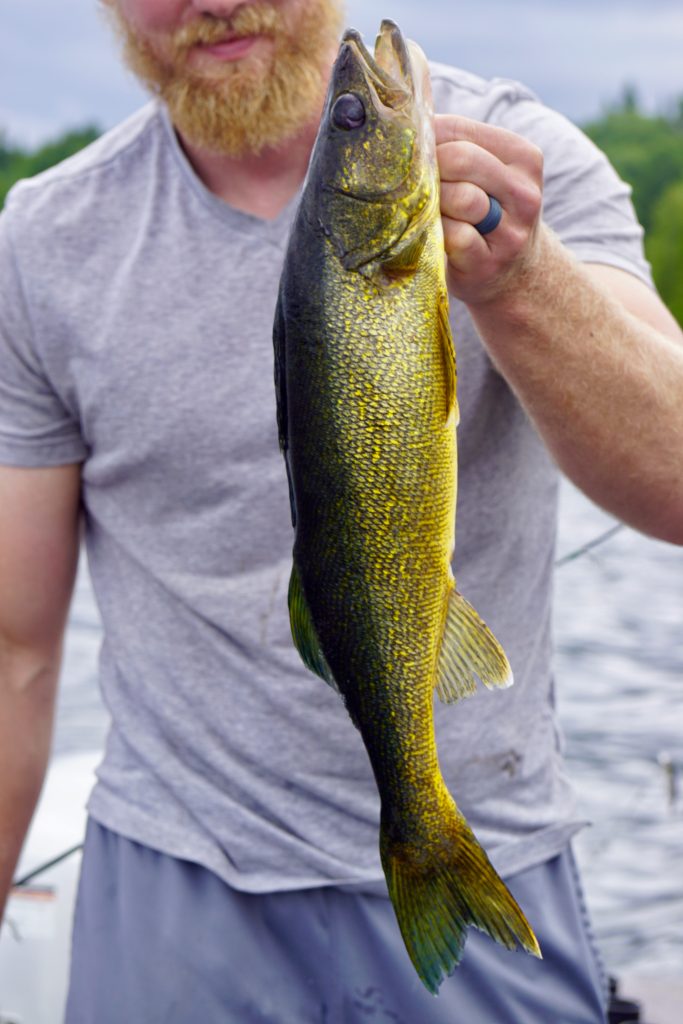
Walleye are Lake Erie’s signature sportfish, but the most productive walleye pattern is not always the most kayak-friendly one.
Spring and fall can bring fish into shallower rocky areas where casting and controlled drifts are more compatible with a kayak. In summer, much of the fishery shifts toward offshore trolling. A kayak angler should evaluate the route first and the fishing report second.
Approaches worth considering when the water is realistically reachable include:
- Jigging rocky breaks or reef structure.
- Casting stickbaits or other baitfish imitations in low-light nearshore areas.
- Short, controlled trolling passes where the route remains close enough to protected water.
- Drifting only when the wind direction and return route make the drift reversible.
Avoid building a small kayak into a miniature version of an offshore trolling boat. Simpler presentations and reachable structure are usually the better fit.
Smallmouth Bass
Smallmouth may offer the cleanest intersection of Lake Erie fishing quality and kayak-friendly structure. New York DEC specifically states that inshore smallmouth are available to anglers using kayaks and other small vessels.
Rocky reefs, rubble, drop-offs, harbors, and other hard-bottom structure are recurring smallmouth targets. Spring fish can be relatively nearshore, while summer fish commonly move deeper.
Useful presentations include tubes, drop-shot rigs, Ned rigs, small swimbaits, jerkbaits, and crankbaits. The exact weight and line setup should match depth, current, water clarity, wind, and the cover being fished rather than a single Lake Erie formula.
Yellow Perch
Yellow perch remain an important Lake Erie species, but abundance and harvest regulations vary by jurisdiction and management zone. That makes current agency information especially important before building a perch-specific trip.
From a kayak, the fishing challenge is often staying with a school without letting anchoring or drift control create a safety problem. Sonar can help relocate fish, but no school is worth anchoring in a navigation lane, exposed wave train, or position that loads the kayak broadside.
Steelhead
Steelhead are central to the Pennsylvania and New York Lake Erie fishery, especially in tributaries. Pennsylvania Fish & Boat Commission describes Lake Erie and its tributaries as a major steelhead fishery and maintains special Lake Erie fishing and boating regulations.
For kayak anglers, steelhead are best treated as a conditions-dependent opportunity rather than a reason to force an open-lake trip. When the lake is rough or cold-water exposure is the dominant concern, fishing tributaries from shore can be the more practical choice.
Simple Tackle and Electronics
Lake Erie’s species diversity makes it easy to overpack. A better kayak system is built around the species and water you actually plan to fish that day.
Walleye
- Jigheads and baitfish-style plastics for rocky structure and controlled drifting.
- Stickbaits or crankbaits for casting or short trolling passes.
- Appropriate live-bait or harness systems where legal and useful for the specific pattern.
Smallmouth
- Tubes and Ned rigs for bottom-oriented presentations.
- Drop-shot rigs for holding a bait above rock and rubble.
- Jerkbaits, crankbaits, or small swimbaits for covering structure.
Yellow Perch
A light spinning setup and simple vertical presentation are easier to manage than a deck crowded with specialized gear. If live bait is part of the plan, check the current bait and transport rules for the state or province you are fishing.
Fish Finder and GPS
Electronics can add meaningful value on Lake Erie because structure, depth transitions, and fish schools may not be visible from the surface. A compact sonar/GPS unit can help you:
- Relocate reefs, humps, rock, and break lines.
- Monitor depth as the kayak drifts.
- Mark a productive pass without relying on visual landmarks alone.
- Navigate back toward the launch in poor visibility—while still using appropriate navigation and safety practices.
Electronics should make the trip easier to manage, not encourage a longer offshore route simply because fish appear on the screen.
Boat Control Matters More Than Lure Count
Wind, wave direction, and kayak drift change how every presentation fishes. If the kayak moves too quickly, a jig may lift away from the bottom. If the boat slides sideways along a breakwall, a lure may spend only a small part of the retrieve in the target zone. If a downwind troll carries you too far, the return becomes the hardest part of the day.
A useful Great Lakes rhythm is:
- Set up the kayak so the first pass has a deliberate angle.
- Fish the pass without letting the boat travel farther than intended.
- Reset while the return is still easy.
- Recheck wind, waves, traffic, and distance from the launch.
- Decide whether another pass still makes sense.
A pedal drive can make hands-free corrections easier, but propulsion type does not override weather or route selection. A paddle kayak can be appropriate in protected water, and a pedal kayak can still be a poor choice on an exposed day.
Lake Erie Kayak Safety
Lake Erie is Great Lakes water, and the safety plan should reflect that scale. The National Weather Service advises boaters to obtain the latest marine forecast and warning information before heading out and notes that marine conditions can change suddenly.
Start with a properly fitted PFD and wear it while on the water. Requirements vary by jurisdiction and season, so verify the applicable rules for the exact water you plan to fish.
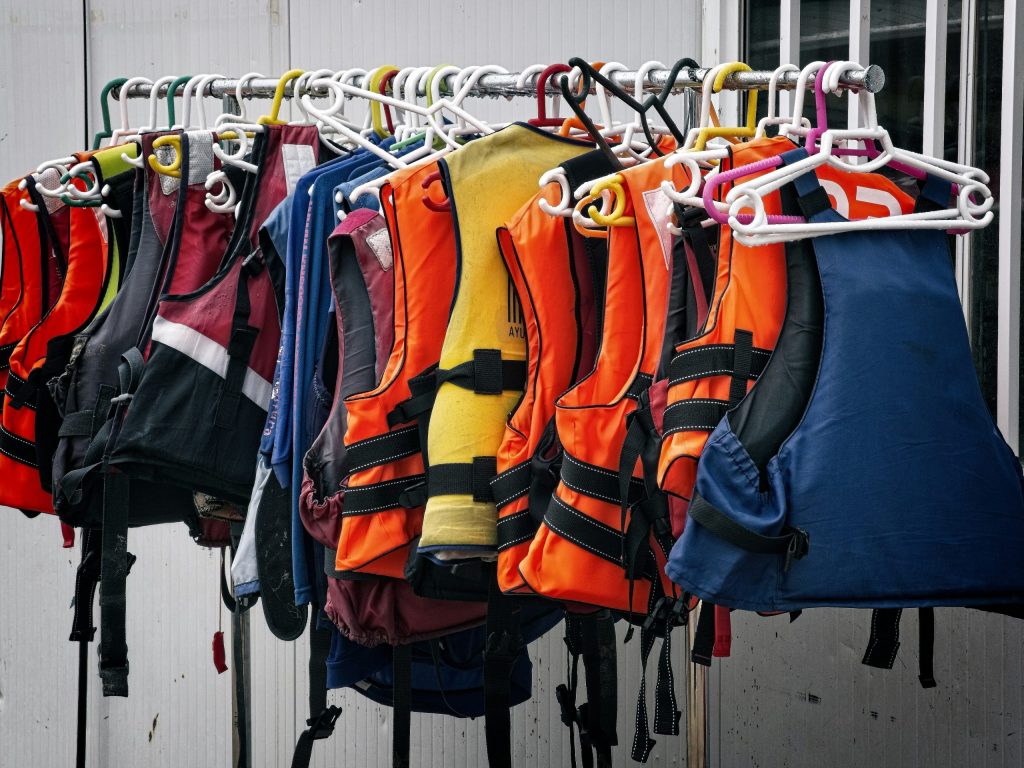
For fishing-specific PFD considerations, see our guide to the best PFDs for kayak fishing.
Use the Marine Forecast
NWS marine forecasts include wind speed and direction, wave information, significant weather, and marine warnings. Forecast ranges cover large areas and actual conditions can be higher or lower than the stated range, so the forecast should be treated as decision information rather than a guarantee.
Check:
- Wind speed, direction, and gusts.
- Wave height and how the wind direction affects the shoreline or route.
- Thunderstorm potential and rapidly changing weather.
- Small Craft Advisories and other marine warnings.
- The forecast for the return window, not only launch time.
For more on interpreting wind from a kayak-fishing perspective, see our kayak fishing in the wind guide.
Dress for Immersion, Not the Parking Lot
Spring and fall air temperatures can feel comfortable while Lake Erie remains dangerously cold. Clothing should be selected around the water temperature, expected recovery time, distance from shore, and your ability to re-enter the kayak.
Carry protected dry layers and practice re-entry under controlled conditions before depending on that skill in rough water. Our kayak fishing safety guide covers cold water, traffic, visibility, and trip planning in more detail.
Communication and Float Plan
Carry waterproof communication appropriate for the trip and tell someone where you are launching, the area you plan to fish, and when you expect to return. NWS specifically recommends marine radio capability for boaters using marine waters; a handheld marine VHF can provide weather information and another communication option on serious Great Lakes trips.
Boat Traffic and Navigation Areas
Harbors, ferry routes, marina entrances, marked channels, and commercial navigation areas deserve extra space. A fishing kayak has a low profile and should never rely on another vessel noticing it in time.
Use the legally required lighting for the jurisdiction and conditions you are operating in, and consider additional high-visibility measures that do not interfere with navigation rules. Avoid stopping or anchoring where other vessels need the channel.
Anchoring
Anchoring can help hold over perch or other structure, but waves, boat wakes, and current make a poor anchor position more consequential. Avoid anchoring broadside to the dominant wave direction, in navigation routes, or where a snagged anchor prevents a quick move.
If you are comparing anchor systems and quick-release considerations, see our guide to the best kayak anchors.
A Better First Lake Erie Kayak Plan
A first Lake Erie kayak trip should be deliberately small. The goal is to learn how your boat, clothing, electronics, and fishing system behave on Great Lakes water without making offshore distance part of the challenge.
- Choose a protected launch with useful structure nearby.
- Pick one target species instead of carrying gear for every Lake Erie fishery.
- Build a short route that can be reduced further if the wind changes.
- Check the marine forecast immediately before departure and continue watching conditions while fishing.
- Set a turnaround point based on conditions and distance—not whether the bite has started.
A protected breakwall smallmouth trip, sheltered-bay perch trip, or nearshore walleye attempt during a stable window can teach more useful Great Lakes skills than making the first outing an offshore run.
If you are still learning basic launch, re-entry, drift-control, and gear-management skills, build those fundamentals on smaller water first. See our kayak fishing for beginners guide.
Common Lake Erie Kayak Mistakes
1. Assuming the Launch Represents the Main Lake
Breakwalls, points, and harbors can shelter the put-in while exposed water outside is substantially rougher. Evaluate the route and marine forecast, not only the first hundred yards of water.
2. Letting an Easy Downwind Leg Create a Hard Return
Traveling or trolling with the wind can make distance accumulate quickly. Keep enough margin to return against the forecast conditions without turning the paddle or pedal home into an endurance problem.
3. Copying Offshore Boat Patterns
A charter or deep-V boat fishing several miles offshore is solving a different mobility and safety problem than a kayak. Use the same fisheries information to find a kayak-compatible version of the pattern rather than copying the route.
4. Carrying Too Much Gear
A cluttered deck makes landing fish, reaching safety equipment, handling a paddle, and recovering from unexpected waves harder. Carry the tackle needed for the day’s species and keep essential safety items immediately accessible.
5. Assuming Lake Erie Has One Set of Regulations
Lake Erie borders multiple U.S. states and Ontario. Fishing seasons, harvest limits, special permits, boating requirements, and access rules vary by jurisdiction. Verify the rules for the exact water you intend to fish.
What Kind of Fishing Kayak Makes Sense?
There is no single Lake Erie kayak size or propulsion system that guarantees safety. More useful characteristics are predictable handling, adequate capacity for the angler and gear, efficient tracking, a secure seating position, dependable flotation, and a layout that keeps critical equipment accessible.
A pedal drive can make boat-position corrections easier while fishing and trolling, but it also adds weight, cost, and mechanical complexity. A paddle kayak can work well on protected routes when the hull and angler are suited to the conditions.
The key question is not whether a kayak is marketed as “offshore capable.” It is whether you can control that specific boat in the wind, waves, wakes, distance, and water temperature you are choosing to fish—and recover from a capsize if something goes wrong.
Plan your Lake Erie kayak fishing setup:
Regulations and Access Checks
Do not publish a Lake Erie trip plan around remembered regulations. Fishing limits, seasons, permits, boating rules, launch status, and weather information can change.
- Ohio: Check Ohio Department of Natural Resources for current Lake Erie fishing information, regulations, limits, and access resources.
- Pennsylvania: Pennsylvania Fish & Boat Commission maintains Lake Erie-specific fishing information and notes that special fishing and boating regulations apply to Lake Erie and Presque Isle Bay.
- New York: Check New York DEC for current Lake Erie and Great Lakes special regulations, fishing reports, and access information.
- Michigan or Ontario: Use the applicable state or provincial agency for the exact water you are fishing.
- Weather: Check the National Weather Service Lake Erie nearshore/open-lake forecast and current advisories immediately before the trip.
Official agencies remain the source of truth for current regulations, access restrictions, and marine warnings.
Sources and Method
This guide does not claim firsthand kayak-fishing, launch, or boating experience on Lake Erie. Fishery and regulatory context was checked against official state fisheries agencies, while marine-weather guidance comes from the National Weather Service. Kayak-Fishing.com analysis is used to explain how those documented fisheries interact with small-craft range, boat control, cold-water exposure, and route planning.
- Ohio Department of Natural Resources — 2026–27 Ohio Fishing Regulations
- Pennsylvania Fish & Boat Commission — Lake Erie
- New York State DEC — Smallmouth Bass Fishing on Lake Erie
- New York State DEC — Walleye Fishing on Lake Erie
- National Weather Service — Lake Erie Marine Forecasts
Final Thoughts
Kayak fishing Lake Erie works best when good fishing and manageable small-craft water overlap. That intersection changes by basin, season, wind direction, target species, and launch.
The Western Basin offers extensive reef and island structure. The Central Basin rewards selective use of harbors, breakwalls, and reachable contours rather than automatically copying offshore walleye patterns. The Eastern Basin provides exceptional smallmouth opportunities, seasonal nearshore walleye possibilities, and access to the broader Pennsylvania and New York steelhead fishery.
Keep the route conservative, use the marine forecast, dress for immersion, wear the PFD, and choose fishable structure that does not require you to prove how far a kayak can travel.
Lake Erie is large enough that there will always be fish somewhere beyond the safest kayak plan. The better trip is the one that keeps good fishing within a route you can confidently control from launch to return.